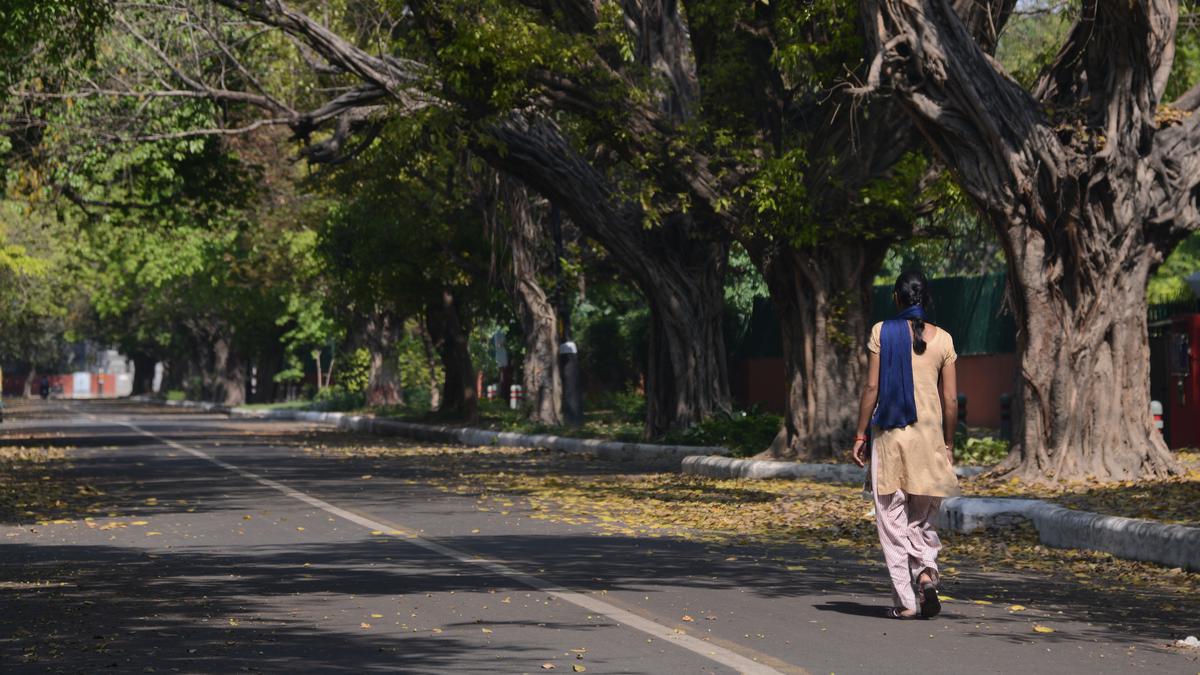
What’s coming in the way of Delhi women from stepping out of home
The Hindu
The concept of mobility translates differently for women under different circumstances. But that’s not the case with men
With a bottle of milk in one hand and a rattle in the other, Tavleen Tandon, a mother of two, barely has any time to talk. The 27-year-old woman doesn’t remember the last time she stepped out of her house for leisure or work.
A former teacher, Ms. Tandon had to quit her job after the birth of her first child three years ago. “In the past few years, I can count the number of times I stepped out of my house. While it’s difficult to take out time for any leisurely activity because of household chores, it’s also not easy for a lactating mother to travel with her baby in public spaces in a city with no feeding rooms,” says the Dwarka resident.
Ms. Tandon is one of thousands of women in Delhi who do not step out of their houses even once a day, as per research published in the Springer Journal. Rahul Goel, Assistant Professor at Transportation Research and Injury Prevention Centre at Indian Institute of Technology Delhi, who contributed to the paper, says Delhi was the only one out of 19 cities worldwide where the rate of immobility among women was much higher than the men. The other cities were Accra, Kisumu, Cape Town, Melbourne, London, Berlin, Cologne, Hamburg, Munich, Zurich, Buenos Aires, São Paulo, Santiago, Bogota, Mexico City, Chicago, Los Angeles and New York City.
The research found that 58% of the 6,844 women surveyed from lower- and middle-income families did not step out of their houses even once a day. Mr. Goel attributes it to the lack of personal safety, absence of women-friendly infrastructure and gender roles that keep women tied to homes even though this is a very small sample for a city which had around 78 lakh women out of a total population of 1.68 crore, as per Census 2011.
Experts say there has been a considerable increase in the number of girls getting enrolled in schools and colleges, and many more joining the formal and informal workforce. But the concept of mobility translates differently for women under different circumstances. But that’s not the case with men. Like, in the case of Ms. Tandon. While she had to quit her job, there was no change in her husband’s lifestyle or mobility after the birth of their children.
“I do see that my wife doesn’t get much time for herself. I help her with some household chores on weekends but taking care of the needs of children is something she understands way better than me. So, even during weekends her hands are full,” says Ms. Tandon’s husband Ritesh, 32, a software engineer.
Sunita Jhangu, 19, who is in her final year of college, had been stepping out of home to attend her classes all these years. However, after college, she wants to take up a job only if the place allows her to work from home as she doesn’t wish to add to her parents’ anxieties.


BJP's seal on a 2019 Election Commission letter ignites controversy in Kerala, prompting claims of careless handling by CPI(M).

Transgenders go on rally condemning Transgenders Amendment Bill 2026

Supreme Court dismisses plea challenging Sonam Wangchuk's detention, noting the Centre revoked it on March 14, 2026.

Private medical shops in Telangana government hospitals face eviction due to expired leases and ongoing legal challenges, says Health Minister.

A.P. BIE Secretary reviews answer script evaluation, emphasizing transparency and accuracy to ensure error-free marking and timely results.

Join the walkathon in Puducherry to promote oral hygiene awareness and celebrate World Oral Health Day with community participants.

The ‘Swastha Mysuru’ initiative aims to promote healthy living and preventive healthcare in Mysuru through community engagement and awareness.

Farmers in Ongole protest against BJP's policies, citing dangers to their livelihoods and demanding support for local agriculture.

From March 24, paneer queserotta, prawn tostadas, beef birria and more feature on MadCo's special Mexican pop up menu by Chef Mathangi Kumar alongside experimental cocktails, including a marigold highball

Revenue Minister Krishna Byre Gowda defends subsidies as crucial for economic growth, emphasising their role in boosting consumer demand during recessions.

Three doctors were arrested by the Mico Layout traffic police on Monday (March 23) after a video allegedly showing them triple-riding without helmets with one of the pillion riders seen drinking from a bottle went viral on social media.

Assembly protest ends in arrests as BJP targets Government over guarantees

Andhra Pradesh accelerates city gas distribution with streamlined approvals, enhancing access to cleaner energy and supporting sustainable urban development.