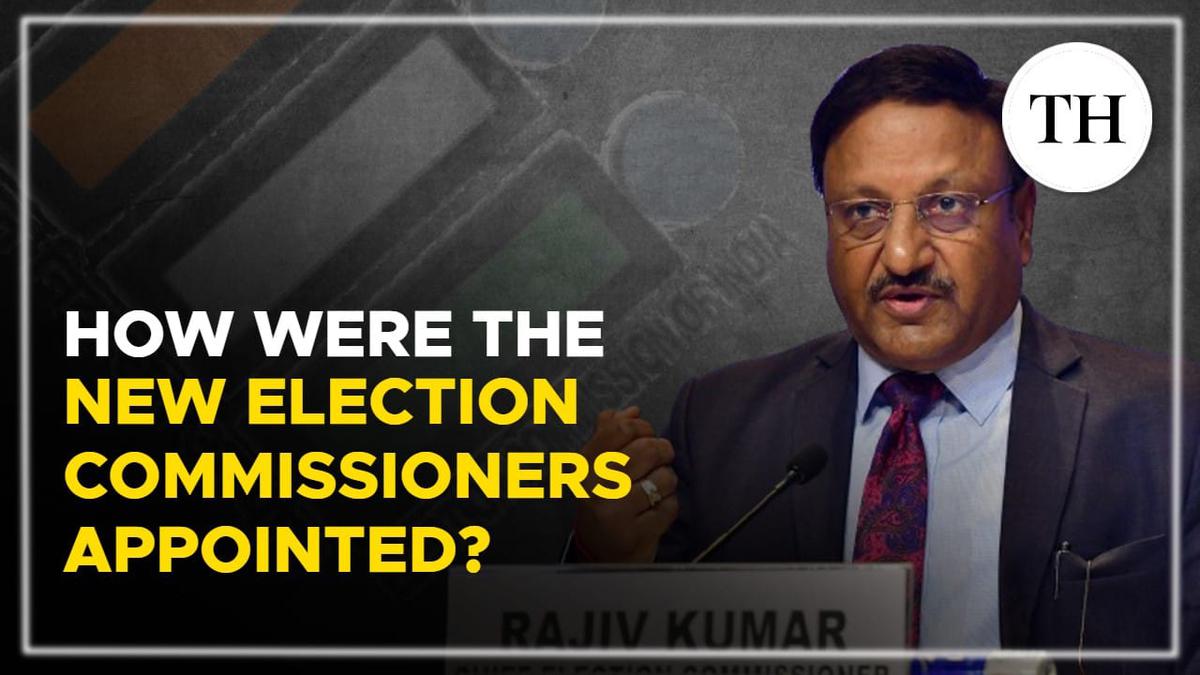
Watch | How were the new Election Commissioners selected, and why is the new law being criticized?
The Hindu
A video explaining the old and new process of appointment of election commissioners and why the new law is being criticized and the Supreme Court angle
On March 14, two retired bureaucrats, Gyanesh Kumar and Sukhbir Singh Sandhu, were appointed as Election Commissioners, just two days ahead of the announcement of the dates of the 2024 Lok Sabha elections.
They are now part of the three member Election Commission of India panel, headed by Rajiv Kumar, the Chief Election Commissioner.
The two officials are the first to be appointed under the new law governing appointments to the constitutional body, the Chief Election Commissioner and other Election Commissioners (Appointment, Conditions of Service and Term of Office) Act, 2023.
What is the new law?
Under the new law, the two commissioners were selected by a three-member Selection Committee, comprising Prime Minister Narendra Modi, Union Home Minister Amit Shah, and the Leader of the Indian National Congress in the Lok Sabha, Adhir Ranjan Chowdhury, as leader of the largest party in the Opposition.
They were chosen out of a shortlisted panel of six names. The shortlisting was done by a search committee which, according to the Act, is headed by the Union Minister for Law and Justice and includes two officials of the rank of Secretary to the government.
What was the process before this?


PM Modi and UAE President agree on ensuring safe navigation through the Strait of Hormuz amid regional tensions.

JNU student leaders face severe repercussions for activism, risking their academic futures amid allegations and online abuse.

India Post launches 24-hour and 48-hour Speed Post services in Bengaluru, ensuring urgent delivery across major metro cities.

A 24-hour control room in Krishnagiri monitors the Model Code of Conduct and manages election-related complaints ahead of polls.

Madurai Collector inaugurates voter awareness campaign

MLC Kishore Kumar Puttur criticizes the State for poor implementation of the Centre's health scheme for senior citizens.

Karnataka's Health Minister announces redeployment of specialists to taluk hospitals to reduce neonatal mortality rates effectively.

Celebrate IPL's start and Polly Umrigar's legacy, reflecting on cricket's evolution and the enduring impact of its pioneers.

BJP accuses Congress and Rahul Gandhi of endorsing an ‘anti-India’ USCIRF report undermining India's global image.

Education Ministry proposes UGC-like funding under Shiksha Adhishthan, raising concerns about centralization and public university financing.

Shivraj Singh Chouhan defends the new rural jobs Act, dismissing opposition protests as ineffective and highlighting increased funding and worker protections.

Supreme Court questions why heirs can't access unclaimed funds of deceased depositors, urging government to develop a disclosure policy.

Karnataka High Court demands LPG supply details amid state restrictions, threatening Bengaluru's restaurants and livelihoods.