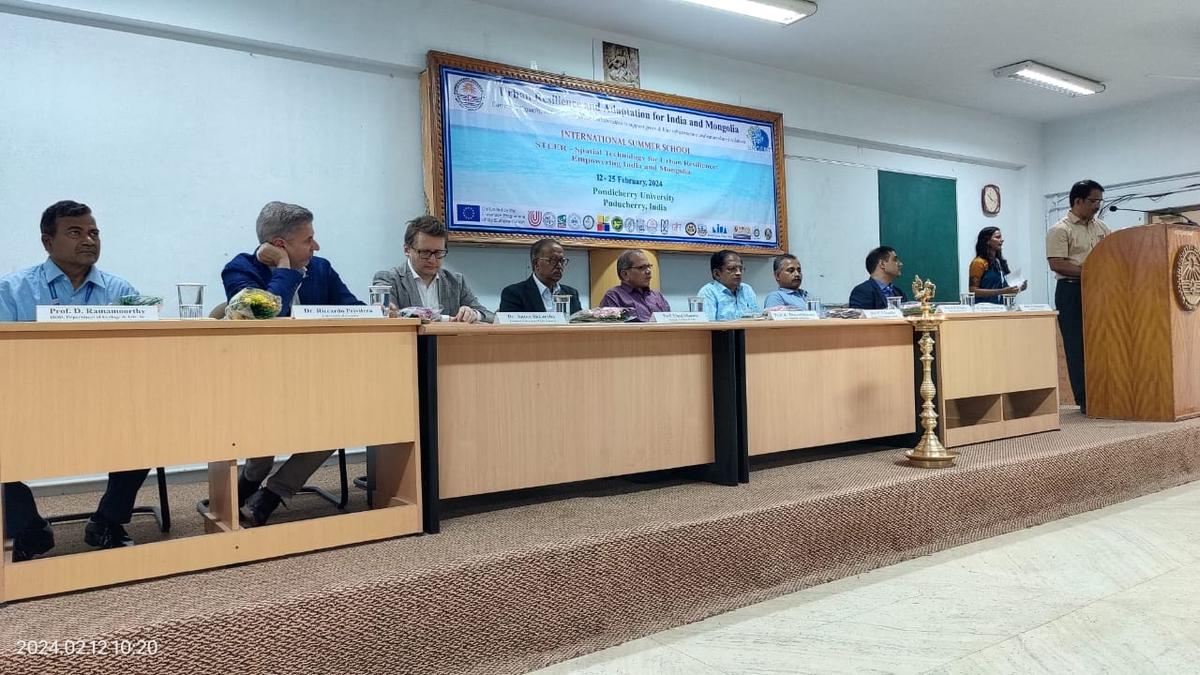
Urban planning experts discuss spatial technologies
The Hindu
Pondicherry University hosts international summer school on urban resilience and spatial technologies for future urban leaders.
Urban planning experts from international institutions, and across the country, discussed the promotion of education and research in the fields of urban resilience and spatial technologies during an event hosted at Pondicherry University.
The ‘Spatial Technologies for Urban Resilience: Empowering India and Mongolia’ (STEER–2024), a 14-day international summer school, is designed to provide participants with a comprehensive understanding of urban resilience and spatial technologies through a series of lectures, workshops, and hands-on exercises, a press note from the University said.
As cities around the world grapple with issues such as rapid urbanisation, climate change, and social inequality, initiatives such as the STEER–2024 play a crucial role in equipping future leaders with the right skills and expertise to build more sustainable and resilient urban environments.
Participants were given the opportunity to engage with leading experts in the field, explore cutting-edge research, and gain practical skills that are essential to address the complex challenges that modern cities face. The goal is to empower the next generation of urban innovators and leaders with the knowledge, skills, and tools needed to address the complex challenges faced by modern cities.
K. Tharanikkarasu, officiating Vice-Chancellor, Pondicherry University, officially launched the summer school, that assembled a diverse cohort of teachers, scholars, students and experts from across the world.
The ceremony also featured the unveiling of the summer school’s ambitious agenda, which includes topics such as satellite data acquisition and pre-processing, GIS data handling and management, urban mapping and monitoring, and spatial analysis for urban resilience, among others. Participants also got to engage in capacity-building workshops, field trips and networking events, that enhanced their learning experience.


Supreme Court affirms the public's right to critique its judgments while addressing concerns over an NCERT textbook's content.

Amit Shah reviews Manipur's security, urging the CM to tackle drug cartels and aid displaced communities after ethnic violence.

Kerala's fisherfolk urge political parties to address livelihood concerns, demanding fair pricing, rule enforcement, and better support during elections.

Moderate rainfall in Visakhapatnam brings relief but causes traffic disruptions and power outages across the city.

Shubman Gill’s Gujarat Titans banks on its tried-and-tested formula

Agriculture Ministry reviews unseasonal rains' impact, assesses farm losses, and discusses relief measures for affected farmers.

Premium petrol prices rise by ₹2 per litre, but government claims no impact on the common man amidst global oil tensions.

Kum. Veerabhadrappa’s acclaimed novel Aramane has been adapted into a television serial. Kannada channel DD Chandana (Doordarshan) has launched the serial with the same name. National Award-winning filmmaker Mansore is the director behind the project,

Diya Chitale and Manav Thakkar reach semifinals, while Yashaswini Ghorpade upsets top seed Sreeja Akula at National TT Championships.

DYFI criticizes A.P.'s job calendar for failing unemployed youth, demanding a revision to include 1 lakh posts and higher age limits.

‘Lethargic’ officials who left Chambal sanctuary to the mercy of sand miners will be held liable: SC
Supreme Court holds negligent officials accountable for enabling illegal sand mining in Chambal Sanctuary, emphasizing habitat protection laws.

Work on the Srisailam Left Bank Canal tunnel resumes after 13 months, with completion targeted by 2027-end, says Minister Reddy.

Ancient ‘Vanni’ tree at Sri Meenakshi Sundareswarar Temple tilts; steps on to restore it