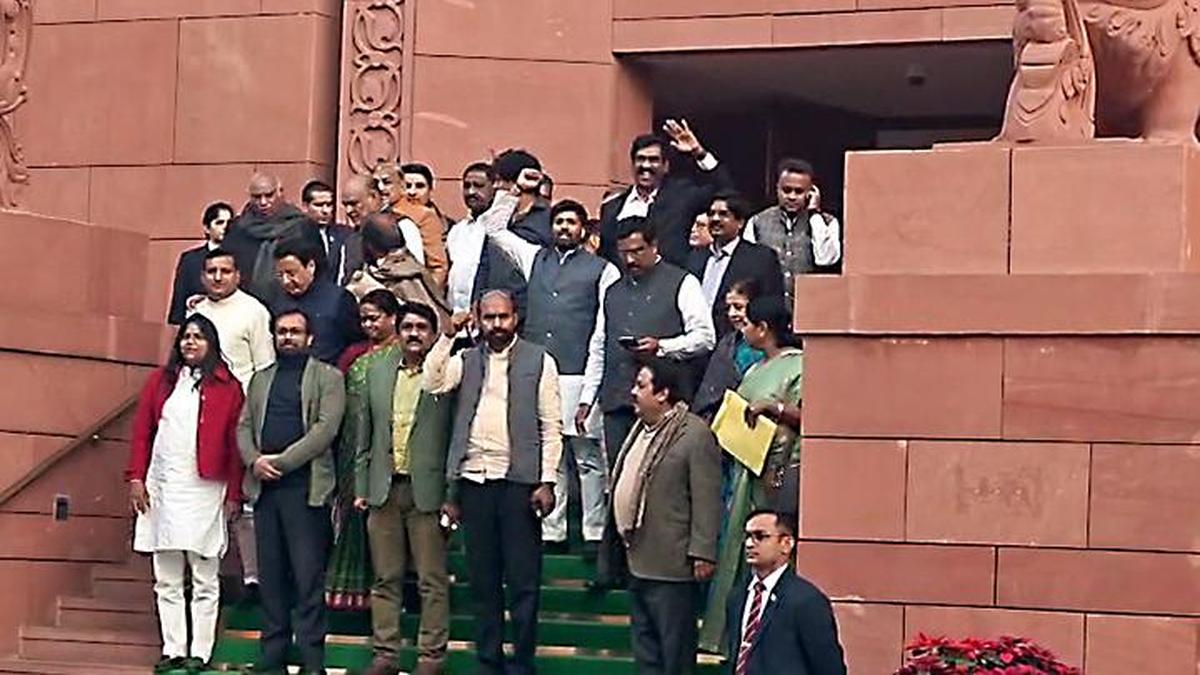
Treasury and Opposition benches trade barbs in Rajya Sabha
The Hindu
Tensions rise in Rajya Sabha as Opposition protests, accusing government of silencing Rahul Gandhi during crucial debates.
The Congress and other Opposition parties staged a walkout from the Rajya Sabha on Thursday (February 5, 2026), accusing the government of preventing Leader of the Opposition in the Lok Sabha Rahul Gandhi from speaking during the debate on the Motion of Thanks to the President’s Address. The protest followed a heated exchange between the Treasury and Opposition benches.
In the Upper House, Leader of the Opposition and Congress president Mallikarjun Kharge attempted to read out excerpts from an unpublished book by former Army chief M.M. Naravane, the very point of contention in the Lok Sabha. Chairman and Vice-President C.P. Radhakrishnan disallowed him from doing so, prompting Opposition members to walk out in protest.
Leader of the House J.P. Nadda criticised the Congress, remarking that the party should not allow itself to be held hostage by an “abodh balak (ignorant child)”, in a reference to Mr. Gandhi.
Tensions escalated soon after Zero Hour began. Raising the issue first, Mr. Kharge said Mr. Gandhi had not been permitted to speak in the Lok Sabha despite wanting to address matters of national interest. Before he could continue, Mr. Radhakrishnan ruled that the proceedings of the Lok Sabha could not be discussed in the Rajya Sabha, and handed the floor to Mr. Nadda.
Mr. Nadda countered, saying that the Opposition should advise its Lok Sabha members to participate in the debate rather than disrupt the House. Opposition MPs responded with slogans, alleging that democracy was being “throttled”. Parliamentary Affairs Minister Kiren Rijiju questioned the timing of the protest, noting that the Rajya Sabha debate had proceeded uninterrupted for three days.
Reiterating his ruling, the Rajya Sabha Chairman cited a precedent based on an intervention by former Prime Minister Jawaharlal Nehru, advising against references to Lok Sabha proceedings in the Upper House.


Discover why pension planning is essential in modern India to ensure financial security and peace during retirement.

The U.S. has launched two investigations under Section 301 of the Trade Act of 1974 against India and other economies to examine practices that may be ‘unreasonable or discriminatory and burden or restrict U.S. commerce’. One probe examines whether countries, including India, are using excess manufacturing capacity to export to the U.S. in a manner that hurts American businesses, while another looks at whether countries have taken ‘sufficient steps’ to prohibit imports of goods produced with forced labour.

NHAI raises annual pass fee to ₹3,075 from April 1, 2026, streamlining toll payments for FASTag users.

The U.S. probes forced labour in global supply chains, scrutinizing China and India's exports, warns the Global Trade Research Initiative.

The Hindu collection of images of the LPG crisis: War lights a kitchen fire

The company, which launched its IPO in 2020, is now listed on the National Stock Exchange as well as the Bombay Stock Exchange.

Explore the Essential Commodities Act's role in addressing India's gas crisis and its impact on various sectors.

Star Health Insurance plans to boost AI-driven claim settlements from 20% to 50% within two years, investing heavily in technology.

The iron ore production has increased by nearly two-thirds since 2015

Benchmark indices fell 2% as high crude oil prices and FII selling pressures impacted market sentiment on March 14, 2026.

Follow The Hindu LIVE for updates on LPG crisis and crude oil prices due to the escalating Iran-Israel war in West Asia.

ICRA projects integrated sugar mills will see 5-8% revenue growth in FY26 due to improved cane supply and stable prices.

Benchmark indices fell 2% as high crude oil prices and FII selling pressures impacted market sentiment on March 14, 2026.