Too many women STEM students drop out before entering careers: Kiran Mazumdar-Shaw
The Hindu
Kiran Mazumdar-Shaw highlights the need to empower women in STEM to reduce dropout rates and enhance career opportunities.
While women enter STEM (science,technology, engineering and mathematics) education in large numbers in the country, too many drop out at the stage of entering professional roles, lamented Kiran Mazumdar-Shaw, chairperson, Biocon.
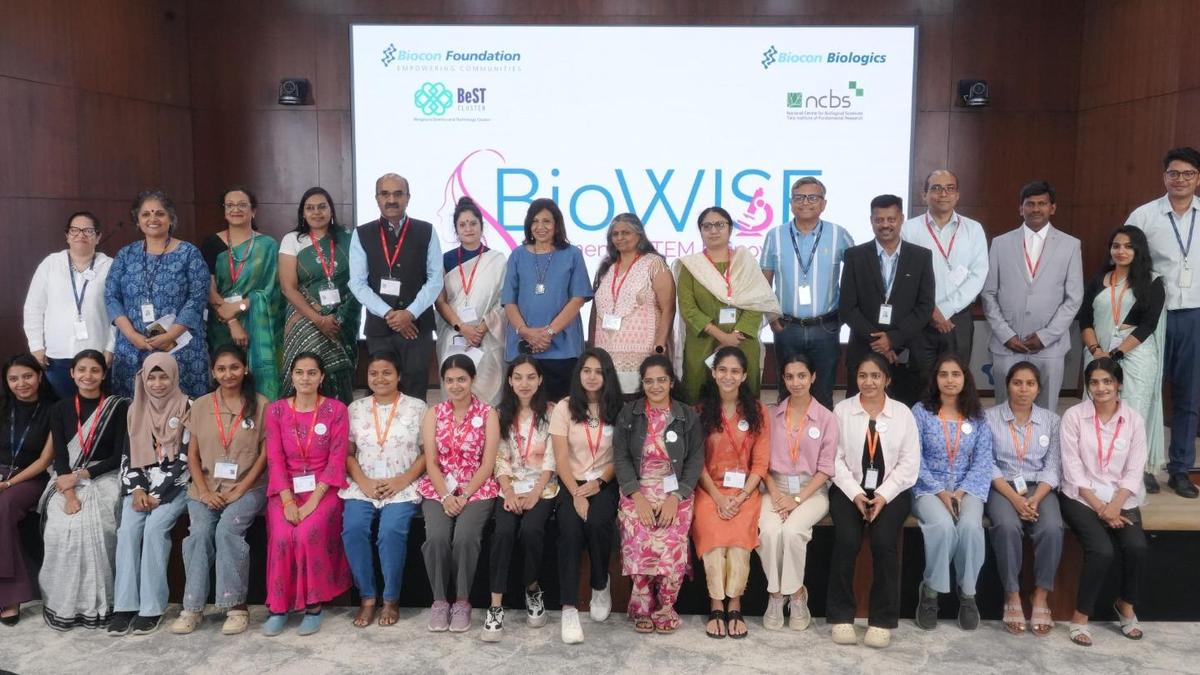
“India does not have a pipeline problem in science, it has a transition problem,” she said, while speaking at the onboarding of the first cohort of BioWISE, an initiative to empower women for employment in STEM (mostly in life sciences) areas, held at Biocon Park in the city on Friday.
The Biocon Foundation, the Corporate Social Responsibility arm of Biocon, in collaboration with the Bengaluru Science and Technology Cluster (BeST Cluster) and the National Centre for Biological Sciences (NCBS), formally onboarded the first batch of BioWISE.
These 15 postgraduate women students were selected through a multi-stage process from over 350 applicants across tier 2 and tier 3 colleges in Karnataka for a six-month internship programme, including scholarship and mentorship. As part of the training programme, 25 women students, 15 postgraduates and 10 undergraduates from tier 2 and tier 3 universities across Karnataka would be supported with academic training spanning biotechnology, life sciences, microbiology, bioinformatics and allied disciplines, enabling them to build sustainable STEM careers.
The BioWISE was a strategic intervention where talent met opportunity, Ms. Mazumdar-Shaw said, adding, “This programme is about building confidence and ecosystems of support so women not only stay in science, but lead, innovate, and shape the future of India’s scientific enterprise.”
Fifteen women STEM training participants have been placed with the National Centre for Biological Sciences (1), Institute of Bioinformatics and Applied Biotechnology (2), Indian Institute of Science (5) and Biocon (7), where they would be working alongside scientists and industry professionals on live research and development programmes.


Kiran Mazumdar-Shaw highlights the need to empower women in STEM to reduce dropout rates and enhance career opportunities.

BJP, Congress announce candidates for constituencies in Kanniyakumari district

Chicken prices have dropped sharply, bringing customers back to shops although retailers say margins remain tight.

Tirupati's Rotary Human Milk Bank celebrates two years of service, promoting milk donation to support malnourished infants.

Tensions rise in Hubballi as a Muslim youth is beaten over 'love jihad' allegations, sparking protests and police involvement.

Priyank Kharge calls on X to investigate alleged mass-reporting and stagnant follower counts affecting opposition leaders' accounts.

BJP fields Radhakrishnan in Tiruchendur; Amirtharaj renominated in Srivaikuntam

District Collector Abhishikt Kishore reviews GVMC initiatives, emphasising cleanliness, summer water kiosks, and timely road work before Bhogapuram Airport opening.

Rajasthan High Court expunges remarks on Trans Amendment Act, clarifying unintended criticisms and affirming transgender rights in new ruling.

Karnataka High Court orders government to appoint three candidates selected as works inspector despite the abolition of the posts.

Former Lokayukta N. Santosh Hegde collapsed during an event in Bengaluru but is now recovering after hospital treatment.

Andhra Pradesh targets 23 lakh MT paddy procurement from April 4, ensuring farmers receive payments within 24 hours.

VMRDA promotes the VISTA App for easier park access, while YSRCP protests a new ₹10 per person visitor fee.