The tale of Bharatha Matha temple, a pet project of C.R. Das and Subramania Siva Premium
The Hindu
Congress veteran Kumari Ananthan passionately pursued the Bharatha Matha temple project in Dharmapuri, fulfilling the dreams of past leaders.
Congress veteran Kumari Ananthan (1933-2025), who passed away recently, had vigorously pursued a project in the later years of his life: the Bharatha Matha temple in a remote corner of the backward Dharmapuri district.
Actually, he had only followed up on what was initiated by two Congress stalwarts: former president of the All India Congress Committee C.R. Das (1870-1925), famously called Deshbandhu, and Subramania Siva (1884-1925). Coincidentally, this year marks the 100th death anniversary of the two leaders: Das died on June 16 and Siva on July 23. Siva, also known as Sivam, was one of Tamil Nadu’s triumvirate of the freedom struggle; the others were V. O. Chidambaram (VOC) (1872-1936) and Subramania Bharati (1882-1921). Besides being a powerful orator, Siva was a writer-journalist. This great lover of Tamil had quoted from The Thirukkural to illustrate the “tyrannical rule” of the British, something that had landed him in prison.
Two years before his death, Das laid the foundation for the temple at Paparapatti in Pennagaram taluk, about 25 km from Dharmapuri. According to a report published in The Hindu on June 26, 1923, Das reached Paparapatti at 11 a.m. from Bangalore where he was a guest of Adinarayana Chettiar. “The scene there was a memorable one. The entire village and the approaches had been beautifully decorated and lavishly beflagged... People had gathered in tens of thousands, nearly half the number being women,” says the report.
The report goes on to say that Chinnamuthu Mudaliar, chairman of the taluk board of Dharmapuri, then part of Salem district, donated land for the temple. He also announced that a purse of ₹501, on behalf of “people of Paparapatty”, would be presented to Das. The former AICC president made a “short but eloquent” address, which was translated by Siva into Tamil. In his speech, Das, who later visited the house of Mudaliar, emphasised that “various activities of a nation” — social and political — were but “different manifestations” of the same impulse and had “but one goal”.
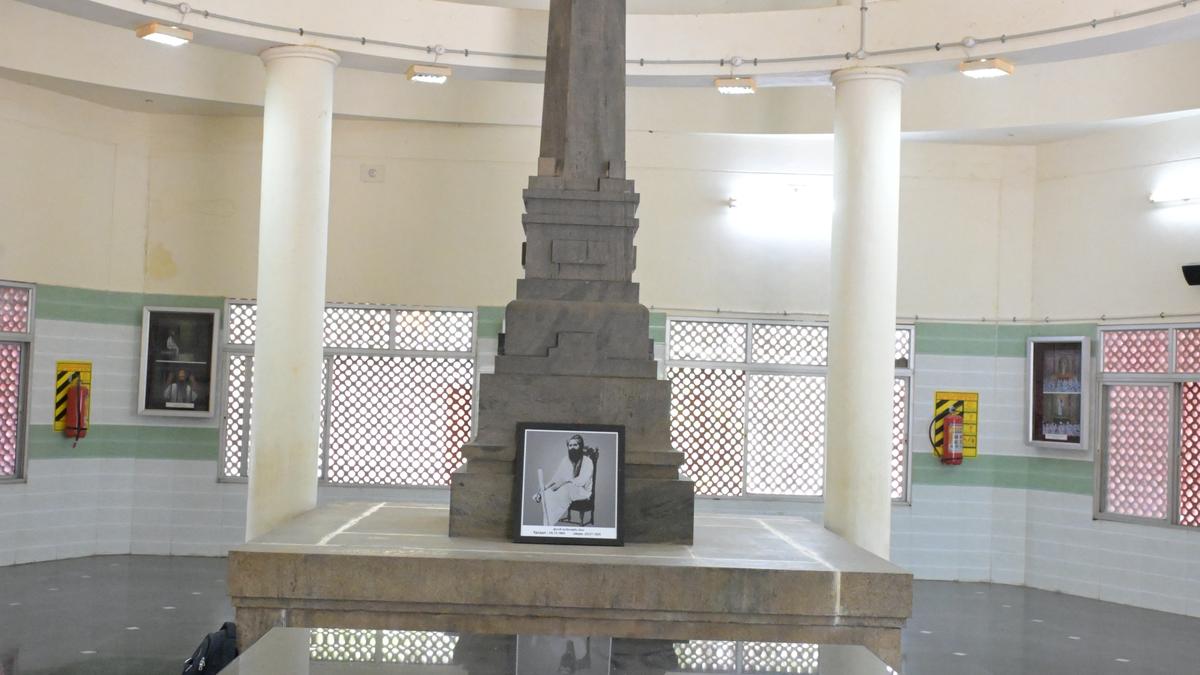
Though Siva was born at Batlagundu (Vathalagundu in Tamil), now part of Dindigul district, he had spent his last years in Paparapatti. By then, he suffered from leprosy, which he contracted while serving a prison term during the British Raj. Siva became the first patriot in the Madras Presidency (encompassing many parts of Tamil Nadu, Andhra Pradesh, Karnataka, and Odisha) to be found guilty and imprisoned on the charge of sedition in King Emperor vs Subramania Siva and V.O. Chidambaram Pillai.
The case was filed in connection with Siva’s four public speeches at Thoothukudi (then Tuticorin) on February 23, 25 and 26, and March 5, 1908, to mark the release of Bipin Chandra Pal (1858-1932), a torch-bearer of the renaissance in Bengal. In March 1907, Pal was charged by the Bengal government with contempt of court and awarded a six-month imprisonment. VOC was accused of organising those events, though he did not take part in any of them. Siva was awarded a sentence of 10 years of transportation and VOC was awarded transportation for life. The severity of the punishment not only attracted widespread condemnation from a host of leaders but also triggered a wave of unrest and violence in the undivided Tirunelveli district that included the present-day Thoothukudi and Tenkasi districts. Owing to a variety of factors, Tirunelveli Collector Robert William d’Escourt Ashe was assassinated by Vanchinathan at the Maniyachi railway junction three years later.
After the release, Siva’s movement was restricted because of his illness and the stipulation of the British authorities. Yet, he managed to reach Paparapatti where Mudaliar had supported him. Siva wanted the temple to come up in his lifetime. That was not to be. For over 75 years, the project went out of public discourse. It returned to prominence during the second half of the DMK government (2006-11) ahead of the Pennagaram Assembly constituency by-election in March 2010. Chief Minister M. Karunanidhi announced the sanction of ₹40 lakh for the 205-square metre memorial for Siva on 85 cents at Paparapatti. In August 2010, Information Minister Parithi Ilamvazhuthi laid the foundation, and in July 2011, Chief Minister Jayalalithaa declared the memorial open.


Anuradha Jonnalagadda took over as in-charge Vice-Chancellor of the University of Hyderabad, focusing on continuity during the transition.

Telangana government awaits committee report on TGSRTC staff absorption, with decisions to be made at an appropriate time.

Telangana's revised pay scale implementation for employees will take timer. The tenure of Pay Revision Commission extended. Govt likely to take decision on reccomendation based on its report.

Vizianagaram's SP A.R. Damodar highlights 20 accident-prone areas and urges drivers to prioritize safety with helmets and seat belts.

Kerala HC stays disqualification of SNDP Yogam leaders, reversing a single judge's order regarding financial and regulatory compliance issues.

Karnataka announces daily supply of 10,000 LPG cylinders to hotels, easing the commercial shortage for the hospitality industry.

Malayalam superstar Mohanlal will be reuniting with filmmaker Priyadarshan, it was announced recently. It will mark the 100th film of Priyadarshan and is backed by Mohanlal’s longtime collaborator, Antony Perumbavoor

Gautham Vasudev Menon loses Madras High Court appeal, ordered to pay ₹4.25 crore to R.S. Infotainment with interest.

AIADMK faces its toughest challenge in 53 years as it prepares for the crucial 2026 T.N. Assembly elections.

Lakmé Fashion Week x FDCI 2026 in Mumbai: What worked and what didn’t

Telangana CM announces underpass beneath Begumpet Airport runway to alleviate traffic congestion in Hyderabad.

Congress leader Ramesh Chennithala claims an alliance between Pinarayi Vijayan, Modi, and Shah aims to undermine UDF in Kerala elections.

CCB arrests Bengaluru couple for running a fake government job scam, cheating over 100 victims out of crores.