The solution to the falling rupee lies in diplomacy Premium
The Hindu
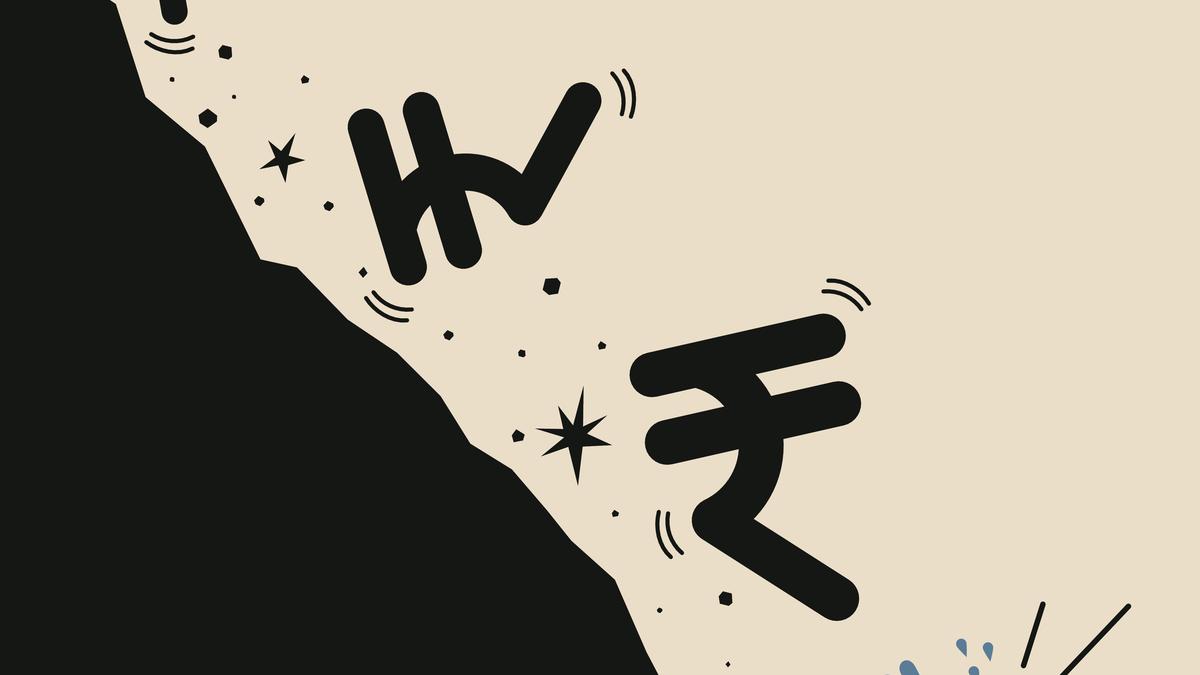
Capital outflows are hitting the rupee. These outflows will continue to take place until India and the U.S. come to an understanding
The sudden decline in the value of the rupee has somewhat shaken the people and the markets. They wonder why this is happening when the economy is doing well, characterised by a good growth rate, low inflation, and a modest current account deficit.
India’s growth rate in the current year is estimated at 7.4%. Inflation has been subdued with CPI inflation ending the year 2025 at 1.33%, below the Reserve Bank of India (RBI)’s lower target band for the fourth consecutive month. The current account deficit as a percentage of GDP in the first half of 2025-26 is only 0.76 compared to 1.35 in the previous year. The fall in the value of rupee since April 2025 is about 6%.
Since the trade deficit (merchandise and services), which was $96.58 billion in April-December 2025 compared to $88.43 billion in the same period last year, is not that large, the main villain in the piece is capital outflows. There has been a steady outflow of capital since U.S. President Donald Trump took an adverse view on India and imposed 50% import duty on Indian exports. Initially, the U.S. imposed a 25% tariff on ‘reciprocal’ basis and then another 25% because India was importing crude oil from Russia. Now, it is threatening to impose an additional 25% tariff on countries that are doing business with Iran. This includes India, although trade with Iran is only 0.15% of the country’s total trade.
Net capital inflows in April-December 2024 were $10,615 million. In the same period in 2025, they turned negative, with a net outflow of $3,900 million. Despite months of negotiations with the U.S., no agreement has been reached yet. There seem to have been issues that could not be resolved easily. If this stalemate continues, the rupee will continue to fall.
We have to note that in the changed context, capital outflows are caused not by strict economic factors but by fears generated by the ‘hostile’ attitude of the U.S. In 2022, the rupee depreciated by almost 10%. That had some economic explanation, such as the Federal Reserve’s sharp hikes in interest rates. But this time, there is no clear economic explanation. Thus, the situation has shifted from the economic arena to the diplomatic platform. When tariffs are getting weaponised for geopolitical reasons, diplomacy is the major route for a solution.
India’s exchange rate regime underwent a change in 1993 when it moved to a market-determined exchange rate regime. But the new system did not rule out the RBI’s intervention in the foreign exchange market. Since 1993, all RBI Governors have made it clear that the intention is not to use intervention to peg the value of the rupee, but to reduce its volatility.


Stock markets recover as Sensex and Nifty bounce back following a three-day slump, driven by value-buying in blue-chip stocks.

U.S. President Donald Trump’s administration is set to receive a roughly $10 billion fee from investors in the recently completed deal to take control of TikTok’s U.S. business, the Wall Street Journal reported

Meta is planning sweeping layoffs that could affect 20% or more of the company, three sources familiar with the matter told Reuters

Learn how to choose the best personal loan lender by evaluating eligibility, interest rates, and borrowing experience.

Discover why pension planning is essential in modern India to ensure financial security and peace during retirement.

The U.S. has launched two investigations under Section 301 of the Trade Act of 1974 against India and other economies to examine practices that may be ‘unreasonable or discriminatory and burden or restrict U.S. commerce’. One probe examines whether countries, including India, are using excess manufacturing capacity to export to the U.S. in a manner that hurts American businesses, while another looks at whether countries have taken ‘sufficient steps’ to prohibit imports of goods produced with forced labour.

NHAI raises annual pass fee to ₹3,075 from April 1, 2026, streamlining toll payments for FASTag users.

The U.S. probes forced labour in global supply chains, scrutinizing China and India's exports, warns the Global Trade Research Initiative.

The Hindu collection of images of the LPG crisis: War lights a kitchen fire

The company, which launched its IPO in 2020, is now listed on the National Stock Exchange as well as the Bombay Stock Exchange.

Explore the Essential Commodities Act's role in addressing India's gas crisis and its impact on various sectors.

Star Health Insurance plans to boost AI-driven claim settlements from 20% to 50% within two years, investing heavily in technology.

The iron ore production has increased by nearly two-thirds since 2015