The legality of U.S.-Israel strikes on Iran Premium
The Hindu
U.S., Israel launch strikes on Iran as a ‘pre-emptive’ response to an imminent threat, raising questions about the legality of the use of force under the UN Charter; missile strike on a girls’ primary school raises concerns over violations of International Humanitarian Law, particularly the principles of distinction, proportionality, precaution
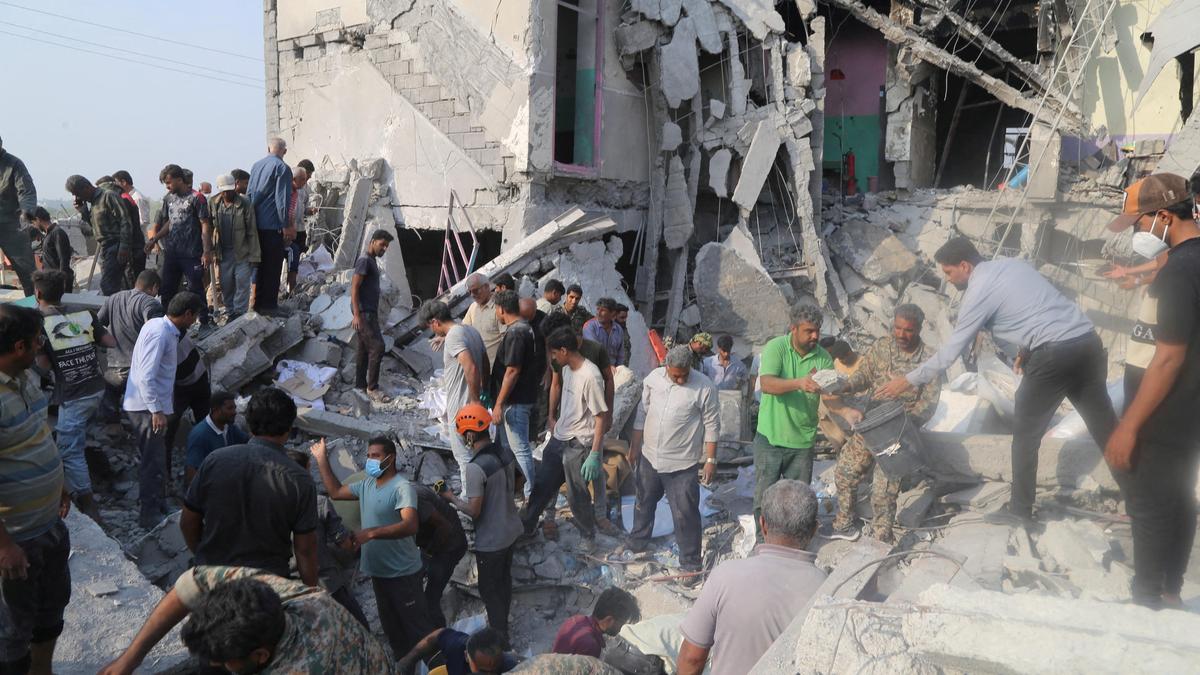
As the U.S. and Israel launched coordinated strikes across Iran, reports have surfaced that a missile had hit a girls’ primary school in the southern city of Minab, killing around 150 people and injuring nearly 100. Many of the victims are believed to be schoolchildren. UNESCO has condemned this as a grave violation of International Humanitarian Law (IHL), or the ‘laws of war’, which is designed to limit the human suffering caused during ‘armed conflict’ by imposing restrictions on the ‘means’ and ‘methods’ of warfare. Attacks on civilian objects such as schools and hospitals, and on civilians, especially children, are prohibited under IHL.
On February 28, Israel and the U.S. launched strikes on Iran, framing the operation as a ‘pre-emptive’ response to what they described as an imminent threat. Importantly, the UN Charter was created in 1945 following the devastation of World War II to save future generations from the “scourge of war” and maintain international peace and security. Article 2(4) of the UN Charter prohibits all member states from threatening or using force against the ‘territorial integrity’ or ‘political independence’ of another state. Under the Charter, only the UN Security Council may authorise the ‘use of force’ against a member state in response to breaches of international peace. The sole exception is Article 51, which permits the ‘use of force’ in self-defence, but only in response to an actual armed attack.
Under this legal framework, neither Israel nor the U.S. can plausibly claim to be exercising the right of self-defence against Iran under Article 51, whether individually or collectively. Notably, Iran has not recently attacked either state, and any earlier threat has long dissipated. In the absence of an ongoing armed attack, the ‘use of force’ cannot be justified as self-defence. At most, the argument rests on preventing a potential future Iranian attack — nuclear or otherwise — under the theory of “anticipatory” self-defence in response to an imminent threat.
Yet many scholars argue that international law does not recognise a right to use force in self-defence against an attack that has not yet occurred. Nevertheless, even under the broadest plausible theory of “anticipatory” self-defence, the use of force against Iran would be lawful only if three conditions were met: first, that Iran’s leadership had decided to attack the U.S. or Israel; second, that it possessed the capability to do so; and third, that the ‘use of force’ was necessary now because this was the last window of opportunity to prevent that future attack.
However, the “anticipatory” self-defence argument appears even weaker today. The U.S. strikes in June 2025 had already substantially degraded Iran’s capacity to develop a nuclear weapon. President Donald Trump had claimed that Iran’s nuclear programme had been “obliterated”. Since then, no evidence has been presented to show that Iran reconstituted its programme, formed the intent to build a weapon, mounted it on a ballistic missile, and prepared to use it against the U.S. or Israel.
Furthermore, neither regime change nor the protection of populations (Iranians) from mass atrocities by the Iranian government finds any basis in international law or the UN Charter as a lawful justification for the ‘use of force’.


NMC mandates medical colleges to link patient records with Ayushman Bharat IDs, enhancing transparency and combating fraudulent patient claims.

The Karnataka Lokayukta Police on Thursday conducted simultaneous searches at over 42 locations across the state in connection with disproportionate assets (DA) cases registered against nine government officers. Searches were carried out in Bengaluru, Mandya, Gadag, Mysuru, Vijayapura, Hassan and Yadgir districts. According to officials, assets worth a total of ₹35.65 crore were unearthed, including ₹24.05 crore in immovable properties and ₹11.59 crore in movable assets.

U.S., Israel launch strikes on Iran as a ‘pre-emptive’ response to an imminent threat, raising questions about the legality of the use of force under the UN Charter; missile strike on a girls’ primary school raises concerns over violations of International Humanitarian Law, particularly the principles of distinction, proportionality, precaution

West Bengal Governor C.V. Ananda Bose stepped down from his post on March 5, submitting his resignation to President Droupadi Murmu in Delhi. Tamil Nadu Governor R.N. Ravi has been appointed to replace him ahead of the State Assembly polls. Chief Minister Mamata Banerjee said she was “shocked and deeply concerned” and alleged she was not consulted as per established convention.

Madhya Kailash flyover receives a smooth tar coat after commuter complaints about its bumpy surface.

Karnataka's RTOs now issue Fitness Certificates exclusively at geo-fenced locations via the mVahan app, ensuring transparency and compliance.

Maoist Rajesh Punem, linked to Bhairamgarh Area Committee, killed in police encounter in Dantewada, Chhattisgarh.

GBA Chief directs corporations to pursue criminal cases against illegal advertisements following citizen complaints in Bengaluru.

Singhvi and Vem Narender Reddy to be elected unanimously for Rajya Sabha

New DIG of Police for Dindigul range assumes office

Safety inspection of the MRTS extension to St. Thomas Mount is completed, paving the way for its commissioning.

Musi Jan Andolan writes to AICC Telangana in-charge against Gandhi Sarovar

Karnataka High Court urges government to implement police verification for migrant workers while ensuring their dignity and equality.