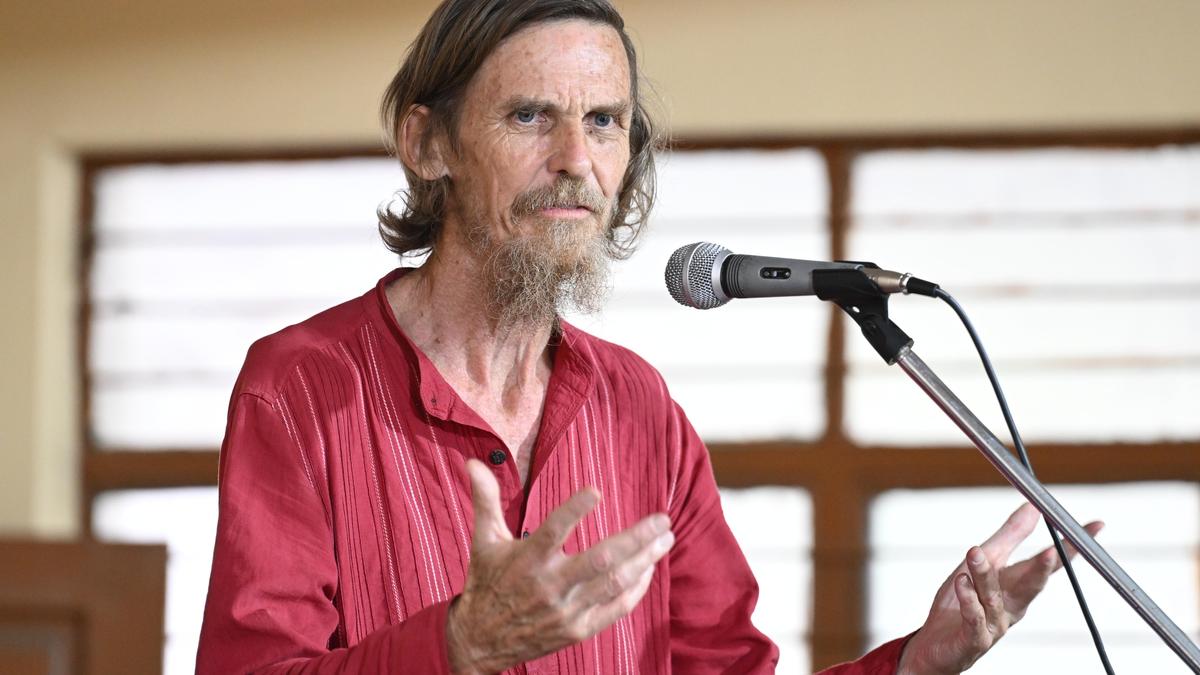
India has resources, but not the will: Jean Dreze on the future of MGNREGA
The Hindu
Economist Jean Dreze discusses MGNREGA's challenges, emphasizing India's resource abundance but lack of political will for worker empowerment.
Mahatma Gandhi National Rural Employment Guarantee Act, 2005, (MGNREGA) is a pro-worker law implemented by an anti-worker system, economist Jean Dreze said, reflecting on how the country’s flagship rural employment programme, conceived as a rights-based guarantee, has increasingly been shaped by administrative practices that work against the workers it was meant to empower.
Mr. Dreze, who played a key role in the conceptualisation and drafting of the MGNREGA, was speaking on the “harsh realities of MGNREGA vs the proposed Viksit Bharat – Guarantee for Rozgar and Ajeevika Mission (Gramin) Bill (VB-G-RAM-G)” in the city on Thursday. During the discussion, he examined the changing trajectory of the MGNREGA, the pressures it faces today, and how policy decisions- from wage levels to digitisation have steadily weakened what was once envisioned as a rights-based safety net for rural workers.
“India is not a poor country. It is a country with a lot of poor people,” he said, arguing that the country’s problem today was not the absence of resources but the absence of political will to prioritise the livelihoods of its poorest citizens.
The MGNREGA was conceived as a legal guarantee of employment, giving rural households the right to demand up to 100 days of wage labour from the government. The law, he said, was designed to empower workers by shifting the relationship between citizens and the state. However, he argued that over time the spirit of the law has increasingly been undermined through administrative restrictions, delayed payments, and policy decisions that weaken workers’ ability to actually claim their rights.
Mr. Dreze said one of the most worrying shifts has been the gradual transformation of the programme from a legal entitlement into something the government can effectively regulate or restrict or turn off and on, through administrative decisions.
“What was recognised as a right and conferred as a right for people has now, with the VB-G RAM G Act, become a dispassionate thing that the government will turn on or turn off based on various preferences,” he said.


Exporters seek urgent government aid as 60,000 tonnes of basmati rice remain stuck in ports due to logistics disruptions.

Economist Jean Dreze discusses MGNREGA's challenges, emphasizing India's resource abundance but lack of political will for worker empowerment.

NMC mandates medical colleges to link patient records with Ayushman Bharat IDs, enhancing transparency and combating fraudulent patient claims.

The Karnataka Lokayukta Police on Thursday conducted simultaneous searches at over 42 locations across the state in connection with disproportionate assets (DA) cases registered against nine government officers. Searches were carried out in Bengaluru, Mandya, Gadag, Mysuru, Vijayapura, Hassan and Yadgir districts. According to officials, assets worth a total of ₹35.65 crore were unearthed, including ₹24.05 crore in immovable properties and ₹11.59 crore in movable assets.

U.S., Israel launch strikes on Iran as a ‘pre-emptive’ response to an imminent threat, raising questions about the legality of the use of force under the UN Charter; missile strike on a girls’ primary school raises concerns over violations of International Humanitarian Law, particularly the principles of distinction, proportionality, precaution

West Bengal Governor C.V. Ananda Bose stepped down from his post on March 5, submitting his resignation to President Droupadi Murmu in Delhi. Tamil Nadu Governor R.N. Ravi has been appointed to replace him ahead of the State Assembly polls. Chief Minister Mamata Banerjee said she was “shocked and deeply concerned” and alleged she was not consulted as per established convention.

Madhya Kailash flyover receives a smooth tar coat after commuter complaints about its bumpy surface.

Karnataka's RTOs now issue Fitness Certificates exclusively at geo-fenced locations via the mVahan app, ensuring transparency and compliance.

Maoist Rajesh Punem, linked to Bhairamgarh Area Committee, killed in police encounter in Dantewada, Chhattisgarh.

GBA Chief directs corporations to pursue criminal cases against illegal advertisements following citizen complaints in Bengaluru.

Singhvi and Vem Narender Reddy to be elected unanimously for Rajya Sabha

New DIG of Police for Dindigul range assumes office

Safety inspection of the MRTS extension to St. Thomas Mount is completed, paving the way for its commissioning.