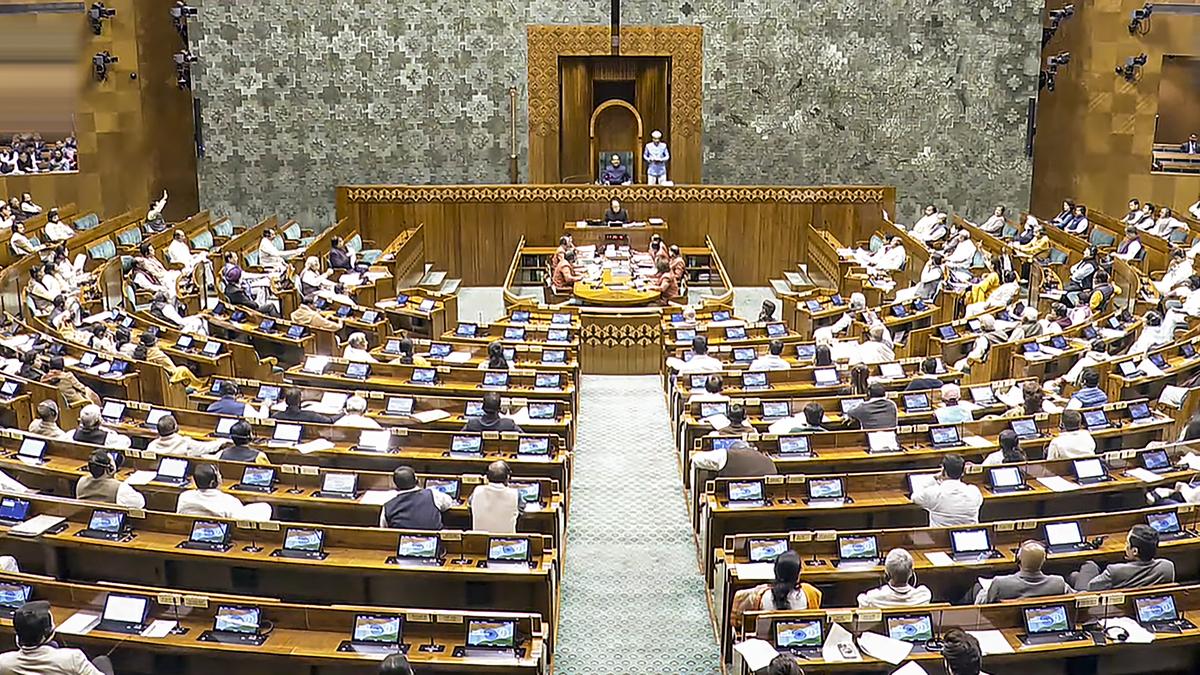
The importance of the Deputy Speaker
The Hindu
Vacant Deputy Speaker position raises concerns on democratic resilience, constitutional adherence, and parliamentary democracy principles in India.
The position of the Deputy Speaker has been lying vacant for the last six years raising questions on constitutional adherence and democratic resilience. The position goes beyond ceremonial significance and is indispensable to parliamentary democracy. The present scenario of the vacant position could be understood through some very important questions. The framers of the Constitution adopted a parliamentary form of governance to ensure effective representation of the people of India in the political system. This idea would lose its significance if the system does not function properly, effectively and smoothly. It is also extremely important that debates and discussions between the ruling establishment and the Opposition remain proper to make the government accountable, and that checks and balances are ensured. It has been alleged that the current ruling government has vehemently denied to hand over the position of the Deputy Speaker to an Opposition member. This is against the principle of sharing of powers which is one of the mandates of a successful parliamentary democracy. It may also be noted that constitutional conventions do have statutory effect in cases of absence.
The Deputy Speaker is not a mere substitute of the Speaker; he plays an indispensable role in maintaining the continuity of legislative work. He also presides over committees such as the private member’s bill and the House Budget Committee of Parliament; oversees crucial debates; and serves as a neutral arbiter during sensitive discussions. Provisions for a Deputy Speaker is listed under Article 93 of the Constitution. The language of the Article which includes the phrase ‘as soon as’ for electing both the Speaker and the Deputy Speaker implies urgency and necessity, and not discretion. Article 94 reinforces the continuity of the Deputy Speaker’s office until resignation, removal, or disqualification.
Conventionally the position of the Speaker goes to the ruling party. There has been an informal practice of offering the Deputy Speaker’s post to a member of the Opposition. The essence of this practice is to develop harmony between the ruling party and the Opposition for the smooth functioning of Parliament.
The Government of India did not appoint a Deputy Speaker in the 17th Lok Sabha (2019-24), and it appears now that it does not have the intention to appoint one in the 18th Lok Sabha as well. It is really unfortunate that the government and the Opposition could not come to terms on the issue of appointing a Deputy Speaker, which could be primarily because the government does not want to give this position to the Opposition. According to Rule 8 of the Rules of Procedure and Conduct of Business in Lok Sabha 1952, election to the post of the Deputy Speaker “shall be held on such date as the Speaker may fix”. The Deputy Speaker is elected once a motion proposing his or her name is moved. He enjoys the same powers as the Speaker when he presides over a sitting House. According to Article 180 of the Constitution, the Deputy Speaker has the power to conduct the duties of the Speaker when his chair is vacant. Thus, this vacancy violates not only Articles 93, 94 and 180 of the Constitution, it is also inconsistent with the Rules of Procedure.
While Article 93 provides for the election of the Deputy Speaker “as soon as may be”, it does not set a timeline. The misinterpretation of this phrase may lead to a long delay which could distort constitutional intent and create a constitutional vacuum. Conventionally, the position is handed over to the Opposition, but now that the position is vacant, authority is centralised in the Speaker and thereby in the ruling party which will be inconsistent with the democratic intent of the Constitution. In fact, constitutional conventions intend to strike a delicate balance between the ruling party and the Opposition to ensure that democratic resilience is maintained and sustained in the parliamentary system, based on the Westminster model, which mandates effective discussions and deliberations. Moreover, in a situation caused due to the resignation of the Speaker or even in case of incapacitation, a severe constitutional crisis may surface which will be detrimental to the system of governance.
Above all, the failure to uphold the tradition of offering the office to the Opposition undermines the spirit of consensus-driven politics.
C. B. P. Srivastava is President, Centre for Applied Research in Governance, Delhi


Indian vessels can freely sail through the Strait of Hormuz without needing permission, confirms a senior government official.

The Hindu Morning Digest gives a select list of stories to start the day. Read the top news today on March 25, 2026

An IndiGo flight at Vijayawada airport was grounded due to a tyre burst, but all 79 occupants are safe.

Tamil Nadu Assembly election 2026: TMC(M) gets five seats in NDA, to contest on BJP's 'Lotus' symbol
TMC(M) secures five NDA seats, to contest Assembly elections using BJP's 'Lotus' symbol in Tamil Nadu.

The Karnataka government will discuss with officials the possibility of creating a portal for unemployed youth to share their details and access job opportunities in micro, small and medium enterprises (MSMEs), Minister for Small Industries and Public Enterprises Sharanabasappa Darshanapur said in the Legislative Council on Tuesday.

AIADMK's 2026 manifesto promises free rations, women's benefits, education reforms, and economic growth initiatives for Tamil Nadu.

U.S.-Israel war on Iran LIVE: Follow The Hindu for updates on the West Asia conflict on March 24, 2026

Join the 'Click & Commit' campaign on World TB Day, uniting Chennai's community to pledge against tuberculosis.

Brahmin candidates join Naam Tamilar Katchi, marking a significant shift in Tamil Nadu's political landscape and inclusivity.

Over 750 wheelchairs are prepared in Thoothukudi for accessible voting, ensuring convenience for differently abled and elderly voters.

Madras HC dismisses S.P. Velumani's petition challenging I-T assessment of ₹7 crore as unexplained election expenses from 2016.

The Lok Sabha passes a contentious Transgender Bill, sparking praise from the government and criticism from opposition parties.

Kamal Haasan announces support for DMK in 2026 elections, emphasizing the need for 'Dravidian Model 2.0' for Tamil Nadu's welfare.