The dark forest: Into the mysterious world of the Myristica swamps Premium
The Hindu
Discover the mysterious world of Myristica swamps through Priya Ranganathan's illustrated guide, The Dark Forest. Email for more info.
Priya Ranganathan’s first encounter with a Myristica swamp was back in 2019 when she was working as a research assistant at the Bengaluru-based Ashoka Trust for Research in Ecology and the Environment (ATREE) on a hydro-ecology project. As part of a field trip with other researchers, she was exploring the Aghanashini, one of the rivers that flows through Sirsi taluk in Uttara Kannada district.
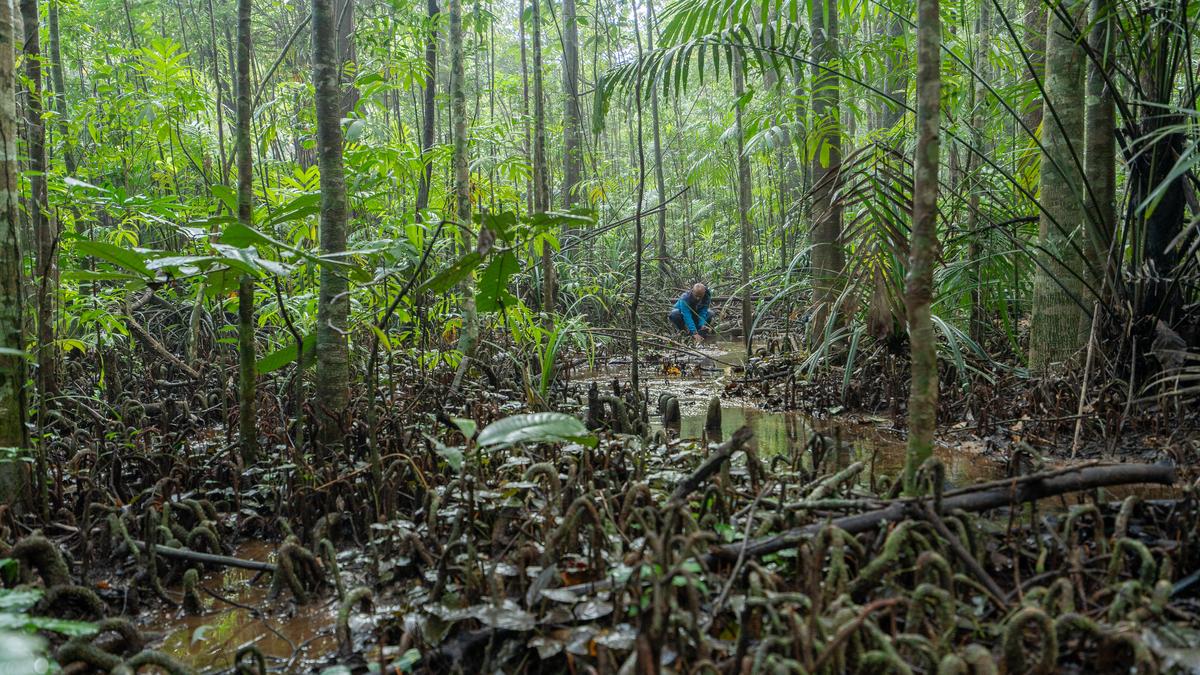
“We trekked quite a distance into one of these swamps,” she says, recalling that since it was during the monsoons, there was a heavy mist all over the landscape. “I remember thinking that it was so incredibly cool: a Malabar pit viper was lying there, roots everywhere, frogs were croaking, the mist was so low…it looked like a lost world,” says Priya, who has since closely studied this unique ecosystem and has just come out with a book titled The Dark Forest: An Illustrated Guide to the Biodiversity of the Myristica Swamps.
Her interest, piqued during this first encounter, deepened as she began studying these swamps as part of a project she was working on with ATREE researchers Dr G. Ravikanth and Dr N.A. Aravind. The time she spent reviewing literature on these swamps, talking to people who had worked in these places, and writing a manuscript based on this work, “made me interested in scientifically assessing swamps as a system,” says Priya, who eventually started her PhD on the subject, which she is currently pursuing at ATREE with Dr Ravikanth and and Dr. Jagdish Krishnaswamy, Dean, School of Environment and Sustainability (SES), Indian Institute for Human Settlements (IIHS). “That is how the journey took off, and I have not looked back since then.”
Myristica swamps are unique, freshwater swamp ecosystems found in certain parts of the Western Ghats, “one of the least studied and most endangered wetland ecosystems in the country,” writes Priya in The Dark Forest, going on to describe them as “relic ecosystems, remnants of an ancient landscape that once stretched across the river valleys of the Western Ghats.”
These swamps, which mostly occur along the ”upper reaches of river systems within wet evergreen forest watersheds” and rely on “monsoon rainfall and seasonal flooding to sustain their unique hydrological cycle,” are named after the dominant trees in this landscape, which belong to the Myristica or nutmeg family, one of the oldest flowering plant groups in the world. “The exact dating of these landscapes hasn’t been done yet, but fossils resembling the Myristica seeds and leaves have been found dating back to the Early Cretaceous period,” she says, referring to a period around 145 to 100.5 million years ago, when the earth’s landmass was still only two continents, Gondwana and Laurasia, with dinosaurs roaming across them.
While there are five species of Myristica trees found in the Western Ghats today, not all of them are adapted to be in swamp conditions, she says. “Some are found in upland forests, but there are two species, Gymnacranthera canarica and Myristica fatua, which have evolved to have knee and stilt roots. This allows them to breathe in waterlogged conditions,” she says, adding that these trees also have lenticels or small pores on the surface of their roots to further help with respiration.
In addition to these trees, the Myristica swamps, which are found scattered across Karnataka, Kerala, Goa and Maharashtra, are home to many other forms of plant life, with around 90 species of herbaceous plants, 46 species of shrubs, 27 species of climbers and lianas and 80 species of trees, states The Dark Forest. It also supports a wide variety of animals, many of which are endemic to the Western Ghats, such as the lion-tailed macaque, Malabar giant squirrel, the rare Myristica Bambootail damselfly only found in these swamps, the critically endangered Kottigehar dancing frog and the Malabar grey hornbill. Also, “apart from being hotspots of unique biodiversity in the Western Ghats, Myristica swamps also provide various ecosystem services to local communities living near them,” explains Priya.


PM Modi and UAE President agree on ensuring safe navigation through the Strait of Hormuz amid regional tensions.

JNU student leaders face severe repercussions for activism, risking their academic futures amid allegations and online abuse.

India Post launches 24-hour and 48-hour Speed Post services in Bengaluru, ensuring urgent delivery across major metro cities.

A 24-hour control room in Krishnagiri monitors the Model Code of Conduct and manages election-related complaints ahead of polls.

Madurai Collector inaugurates voter awareness campaign

MLC Kishore Kumar Puttur criticizes the State for poor implementation of the Centre's health scheme for senior citizens.

Karnataka's Health Minister announces redeployment of specialists to taluk hospitals to reduce neonatal mortality rates effectively.

Celebrate IPL's start and Polly Umrigar's legacy, reflecting on cricket's evolution and the enduring impact of its pioneers.

BJP accuses Congress and Rahul Gandhi of endorsing an ‘anti-India’ USCIRF report undermining India's global image.

Education Ministry proposes UGC-like funding under Shiksha Adhishthan, raising concerns about centralization and public university financing.

Shivraj Singh Chouhan defends the new rural jobs Act, dismissing opposition protests as ineffective and highlighting increased funding and worker protections.

Supreme Court questions why heirs can't access unclaimed funds of deceased depositors, urging government to develop a disclosure policy.

Karnataka High Court demands LPG supply details amid state restrictions, threatening Bengaluru's restaurants and livelihoods.