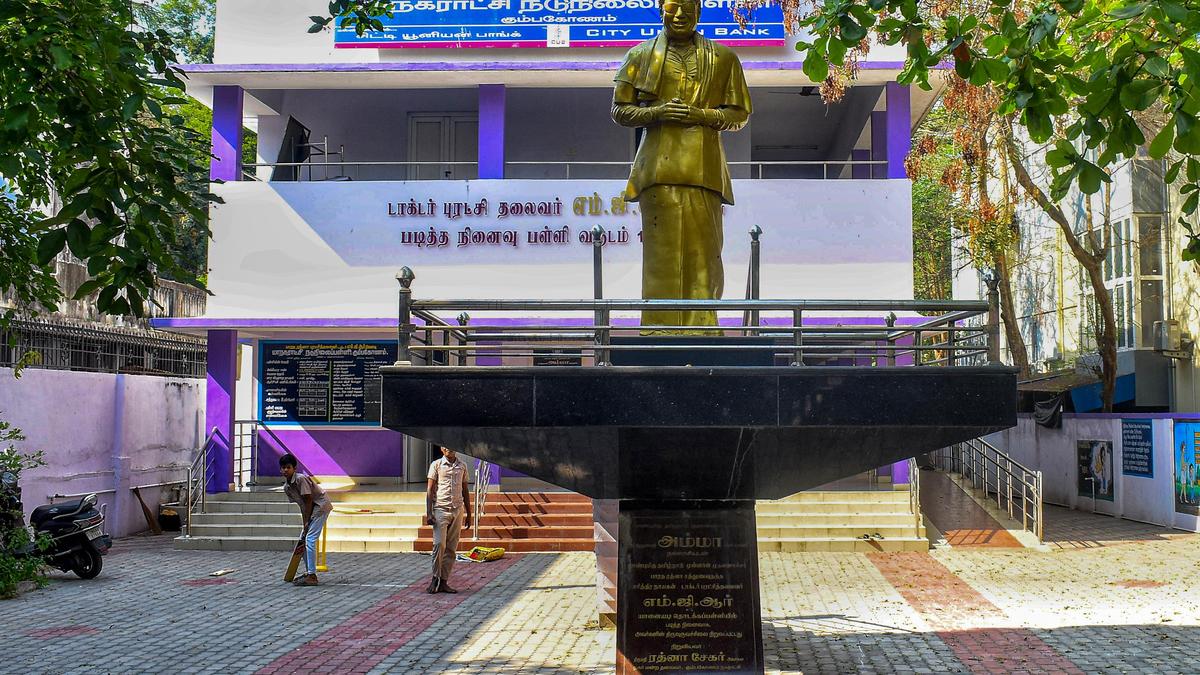
The Kumbakonam connection of MGR, M.K. Nambyar and M.S. Swaminathan Premium
The Hindu
Explore the Kumbakonam connection of MGR, M.K. Nambyar, and M.S. Swaminathan, shaping icons of Tamil Nadu's history.
What unites Meloth Krishnan Nambyar, a distinguished constitutional lawyer; Marudur Gopala Menon Ramachandran, the iconic film star and former Chief Minister of Tamil Nadu; and Monkombu Sambasivan Swaminathan, the celebrated agricultural scientist with roots in Kerala? The answer is Kumbakonam, the historic temple town of Tamil Nadu. Though they hailed from families with origins in Kerala, each of these towering personalities spent a formative part of their lives in Kumbakonam. The town, known for its rich cultural heritage, temples, educational institutions, and vibrant intellectual climate, shaped their life before they rose to national prominence in law, politics, cinema and science.
Nambyar, who appeared for Communist leader A.K. Gopalan in India’s first constitutional case in 1950, belonged to the Meloth, a powerful and wealthy Tharavad family in Kerala. Born in 1898, he completed his SSLC at St. Aloysius High School in Mangalore before joining the Government Arts College in Kumbakonam, after his brother Kunhambu Nambyar secured a government job in the Agriculture Department in the town.
The biography of Meloth Krishnan Nambyar. He studied at the Government Arts College in Kumbakonam. | Photo Credit: The Hindu Archives
His biography, M.K. Nambyar: A Constitutional Visionary, written by his son and former Attorney-General K.K. Venugopal, along with Suhrith Parthasarathy and Suhasini Sen, recounts an incident during a visit to a restaurant that illustrates the social climate of the time. “Three of his friends who were Brahmins were accommodated in the dining hall, while he and his non-Brahmin friend had to sit on a platform built on the veranda of the restaurant. He did not take this amiss because one had necessarily to adapt oneself to this discriminatory treatment,” the book says. Although Nambyar left Kumbakonam to study at Madras Law College, he retained his association with the town.
In 1957, when the Deputy Commissioner of the Hindu Religious and Charitable Endowments Department attempted to take over the Varadaraja Perumal Temple and Sri Vedanarayana Perumal Temple, administered by the Sourashtra community, Nambyar appeared for the Sourashtra Dharma Paripalana Committee. He successfully argued before the Madras High Court that the Sourashtra community constituted a religious denomination and was therefore protected under Article 26 of the Constitution.
According to his biography, the trustees were deeply grateful to Nambyar for winning the case without charging any fee. Every year on Onam, they sent him gifts: an eight-foot silk dhoti, a four-foot silk angavastram, and a six-foot white silk sari for his wife, Kalyani Nambyar. The tradition continued until his death. Even today, a portrait of Nambyar adorns the office of the Sourashtra Dharma Paripalana Committee at Kumbakonam.


AAP criticizes Modi for his silence on the U.S. attack on an Iranian warship amidst a controversial trade deal.

Bombay HC prioritizes airport security over religious practices, dismissing plea for prayer space near Chhatrapati Shivaji Maharaj International Airport.

Study finds higher temperatures during pregnancy lead to fewer male births, highlighting urgent maternal health risks in vulnerable populations.

Explore the persistent under-nutrition crisis in north Karnataka, driven by inter-generational and structural challenges affecting child health.

A massive demolition drive in Khammam leaves over 1,800 residents homeless, igniting political controversy and protests over Bhoodan lands.

Morning Digest: Key updates on new governors, Sri Lanka's Iranian ship evacuation, IAF crash, and T20 World Cup highlights.

Explore the vital roles women played in the Self-Respect Movement through K. Srilata's insightful anthology, "The Other Half of the Coconut."

Explore the Kumbakonam connection of MGR, M.K. Nambyar, and M.S. Swaminathan, shaping icons of Tamil Nadu's history.

Transform diabetes prevention by screening in early pregnancy, safeguarding future generations from metabolic diseases.

Martin has to keep believing in himself: Miranda on striker’s slow start to ISL

Congress nominates newcomer Christopher Manickam for Tamil Nadu's Rajya Sabha seat, highlighting fresh leadership and grassroots dedication.

Chennai Corporation to enhance junctions with improved signage and road markings, supporting an intelligent transport system for better mobility.

West Bengal Governor C.V. Ananda Bose resigns unexpectedly, with R.N. Ravi appointed as his successor ahead of assembly polls.