When gods walk at dawn: A traveller’s guide to experiencing Theyyam in North Kerala
The Hindu
Discover the transformative experience of Theyyam in North Kerala, witnessing the vibrant rituals and rich cultural heritage at Sree Kathivanoor Veeran Temple.
An hour before sunrise Vinu Peruvannan is finally set to play god.
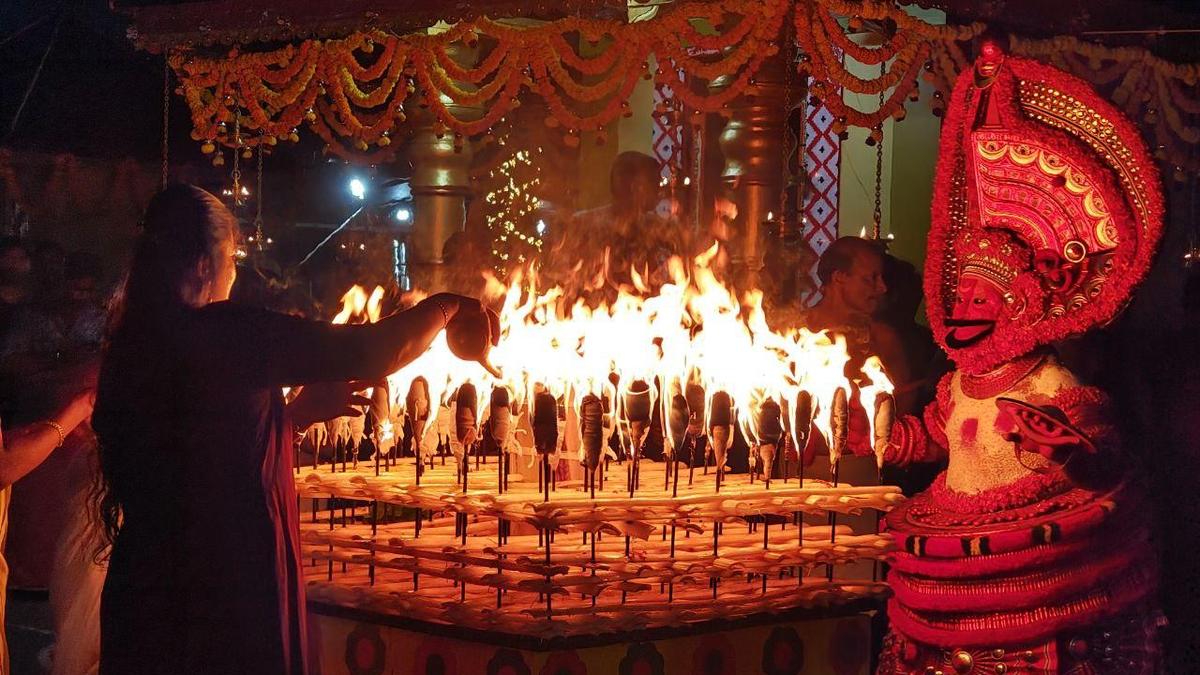
Clad in crimson and black, donning heavy headgear speckled with wild geranium flowers, his torso covered in ashes, he holds up a mirror. His transition to a Kathivanoor Veeran Theyyam, a ferocious Thiyya warrior-turned-deity, is complete.
This sight alone makes my 488-kilometre journey from Thiruvananthapuram to Kannur, to experience my first-ever Theyyam at the Sree Kathivanoor Veeran temple, at Kavvayi, a 40-kilometre bus ride from the city centre, worth it. The final stretch of the Kaliyatta Maholsavam, a grand, multi-day, often triennial ritualistic Theyyam festival, is underway and fortunately I get there early enough to find myself a seat..
Helpers from the Thalikaran Tharavadu, considered the avakashikal (heirs) of the temple, fling palm-leaf torches outside the room. Amidst the beats of the chenda, the artiste moves backwards into the field in a menacing motion, preparing to perform his tale of valour, heartbreak and rebellion. The chronicles of Kathivanoor Veeran, sung by two helpers, which resounded across the arena all night, have now been replaced by quick beats of the drum.
Kathivanoor Veeran is one among the 456 theyyakolams (types of Theyyams) in Kerala, each entrenched in local myth. North Kerala’s Theyyams are between the 10th day of the Malayalam month of Thulam (mid-October) and Edavappathi (mid-June). “There are over 1,000 Theyyam festivals in a season across North Kerala,” says Santhosh Vengara, a tour guide specialised in Theyyam tours since 2010. They draw more and more tourists every year.
Each of these Theyyam performances involves rites that celebrate local lore – from fasting to the artiste returning to his “human self”, differing in preparation and presentation. Though the art form is rooted in the caste system, it brings in a temporary reversal of hierarchies, with performers from historically marginalised communities, including Vannan, Malayan, Velan, Mavilan, Panan, Pulaya, and Anjoottan, donning the roles of gods. Children belonging to Theyyam-performing families start preparing as early as seven years and transition into playing major Theyyams.


BJP accuses Karnataka's Congress government of misusing ₹39,000 crore of SCSP-TSP funds for non-targeted schemes, urging accountability.

Formula 1 kicks off its 2026 season at the Australian GP, raising questions about race safety, team performance, and new regulations.

ASHA workers protest in Vijayawada for better pay and benefits; government promises to address their demands and improve conditions.

Hyderabad's food safety raids uncover widespread adulteration, leading to significant seizures and heightened community concerns about food quality.

Explore the structural barriers in India's education system that limit the availability of qualified naval talent for the Indian Navy.

Explore Ana Paula Maia's chilling novella, "On Earth As It Is Beneath," a harrowing reflection on violence and survival in a brutal prison.

Discover the transformative experience of Theyyam in North Kerala, witnessing the vibrant rituals and rich cultural heritage at Sree Kathivanoor Veeran Temple.

Taranjit Singh Sandhu appointed as Delhi's lieutenant governor, succeeding V.K. Saxena after his tenure of four years.

403 Forbidden Bar in Indiranagar brings together science and theatre with its drinks, with sous-vides and botanical distillation. We check out whether it is worth the hype

Explore the emotional depth of Mirza Waheed's Maryam & Son, examining loss and identity in a Muslim-immigrant context.

Discover the inspiring legacy of Meenambal Sivaraj, a pioneering advocate for Dalit rights and women's empowerment in India.

Explore the decline of Janata Parivar and the rise of Sangh Parivar in Bihar's complex political landscape.

AAP criticizes Modi for his silence on the U.S. attack on an Iranian warship amidst a controversial trade deal.