A Tale of Two Parivars in Bihar Premium
The Hindu
Explore the decline of Janata Parivar and the rise of Sangh Parivar in Bihar's complex political landscape.
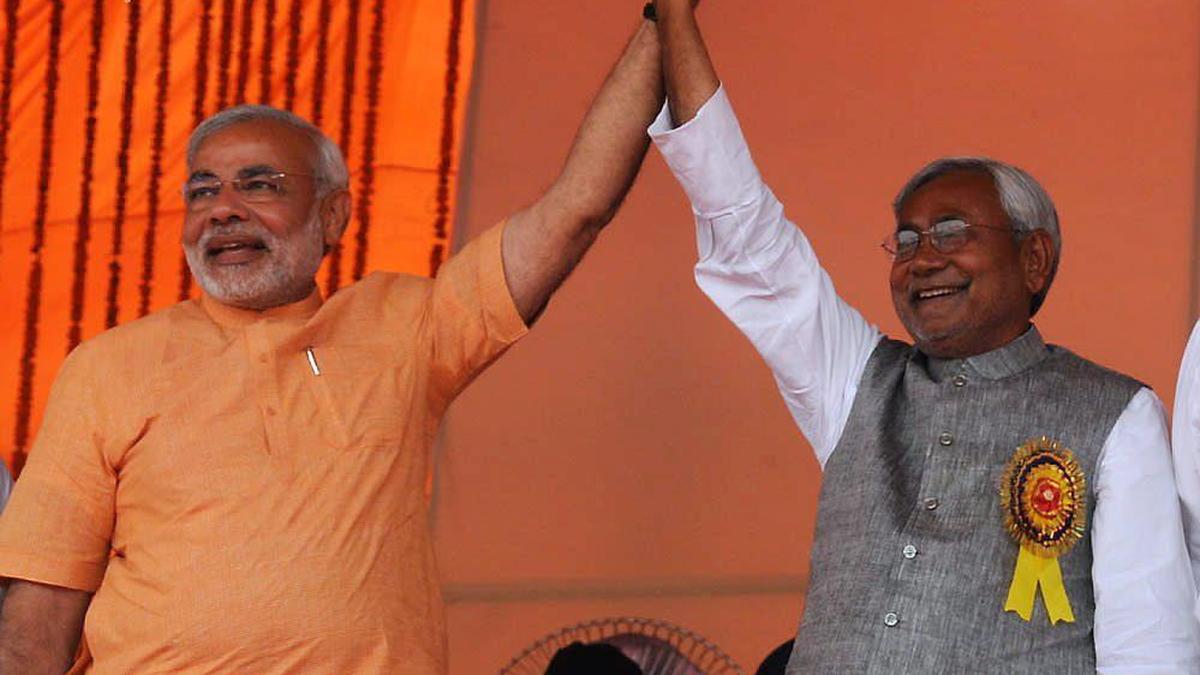
It is curtains down for the political career of Nitish Kumar, who was baptised into politics through the Jayaprakash Narayan movement in the 1970s in Bihar — a movement that was itself a fusion of two families of politics, the Sangh Parivar and the Janata Parivar. The JP movement marked the consolidation of OBC politics in the State, against the Congress dominance that mirrored, and entrenched, upper-caste social hegemony.
OBC politics in Bihar has gone through numerous churns over the last century. Three communities — Yadavs, Kurmi and Koeri — helmed the challenge to upper-caste hegemony in the State. Mr. Kumar is a Kurmi. After playing second fiddle to Lalu Prasad Yadav within the Janata Parivar for many years, Mr. Kumar broke away to found the Samata Party in 1994 — which later transitioned into the Janata Dal (United). After being in the saddle for 20 years as Chief Minister, he is now set to enter the Rajya Sabha.
His exit from the central stage to the antechamber marks the conclusion of a social and political process shaped through the interaction between the Sangh Parivar and the Janata Parivar over the last half-century. With this, the extinction of the Janata Parivar appears closer; it is a triumph of the Sangh Parivar.
Politics in the Hindi heartland has often been framed as Mandal versus Kamandal — OBC assertion and autonomy opposed to the Hindutva push for unity and order among all Hindu castes. That has not been an entirely linear or binary antagonism. Mr. Kumar’s own version of Mandal politics has been in alliance with Kamandal for most of his career. Under Narendra Modi, the BJP absorbed that dynamic of rivalry, contestation and accommodation among castes and converted it into an intra-Parivar affair — the Sangh Parivar’s own affair, rather than inter-party rivalries and alliances.
Caste assertions and rivalries have not ceased; they now play out within the Parivar. The recent controversy around UGC guidelines on tackling caste discrimination is a case in point. The Janata Parivar, that sprawling ecosystem of caste groups organised as competing and collaborating parties, is being retired. The Koeri redoubt in Bihar — Upendra Kushwaha’s Rashtriya Lok Morcha — is also under pressure to dissolve itself into the BJP.
The JP movement and the Janata experiment had aggregated all aggrieved social groups against the upper-caste, Dalit and Muslim coalition that sustained the Congress. The Sangh Parivar helped midwife the Janata Parivar, and both together beat the Congress in the heartland. The Ram Janmabhoomi movement advanced Hindu consolidation, and the Bhagalpur riots of 1989 — which killed nearly 1,000 people, overwhelmingly Muslim — deepened communal polarisation in the State. Yet it was Lalu Prasad who outmanoeuvred the Sangh Parivar by stitching together Hindu subalterns with Muslims into an unbeatable social base for the RJD. The demolition of the Babri Masjid in 1992 completed the decimation of the Congress, pushing its upper-caste supporters towards the BJP, and Muslims and Dalits towards the RJD.


Formula 1 kicks off its 2026 season at the Australian GP, raising questions about race safety, team performance, and new regulations.

ASHA workers protest in Vijayawada for better pay and benefits; government promises to address their demands and improve conditions.

Hyderabad's food safety raids uncover widespread adulteration, leading to significant seizures and heightened community concerns about food quality.

Explore the structural barriers in India's education system that limit the availability of qualified naval talent for the Indian Navy.

Explore Ana Paula Maia's chilling novella, "On Earth As It Is Beneath," a harrowing reflection on violence and survival in a brutal prison.

Discover the transformative experience of Theyyam in North Kerala, witnessing the vibrant rituals and rich cultural heritage at Sree Kathivanoor Veeran Temple.

Taranjit Singh Sandhu appointed as Delhi's lieutenant governor, succeeding V.K. Saxena after his tenure of four years.

403 Forbidden Bar in Indiranagar brings together science and theatre with its drinks, with sous-vides and botanical distillation. We check out whether it is worth the hype

Explore the emotional depth of Mirza Waheed's Maryam & Son, examining loss and identity in a Muslim-immigrant context.

Discover the inspiring legacy of Meenambal Sivaraj, a pioneering advocate for Dalit rights and women's empowerment in India.

Explore the decline of Janata Parivar and the rise of Sangh Parivar in Bihar's complex political landscape.

AAP criticizes Modi for his silence on the U.S. attack on an Iranian warship amidst a controversial trade deal.

Bombay HC prioritizes airport security over religious practices, dismissing plea for prayer space near Chhatrapati Shivaji Maharaj International Airport.