Telangana’s Bhu Bharati act: A legislation to resolve land issues | Explained
The Hindu
Telangana government launches Bhu Bharati Act 2025 and portal to resolve land disputes caused by Dharani portal and Record of Rights Act 2020, offering grievance redressal mechanism
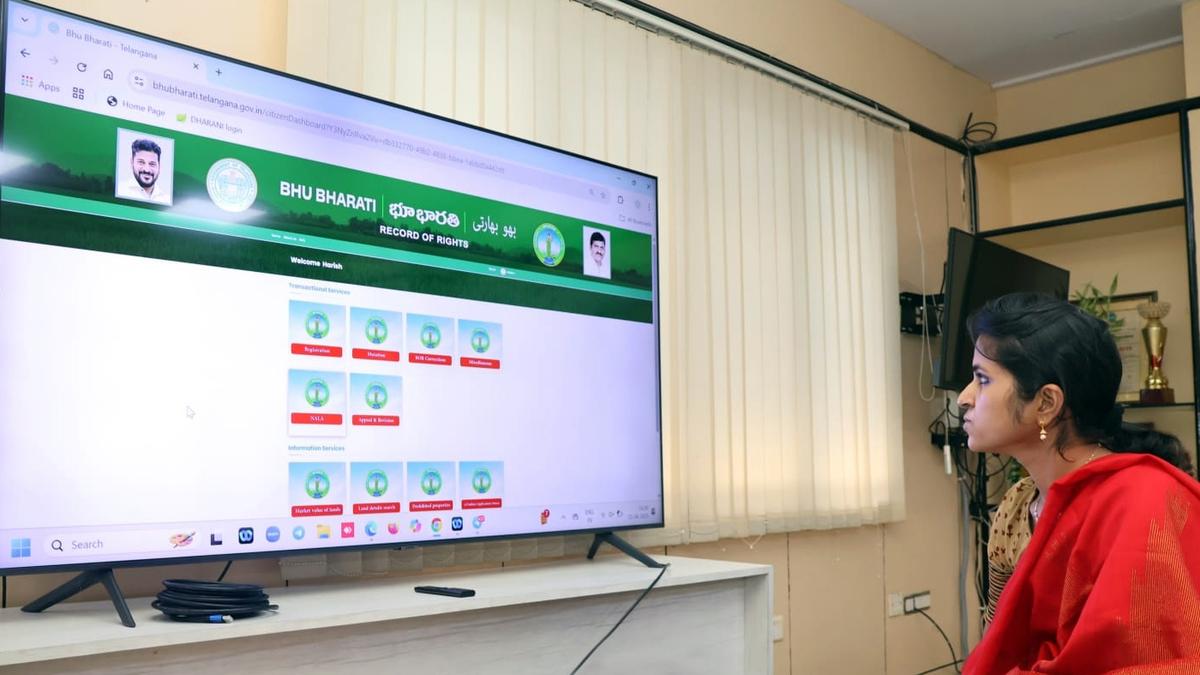
Telangana government has enacted the Telangana Bhu Bharati (Record of Rights) Act and formally launched the Bhu Bharati portal as a solution to land related issues which cropped up after the introduction of Dharani portal by the previous Bharat Rashtra Samiti (BRS) government.
The then government billed the Dharani portal as a one-stop solution for all land related transactions and claimed that 93% of land records were rectified through the Land Record Updation Programme (LRUP) [The exercise included digitisation of the records]. However, a major chunk of these disputes arose during the digitalisation process.
Scrapping the Dharani portal has been one of the main planks on which the Congress has contested the previous [2023] State Assembly elections and the results, especially in the rural areas, reflected the manner in which people suffered because of the Telangana Rights in Land and Pattadar Passbooks Act, 2020 and Dharani portal introduced by the BRS government.
Within days of enactment of the 2020 Record of Rights Act and introduction of Dharani portal, a spate of grievances from the landowners started pouring in. There were complaints like Patta lands being put in the Part-B, the prohibited list, which contained over 18 lakh acres and those about the difficulties faced by landowners by the removal of enjoyment [displaying name of current owner of the property] column in the land registration documents. This resulted in mismatch between the extent of land in records and the actual land available on the ground.
There were complaints about missing survey numbers as also about lands being registered in the name of others without the knowledge of the actual owners. There were several instances where records were uploaded into Dharani portal without field inspections. People were desperate for these issues - which gave them sleepless nights - to be resolved.
Complicating the woes of the landowners was the absence of redressal mechanism at the ground level as the previous government vested the entire power to address grievances in the district Collector and Chief Commissioner of Land Administration, who are usually not easily accessible. This has forced the affected families to take to legal recourse resulting in piling up of cases in the courts at different levels.
Realising the problems caused on account of the 2020 Act and Dharani, the Congress government has enacted the Telangana Bhu Bharati (Record of Rights) Act, 2025, to address these grievances amicably. In the process, the government took steps to decentralise the grievance redressal systems. The draft legislation was put in public domain seeking views and suggestions of the stakeholders, a practise reintroduced after several decades. The three-month-long exercise encompassed an expert committee holding discussions with farmers and other sections that were affected by Dharani portal and understanding the root causes behind their issues. The committee accordingly finalised its recommendations envisaging simpler methods for addressing the issues raised by the affected sections which ultimately resulted in the enactment of the Bhu Bharati Act.


MLC Kishore Kumar Puttur criticizes the State for poor implementation of the Centre's health scheme for senior citizens.

Karnataka's Health Minister announces redeployment of specialists to taluk hospitals to reduce neonatal mortality rates effectively.

Celebrate IPL's start and Polly Umrigar's legacy, reflecting on cricket's evolution and the enduring impact of its pioneers.

BJP accuses Congress and Rahul Gandhi of endorsing an ‘anti-India’ USCIRF report undermining India's global image.

Education Ministry proposes UGC-like funding under Shiksha Adhishthan, raising concerns about centralization and public university financing.

Shivraj Singh Chouhan defends the new rural jobs Act, dismissing opposition protests as ineffective and highlighting increased funding and worker protections.

Supreme Court questions why heirs can't access unclaimed funds of deceased depositors, urging government to develop a disclosure policy.

Karnataka High Court demands LPG supply details amid state restrictions, threatening Bengaluru's restaurants and livelihoods.

Shorts News:UN body investigating deadly strike on Iranian girls school

Moodbidri police inspector suspended pending inquiry over allegations of misbehaviour and inappropriate conduct towards women.

The State currently hosts more than 880 GCCs, up from around 500 GCCs in 2021.

Transgender and intersex activists march to Lok Bhavan, protesting the regressive Transgender Persons Bill and demanding its withdrawal.

Hyderabad's LGBTQIA+ community opposes the Transgender Amendment Bill, stressing dignity over identity verification and highlighting economic and medical concerns.