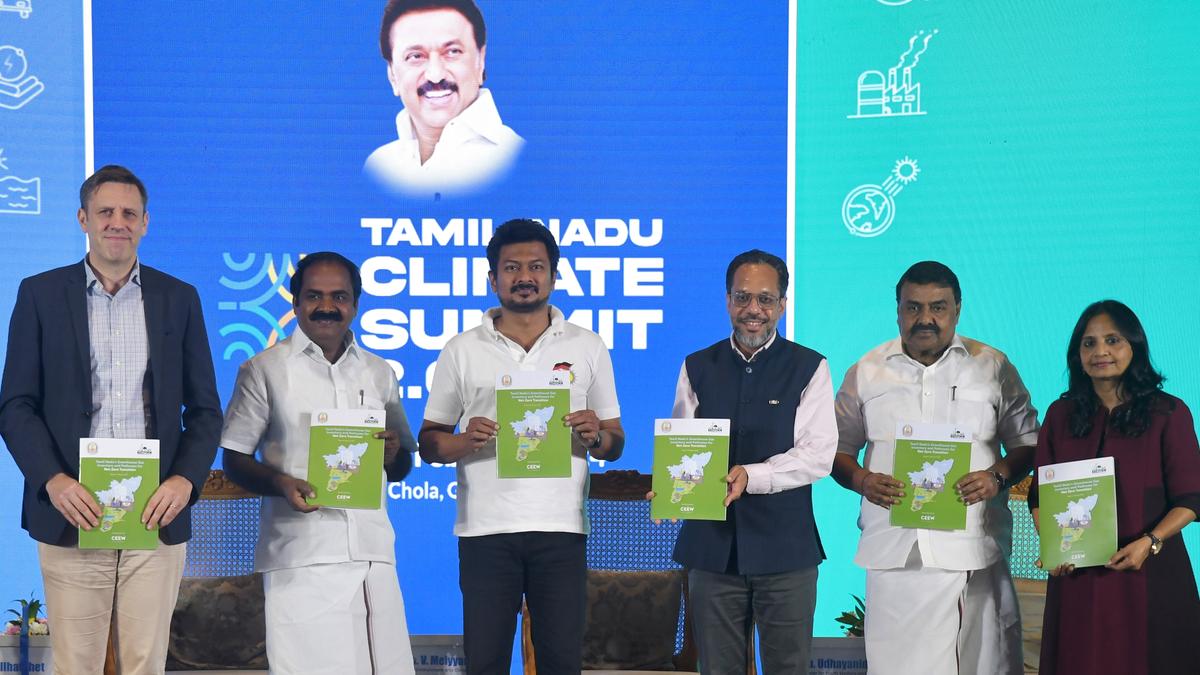
T.N.’s greenhouse gas inventory proposes significant increase in solar, wind energy use to achieve net zero emissions by 2070
The Hindu
Chennai, Tamil Nadu aims for net zero emissions by 2070, requiring significant solar and wind power investments.
Tamil Nadu, which has seen a 84% rise in emissions from 2005 to 2019, needs nearly 475 gigawatt of solar energy and 90 gigawatt of wind power to achieve net zero emissions by 2070, according to the greenhouse gas (GHG) inventory released at the inaugural of the Tamil Nadu Climate Summit 2.0 on Wednesday. The inventory was published by the Tamil Nadu Green Climate Company and the Council for Environment, Energy and Water (CEEW), an independent policy research institution.
The report titled ‘Tamil Nadu’s Greenhouse Gas Inventory and Pathways for Net-Zero Transition’, released by Minister for Youth Welfare and Sports Development Udhayanidhi Stalin, in the presence of Minister for Environment, Climate Change Siva V. Meyyanathan, acknowledges that net zero emissions require significant transformation across key sectors, such as energy, industry, agriculture, forestry and other land use (AFOLU), and waste.
As per the inventory, the State emitted a whopping 184 million tonnes of carbon dioxide equivalent in 2019. Of this, the energy sector contributes 77% of the GHG emissions; the industrial process and product use sector contributes 6%; the share of AFOLU sector is 12%; and the waste sector is responsible for 5% of the emissions.
“The greenhouse gas inventory also talks about the decarbonisation pathways, ways to get to net zero. One thing is clear. We cannot jump into being carbon neutral or become a decarbonised State, because it has got a lot of implications on growth, development and industries. So a timeline is important,” said Supriya Sahu, Additional Chief Secretary to the Government, Department of Environment, Climate Change and Forests.
Besides recommendations, the report also outlines sectoral targets in the upcoming years to align with a net zero emissions future. Significantly, the report says that the Green Tamil Nadu Mission has the potential to sequester carbon dioxide emissions worth 19 to 25 metric tonnes of carbon dioxide equivalent per annum.
Using data from 2019 as the baseline to compare emissions from different sectors across the years, the inventory shows that there has been a 75% overall increase in GHG emissions from the energy sector between 2005 and 2019. A significant portion of the emissions can be attributed to the use of coal as a primary energy source. In the industrial sector, the cement industry alone was responsible for almost 23% of the GHG emissions, followed by iron and steel at 19%. Other significant categories, include textiles and leather, petroleum refining, chemicals and fertilizers, and pulp, paper, and print.
Emissions from livestock farming contributed to roughly 50% of the emissions from the AFOLU sector. Rice is the second largest contributor, and fertilizer consumption is the third most significant GHG emissions contributor. “A significant proportion of forest and agricultural lands have been converted to other land categories, increasing emissions in the land-use sector. This shift has transformed the sector from a carbon sink to a source of emissions since 2015,” the report notes.


Civil society urges Amit Shah to direct police vigilance against open threats of communal violence in Uttam Nagar, Delhi.

PMK leader Anbumani blames alcohol and drug abuse for rising suicides in Tamil Nadu, criticising government inaction.

Bifurcation of Dindigul district is a key election issue, promising focused development and administrative improvements.

Election awareness campaigns gather momentum

Pylontech Advances Southeast Asia Strategy with 150MWh Energy Storage Agreement in Vietnam

BJP announces second list of 111 candidates for West Bengal Assembly polls, including Priyanka Tiberewal and Sumana Sarkar.

Traders urge Election Commission to raise the ₹50,000 cash limit, citing inflation and practical challenges during Tamil Nadu elections.

Kerala CM Pinarayi Vijayan to file nomination from Dharmadam, seeking third term amid tough competition in 2026 polls.

Water level in Mullaperiyar dam was 114.05 feet

PM Modi discussed West Asia peace, condemned Oman's sovereignty violation, and emphasized safe navigation through the Strait of Hormuz.

Contact details of election observers in The Nilgiris released for submitting poll-related complaints during Assembly elections.

Collector directs return of seized cash upon valid document verification amid voter enrollment and election preparations in Erode district.

Telangana Deputy CM Bhatti Vikramarka to present 2026-27 budget on March 20, 2026 , likely to balance welfare, development amid huge fiscal and revenue deficits in the State.