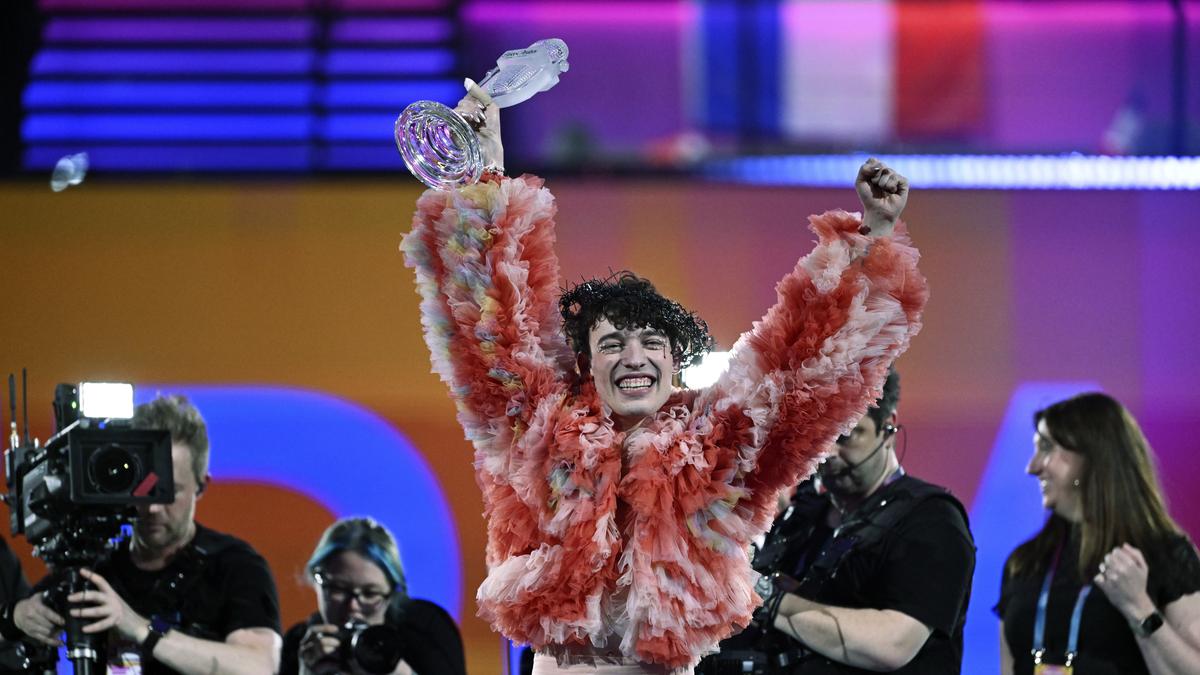
Switzerland’s Nemo wins 68th Eurovision Song Contest after event roiled by protests over Gaza
The Hindu
Swiss singer Nemo wins Eurovision with operatic pop-rap ode to nongender identity, amid controversy and protests.
Swiss singer Nemo won the 68th Eurovision Song Contest early Sunday with “The Code,” an operatic pop-rap ode to the singer’s journey toward embracing a nongender identity.
Switzerland's contestant beat Croatian rocker Baby Lasagna to the title by winning the most points from a combination of national juries and viewers around the world. Nemo, 24, is the first nonbinary winner of the contest that has long been embraced as a safe haven by the queer community. Nemo is also the first Swiss winner since 1988, when Canadian chanteuse Celine Dion competed under the Swiss flag.
“Thank you so much,” Nemo said after the result from Saturday's final was announced soon after midnight. “I hope this contest can live up to its promise and continue to stand for peace and dignity for every person.”
At a post-victory news conference, Nemo expressed pride in accepting the trophy for "people that are daring to be themselves and people that need to be heard and need to be understood. We need more compassion, we need more empathy.”
Nemo’s victory in the Swedish city of Malmo followed a turbulent year for the pan-continental pop contest that saw large street protests against the participation of Israel that tipped the feelgood musical celebration into a chaotic pressure cooker overshadowed by the war in Gaza.
Hours before the final, Dutch competitor Joost Klein was expelled from the contest over a backstage altercation that was being investigated by police. Klein was ejected from the competition after a female member of the production crew made a complaint, competition organizer the European Broadcasting Union said. The 26-year-old Dutch singer and rapper had been a favorite of both bookmakers and fans with his song “Europapa.”
Dutch broadcaster AVROTROS, one of dozens of public broadcasters that collectively fund and broadcast the contest, said that as Klein came offstage after Thursday’s semifinal, he was filmed without his consent and in turn made a “threatening movement” toward the camera. The broadcaster said Klein didn’t touch the camera or the camera operator, and called his expulsion “disproportionate.”


South African naturalist Steve Boyes speaks on ghost elephants, ancestral tracking, and Werner Herzog’s documentary exploring Angola’s elusive highland giants

Actor-director Amol Palekar will receive META's Lifetime Achievement award for 2026 on March 25 in New Delhi.

India's artists unite against rising censorship, advocating for creative freedom and support for marginalized voices in the arts.

Written and directed by Kunal, the film also stars Sparsh Shrivastava and Vanshika Dhir

This year, Bharatnatyam artistes will present the Tyagaraja Aradhane as a dance performance

This year, Bharatnatyam artistes will present the Tyagaraja Aradhane as a dance performance

The actor, along with director Sushant Shah, speak about their upcoming series ‘Chiraiya’, Divya’s process of working on the dialect, Sushant’s approach to telling a story about women, and more

An independent video, ‘Feel the Spark’ by Raleigh Rajan with vocals by Ciera Dumas that celebrates Tamil literary giants, garnered 1.4 million views in less than 36 hours.

In ‘Jack Ryan: Ghost War’, John Krasinski is back as the savvy CIA analyst, diving headfirst into a high-stakes mission that unravels a deadly conspiracy and pits him against a rogue black-ops unit

Shriram Bharatiya Kala Kendra’s Shankarlal festival showcased rare ragas, radiant artistry, and inclusive performances, from Pt Madhup Mudgal’s serene morning ragas to Ramana Balachandran’s Saraswati veena.

Explore "Threads that Bind: The Kantha Project," an exhibition in Delhi reimagining kantha as a medium of repair and renewal.

Sean Penn skips the Oscars to meet Ukraine's Zelenskyy, who praises him as a "true friend" amid the war.

The teaser of Tamil star Suriya’s much-awaited film with director Venky Atluri, titled Vishwanath and Sons, was unveiled by the makers on Monday