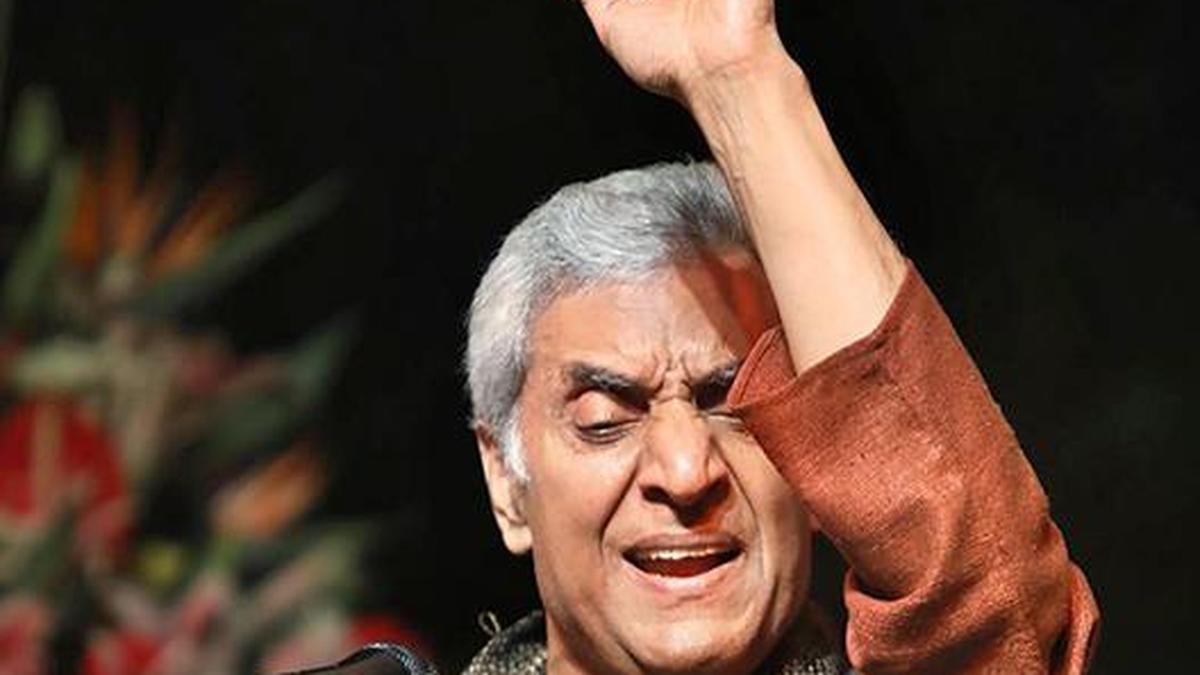
Launched in 1947, the Shankarlal Music Festival finds its formula for continuity
The Hindu
Shriram Bharatiya Kala Kendra’s Shankarlal festival showcased rare ragas, radiant artistry, and inclusive performances, from Pt Madhup Mudgal’s serene morning ragas to Ramana Balachandran’s Saraswati veena.
Enjoying music is a subjective experience, shaped by many factors — familiarity with the artiste’s work, knowledge of the genre, one’s receptivity at the moment, and even the quality of the sound system. At a large music festival, the added element of being exposed to so much music in a short span of time further alters one’s perspective. The current trend in North India of scheduling concerts for only an hour or an hour and a half, followed immediately by another and then a third, is not the most conducive way to experience music. Absorbing what one has heard is an essential part of savouring it. As such, any selection of performances is necessarily open to debate.
Pt. Madhup Mudgal created a serene ambience at his morning concert. There was no hurry, no gimmicks — just pure music. He began with raga Ahir Bhairav, a highly lyrical interpretation of the morning raag Bhairav, enriched by elements of khamach that heightened its melodious quality. The popular vilambit bandish ‘Rasiya Mharo’ was explored with gentleness.
Madhup ji’s daughter, Sawani, accompanied him in the lower register, complementing the difference in their vocal pitches, while his long-time disciple, Khushal Sharma, lent his voice in the higher notes. This contrast was particularly pleasing. One admired how the maestro resisted the current trend of prolonging the exposition to 45 minutes, as is common nowadays. Instead, he sang just enough to fully explore every nuance without unnecessary lingering.
Such restraint is becoming rare among the younger generation of vocalists, many of whom feel compelled to extend the first piece in order to establish their musical credentials.
Next, he sang raga Kukubh Bilawal, a rarity on today’s concert stage. The vilambit composition was one composed by his guru, Pt. Kumar Gandharva. This was followed by an unusual self‑composed tarana, rendered in double speed and marked by deliberate pauses between notes. Dramatic in effect and novel in gait, the piece commanded attention.
Continuing along the time scale of ragas, Madhup ji then presented raga Madhmad Sarang. His tarana, set in Ek taal and again self‑composed, was appealing and served as a fitting conclusion to the concert. He was accompanied by Shambhunath Bhattacharya on the tabla and Chinmay Kolatkar on the harmonium.


Oscars 2026 security heightened amid FBI warnings of a potential Iranian drone threat ahead of the Hollywood ceremony.

Directed by Rahul Pandey, the series also stars Naila Grewal, Nidhi Bisht, Anant Joshi, Anjum Batra and Kusha Kapila

A tribute to the versatile actor and comedian V.K. Ramasamy in his birth centenary year.

‘One Piece’ Season 2 review: As the Straw Hats enter the Grand Line, Netflix’s live-action adaptation finds its sea legs with bigger islands, stranger villains and the same stretch-happy sense of boundless adventure

Geeta Gandbhir, the Indian-origin American filmmaker is waves at this year’s Oscars with not one, but two nominations. Her documentaries, ‘The Perfect Neighbor’ and ‘The Devil is Busy’ are in the race for the Academy Award

Directed by filmmaker and environmentalist Pradip Krishen, the film follows a group of "dope-smoking, bellbottom-wearing and vaguely idealistic" final-year students racing to complete their theses.

Alan Ritchson powers through 'War Machine', a lean sci-fi action thriller on Netflix. A competent, Reacher-style chase adventure with nonstop tension and solid set pieces

Explore the Unshelving Memories exhibition in Thiruvananthapuram, showcasing diverse book art by 61 talented artists until March 15.

Oscars 2026 date and timings: Watch the 98th Academy Awards live on March 15, 2026, at 4:30 a.m. IST in India on various platforms.

The 12-day Tribal Art Festival, taking place in Delhi until March 13, brings together more than 75 tribal artists and over 1,000 artworks representing more than 30 tribal art traditions.

Tom Cruise wins Best Actor at the 2026 Saturn Awards, while 'Avatar: Fire and Ash' takes home multiple major honors.

The new God of War is a coming-of-age story that builds Kratos into the formidable warrior seen in later games

Rachel Weisz dazzles in Vladimir, a sharp, sexy Netflix mini‑series that probes power, desire, and academia in eight smart, bingeable episodes