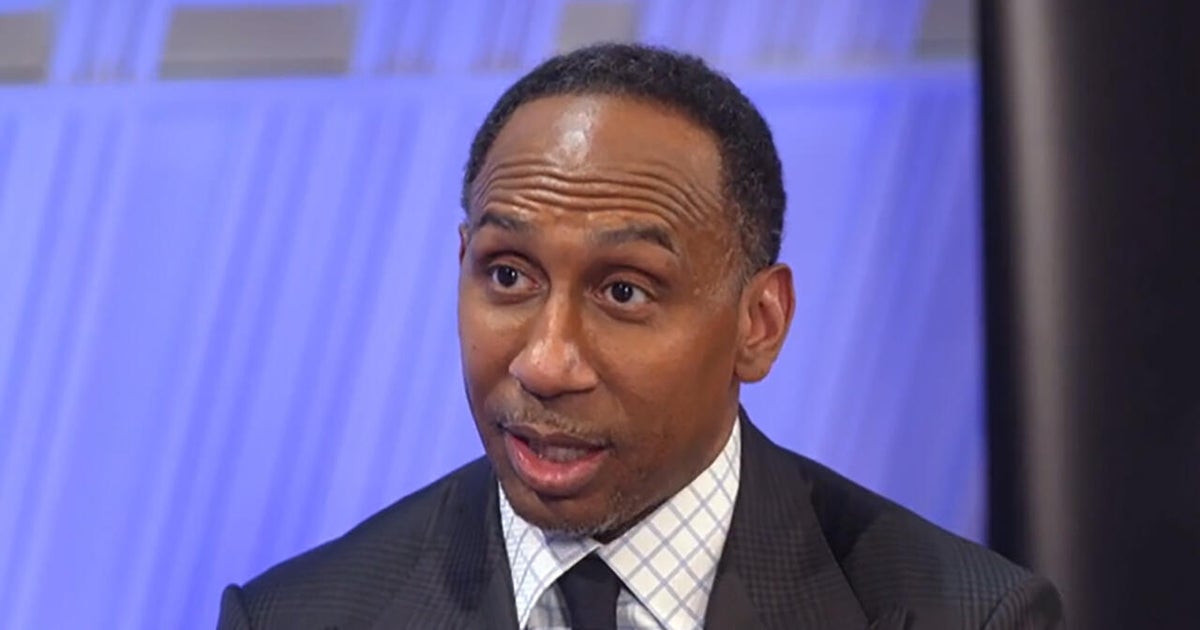
Stephen A. Smith: Always up for a debate
CBSN
These days, Stephen A. Smith is everywhere – on the sidelines, at the games, and of course all over TV. His swaggering sports talk has made him a superstar at ESPN, a modern-day Howard Cosell with a multi-million dollar media empire.
These days, Stephen A. Smith is everywhere – on the sidelines, at the games, and of course all over TV. His swaggering sports talk has made him a superstar at ESPN, a modern-day Howard Cosell with a multi-million dollar media empire.
Smith begins each weekday morning with his popular cable show, "First Take." The set is his court. "We do want to one-up one another along the way," he said, "and when you want to one-up somebody, that's competition, and that's what makes it go
"The key, for us, is to be authentic; don't fake it" he said. "I'm talking about making sure that it's not choreographed. You're not just saying something just to be saying it."
Sports fans like to keep the conversation going. "Remember, the typical stars, they people want your picture, they want your autograph," said Smith. "Me, they want a debate. They want the pictures, too, but they want a debate. There's no such thing as, 'Love you, man, can I get a picture with you?' and that's it. It's, 'Man, did you really mean that about the Knicks? How could you say that about the Cowboys?'"
Smith grew up in the working-class neighborhood of Hollis, Queens, in New York City. His mother, a nurse who worked 16-hour shifts, encouraged him as he struggled with dyslexia …. and with his father. "My father said that I was a lost cause," said Smith. "My father was the one who told my mother, 'He's just not smart.'"


The story of America can be told through the lyrics of folk music – songs of the Great Depression, the civil rights era, and the social revolutions of the 1960s. As folk singer Pete Seeger put it in 1967, "A song isn't a speech; a song is not an editorial. If a song tries to be an editorial or a speech, often it fails as a song. The best songs tell a story, paint a picture, and leave the conclusion up actually to the listener."