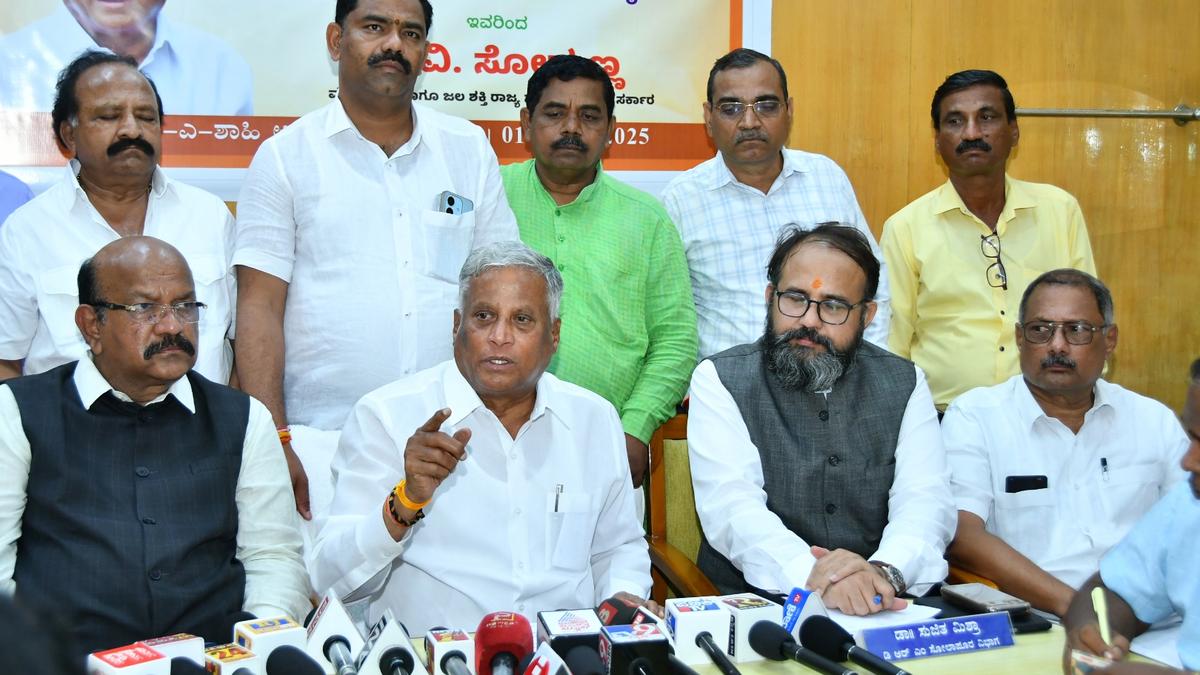
Somanna slams Siddaramaiah for implicating farmers opposing Hemavathi link canal project
The Hindu
Minister criticizes Siddaramaiah, condemns State government for political favoritism, and highlights railway projects in Karnataka.
In a sharp political swipe, Minister of State for Railways V. Somanna on Sunday criticised Chief Minister Siddaramaiah saying he has become like “a train that missed the village station.”
“The old Siddaramaiah is lost. He may take 10 steps forward, but then retreats 50 steps backward under pressure,” he said, while responding to media questions in Kalaburagi about the Hemavati Link Canal Project in Tumakuru.
Accusing the State government of stagnation and political favouritism, the Central Minister condemned the Congress government for implicating farmers who are opposing the project.
“The State government is acting like stagnant water, trying to appease some while punishing others unjustly. Why are poor farmers being targeted with criminal cases? What wrong have they done? The State government should stop harassing people. Officials who once declared the project unfeasible are now saying it’s possible, just to protect their positions,” he said urging the State government to work with Central irrigation experts to resolve issues on technical merit.
Speaking on railway projects in Karnataka, Mr. Somanna said that works worth ₹7,654 crores have been announced in budget for 2025-26.
“During the UPA government, Karnataka got an insignificant amount for railway projects. Now, the amount has crossed ₹7,000 crore. Vande Bharat Express trains are already running across 13 districts in the State. There have been requests to run Vande Bharat trains between Mangaluru and Bengaluru and Belagavi and Bengaluru. These services will be launched shortly,” he said.
Acknowledging concerns that rail services are becoming increasingly skewed toward upper class passengers due to the focus on air-conditioned coaches, Mr. Somanna said that Indian Railways will soon introduce 10,000 new general class coaches to better serve the needs of common passengers and address overcrowding in trains across the country.


Karnataka's Health Minister announces redeployment of specialists to taluk hospitals to reduce neonatal mortality rates effectively.

Celebrate IPL's start and Polly Umrigar's legacy, reflecting on cricket's evolution and the enduring impact of its pioneers.

BJP accuses Congress and Rahul Gandhi of endorsing an ‘anti-India’ USCIRF report undermining India's global image.

Education Ministry proposes UGC-like funding under Shiksha Adhishthan, raising concerns about centralization and public university financing.

Shivraj Singh Chouhan defends the new rural jobs Act, dismissing opposition protests as ineffective and highlighting increased funding and worker protections.

Supreme Court questions why heirs can't access unclaimed funds of deceased depositors, urging government to develop a disclosure policy.

Karnataka High Court demands LPG supply details amid state restrictions, threatening Bengaluru's restaurants and livelihoods.

Shorts News:UN body investigating deadly strike on Iranian girls school

Moodbidri police inspector suspended pending inquiry over allegations of misbehaviour and inappropriate conduct towards women.

The State currently hosts more than 880 GCCs, up from around 500 GCCs in 2021.

Transgender and intersex activists march to Lok Bhavan, protesting the regressive Transgender Persons Bill and demanding its withdrawal.

Hyderabad's LGBTQIA+ community opposes the Transgender Amendment Bill, stressing dignity over identity verification and highlighting economic and medical concerns.

MDMK's manifesto demands total prohibition, life imprisonment for sexual offenders, and measures to protect youth and improve public transport in Tamil Nadu.