Seen on OTT: What TheTwo Popes reveals about the lost dialogue in Indian academia Premium
The Hindu
In an academic climate where there is no space for ideas to clash and grow, ‘The Two Popes’ shows what true dialogue could look like.
Robert Francis Prevost became the first pope from the United States on Thursday (May 8, 2025), picking the papal name Leo XIV after cardinals from around the world elected him as the 267th pope of the world’s 1.4 billion Catholics. This was following Pope Francis’ death on April 21. After decades of conservative leadership of the Roman Catholic Church that culminated in the papacy of Pope Benedict XVI, Pope Francis, the first Latin American leader of the church, had sought to promote inclusion and care for the marginalised over doctrinal purity.
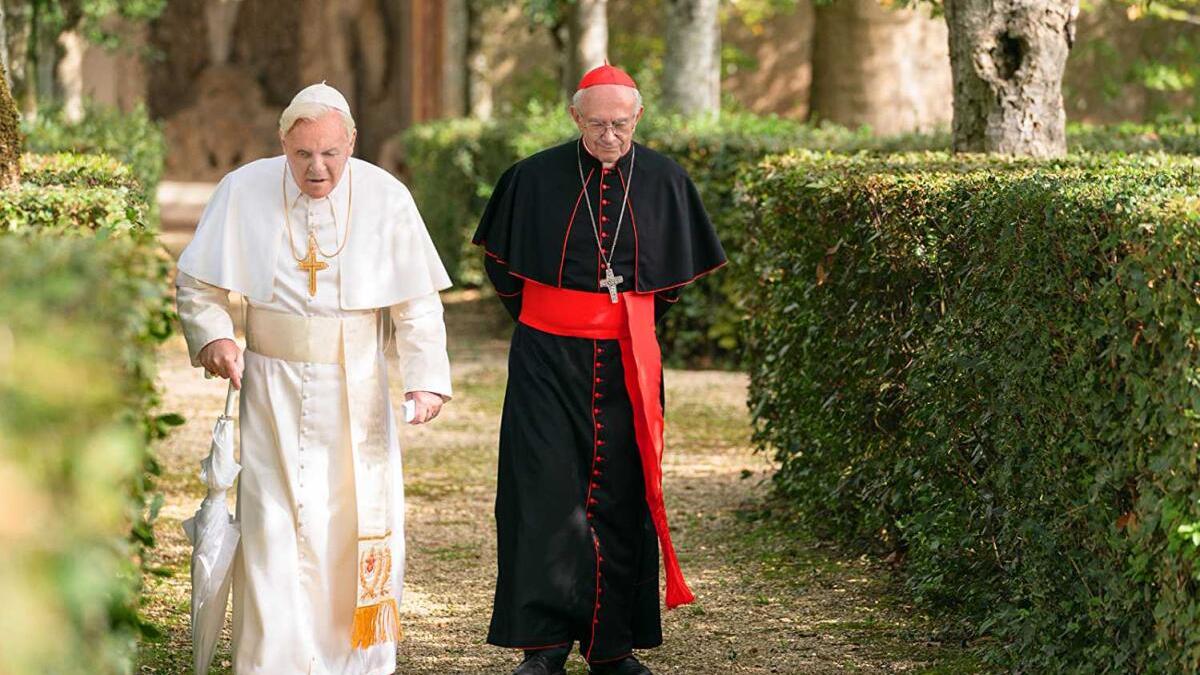
Against this backdrop, I watched the movie The Two Popes (2019) on OTT. Taking us behind the Vatican walls, the movie rewinds to the final days of Pope Benedict XVI, where the conservative Pope Benedict XVI and the liberal future Pope Francis must find common ground to forge a new path for the Catholic Church. Inspired by true events, the movie shows a fictitious dialogue between the two popes. Though their views are poles apart, there is space for an open dialogue.
After the Vatican leaks scandal marred the Catholic Church in controversy, Jorge Mario Bergoglio (later known as Pope Francis) submitted his resignation as the Archbishop. Bergoglio, who was also in line to become Pope, had received the second-highest votes after Pope Benedict. Perceiving Bergoglio’s resignation as a threat to the Church, Pope Benedict invites him to the Palace of Castel Gandolfo. At the castle, the two popes converse about homosexuality, communion of the divorced, and more. “You have been one of my harshest critics, there’s a lot of competition for that title”, Pope Benedict says to Bergoglio, as their views never align.
Pope Benedict asks Bergoglio about him openly giving sacraments to those who are out of communion, to the divorced. Bergoglio says, “Oh, I believe giving communion is not a reward for the virtuous, it is food for the starving”. Pope Benedict then questions him, whether his personal beliefs matter more than what the Church has taught for hundreds of years. To that, Bergoglio cites scriptures, “I came to all sinners”. They have a back and forth on the idea of mercy. Bergoglio has the final word: “Mercy is dynamite that blows down walls.” Instead of taking offence, Pope Benedict says, “You have an answer for everything… you are far too clever”.
In many scenes such as these, the movie showed these two religious leaders with opposing views navigating each other’s thoughts, even though they fundamentally disagreed with each other. They were listening, challenging, reflecting, and even becoming friends as a consequence of the dialogue, apparently.
Dialogue has now become a rarity in the Indian context, even in universities and academia. Universities are supposed to be spaces that foster critical thinking, where ideas should clash and grow, where students and teachers question and disagree, but still talk and learn.
Far from this ideal picture, there has been a lot of talk about the loss of academic freedom in India. Over the past 10 years, India has plummeted on the academic freedom index ranks, according to the “Free to Think 2024” annual report published by the Scholars at Risk (SAR) Academic Freedom Monitoring Project. According to the Academic Freedom Index, India now ranks as “completely restricted”, its lowest score since the mid-1940s.


Written and directed by Kunal, the film also stars Sparsh Shrivastava and Vanshika Dhir

This year, Bharatnatyam artistes will present the Tyagaraja Aradhane as a dance performance

This year, Bharatnatyam artistes will present the Tyagaraja Aradhane as a dance performance

The actor, along with director Sushant Shah, speak about their upcoming series ‘Chiraiya’, Divya’s process of working on the dialect, Sushant’s approach to telling a story about women, and more

An independent video, ‘Feel the Spark’ by Raleigh Rajan with vocals by Ciera Dumas that celebrates Tamil literary giants, garnered 1.4 million views in less than 36 hours.

In ‘Jack Ryan: Ghost War’, John Krasinski is back as the savvy CIA analyst, diving headfirst into a high-stakes mission that unravels a deadly conspiracy and pits him against a rogue black-ops unit

Shriram Bharatiya Kala Kendra’s Shankarlal festival showcased rare ragas, radiant artistry, and inclusive performances, from Pt Madhup Mudgal’s serene morning ragas to Ramana Balachandran’s Saraswati veena.

Explore "Threads that Bind: The Kantha Project," an exhibition in Delhi reimagining kantha as a medium of repair and renewal.

Sean Penn skips the Oscars to meet Ukraine's Zelenskyy, who praises him as a "true friend" amid the war.

The teaser of Tamil star Suriya’s much-awaited film with director Venky Atluri, titled Vishwanath and Sons, was unveiled by the makers on Monday

A 'Golden' moment for a K-pop track at the Oscars.

Parvathi Nayar’s new exhibition, The Primordial, in Mumbai, traces oceans, pepper and climate change
Opened on March 12, the exhibition marks the artist’s first solo show in Mumbai in nearly two decades. Known for her intricate graphite drawings and multidisciplinary practice spanning installation, photography, video, and climate change, her artistic journey has long engaged with the themes of ecology, climate change and the natural world. In this ongoing exhibition, these strands converge through a series of works centred on water, salt, and pepper — materials that carry natural and historic weight across centuries.

Explore the highlights and key winners of the 98th Academy Awards, featuring memorable moments and historic achievements from Oscars 2026.