Scientists rewire bacteria to build ‘designer’ proteins on demand Premium
The Hindu
Scientists have engineered bacteria to produce designer proteins by smuggling artificial amino acids, enabling precise drug delivery and multifunctional applications.
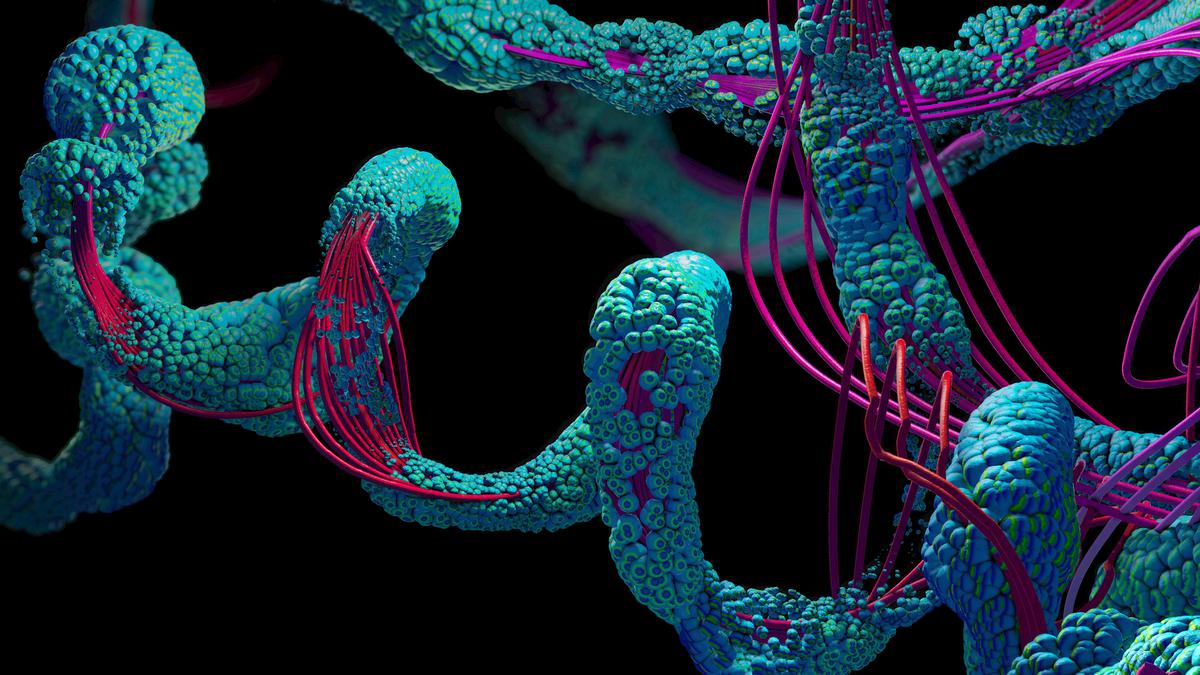
Researchers have found a way to hijack the natural protein-making facilities of bacteria to manufacture specific proteins of interest. They did this by turning a ‘nutrient gate’ on a bacterial cell into a Trojan horse that could ferry artificial amino acids into cells to make these proteins.
The study, conducted by teams at ETH Zurich in Switzerland and the Technical University of Munich in Germany, was published in Nature.
All proteins are made of some combination of the 20 natural amino acids. In the lab, chemists can also synthesise thousands of artificial amino acids, many of which have completely new properties. For example, if an amino acid called p-azido-L-phenylalanine can be built into a protein, it would allow scientists to attach drugs to the protein at a precise spot, helping it treat some disease.
The challenge however has been to get cells’ protein-making machines to use these artificial amino acids.
In the 1980s, Peter Schultz and his colleagues at the University of California, Berkeley, laid the foundations of incorporating artificial amino acids into proteins at specific sites. Over the years, scientists have expanded this toolkit to incorporate artificial amino acids in proteins that cells make.
Yet one problem has persisted: the struggle to get enough artificial amino acids into the cell. Most lab-made amino acids struggle to cross the cell membrane and enter the cytoplasm, where the ribosomes synthesise proteins. This is because the side chains on artificial amino acids are very water-loving whereas the core of the cell-membrane is water-repelling.


The boundaries between clinical care, data science, and tech are fast dissolving, making way for a new blueprint for healthcare education

Marilyne Andersen emphasises the need for scientists and diplomats to collaborate on governance frameworks for emerging quantum computing technologies.

American-Italian restaurant chain, operated by Gourmet Investments in India, Olive Garden opens in Delhi NCR in April, bringing its signature pastas, breadsticks and casual dining format to the region

The Audi A8L Security turns a luxury limousine into a rolling fortress. With advanced ballistic protection, specialised safety systems and the comfort of Audi’s flagship sedan, it is engineered to keep its occupants secure without compromising on performance or refinement.

On the captivating wonders of the natural universe beyond human narratives in science journalism.

Explore how fungi can transform carrot waste into nutritious edible products, enhancing sustainability and food security.

Inside the Arctic cabin of Hilde Fålun Strøm — 19 months, 104 polar bears, and a call to save the planet

From artsy laneways to top-class culinary hotspots; here is what makes Melbourne ideal for the opening round of the 2026 F1 World Championship

Test your knowledge with a quiz on historical 'heretics' who challenged beliefs and changed the world.

West Asia flight disruptions: Stranded Indians in Dubai, Doha and Jordan share stories of uncertainty and support

IISc and Pratiksha Trust launch a groundbreaking project to develop AI-powered brain co-processors for stroke rehabilitation.

India must revamp its PhD programs to prioritize practical innovation and societal relevance over traditional publication metrics.

India must revamp its PhD programs to prioritize practical innovation and societal relevance over traditional publication metrics.