Scientists, diplomats should discuss evolution of quantum computing: Marilyne Andersen Premium
The Hindu
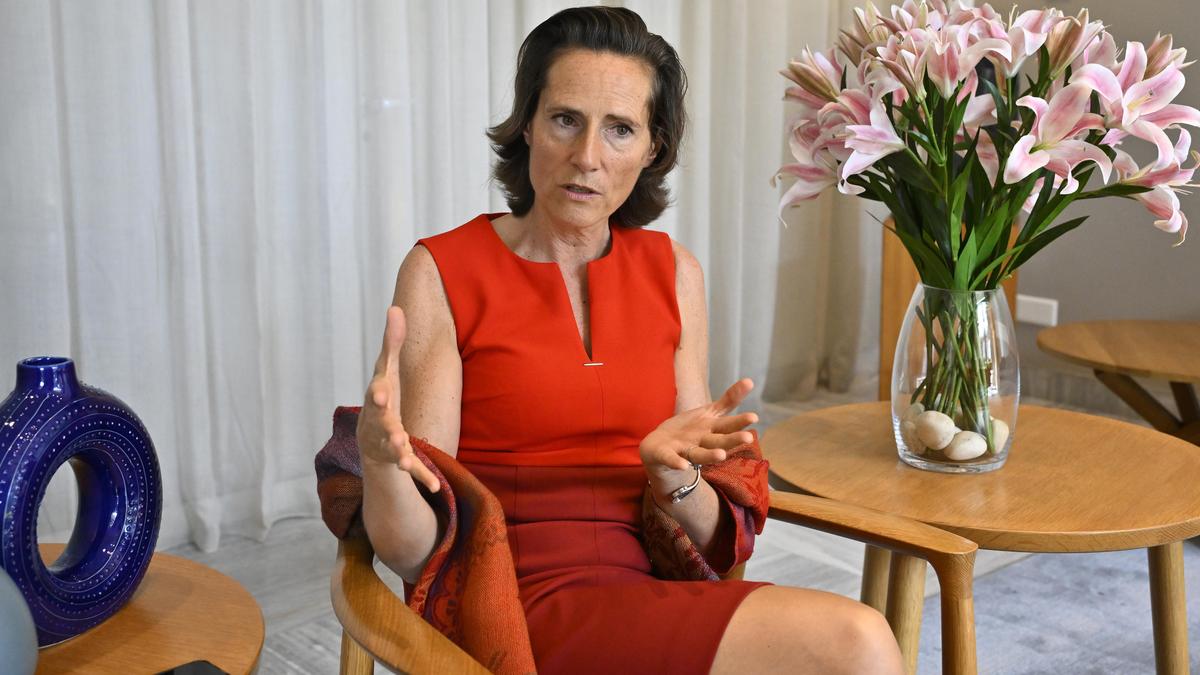
Marilyne Andersen emphasises the need for scientists and diplomats to collaborate on governance frameworks for emerging quantum computing technologies.
Quantum computing is in a nascent stage of development and therefore this is a time that experts in the field and scientists should be engaging with diplomats to be able to form governance frameworks, partnerships, coalitions, international collaboration, and be “concretely ready” when the technology matures, Marilyne Andersen, director general, Geneva Science and Diplomacy Anticipator (GESDA), said in an interview.
Quantum computing refers to computers that use an entirely different non-binary architecture from conventional computers and thus can exponentially accelerate calculation, but at the same time threaten cybersecurity measures, which are premised on binary 1’s and 0’s architecture.
Ms. Andersen, who was a participant at the ongoing Raisina Dialogue here, met India’s Principal Scientific Adviser (PSA), Ajay Sood, on Friday along with members of the PSA office and around 60 representatives from science, government, diplomacy, business and civil society to “anticipate and govern emerging scientific and technological breakthroughs,” according to a press statement from the Swiss Embassy.
“As technology matures and disruption occurs, a governance gap becomes visible…this conventional reactive cycle served us adequately in eras when the pace of change was measured in decades. However, it is no longer adequate. are not distant abstractions. The governance choices we make in the next decade will determine the effectiveness with which technologies such as quantum computing, artificial general intelligence will serve humanity,” Prof. Sood said in a statement.
Ms. Andersen, who was formerly a professor at the Massachusetts Institute of Technology, Boston and the Swiss Federal Technology Institute of Lausanne (EPFL), said scientists weren’t always able to forecast the course of technology as they, like other humans, thought “linearly rather than exponentially.” However because scientific funding cycles usually worked in 5 or 10-year cycles, they did have a deeper insight into the stage of development of certain fields. Around 2021, the scientific community was largely confident of the emergence of something like GPT3 — the Generative Pre-Trained Transformer-3 (by OpenAI with its 175 billion-parameters).
“What they didn’t anticipate was that someone would put it out in the open — the ‘chat’ aspect of it. Many didn’t want to do that because they knew that once it is out in the general population it is a whole new game. So while scientists can’t precisely forecast, being experts and participants at conferences at the cutting edge of their science, they have a special voice,” she explained.


Witness the blood moon during the lunar eclipse day in India and other countries, through pictures here.

Discover the fascinating world of hydroxyl megamasers, powerful cosmic lasers revealing secrets of distant galaxies and the universe's evolution.

Discover how India's unique resources could lead to groundbreaking advancements in global cancer care and research.

Discover groundbreaking research on Mars lightning, innovative smart materials, and a universal ageing marker in just one minute.

A launch vehicle’s ascent battles gravity to gain orbital velocity, while re-entry is a controlled struggle against the atmosphere to systematically shed that immense kinetic energy through aerobraking, thermal protection and precise guidance within the re-entry corridor. Operating as a semi-ballistic body, the crew module performs a deorbit burn, manages communication blackout, and deploys a three-stage parachute system to ensure a safe splashdown.

The Nissan Gravite is a budget-friendly seven-seater MPV designed for practical family use in India. Sharing its platform with the Renault Triber, it offers flexible 2-to-7 seating, a removable third row, generous boot space, and a fuel-efficient 1.0-litre petrol engine delivering around 19 km/l. With features such as a floating touchscreen, wireless connectivity, digital instrument cluster, and six airbags as standard, the Gravite blends affordability, safety and everyday usability in a compact footprint tailored to urban and small-family needs.

Discover the dedication of Tamil Nadu's teenage cyclists competing at the Track Asia Cup, balancing sport and academics.

Explore how Salar de Pajonales in Chile serves as a vital Mars analogue for studying microbial life and ancient fossils.

NASA revamps its Artemis lunar program to address delays and ensure a Moon landing by 2028.