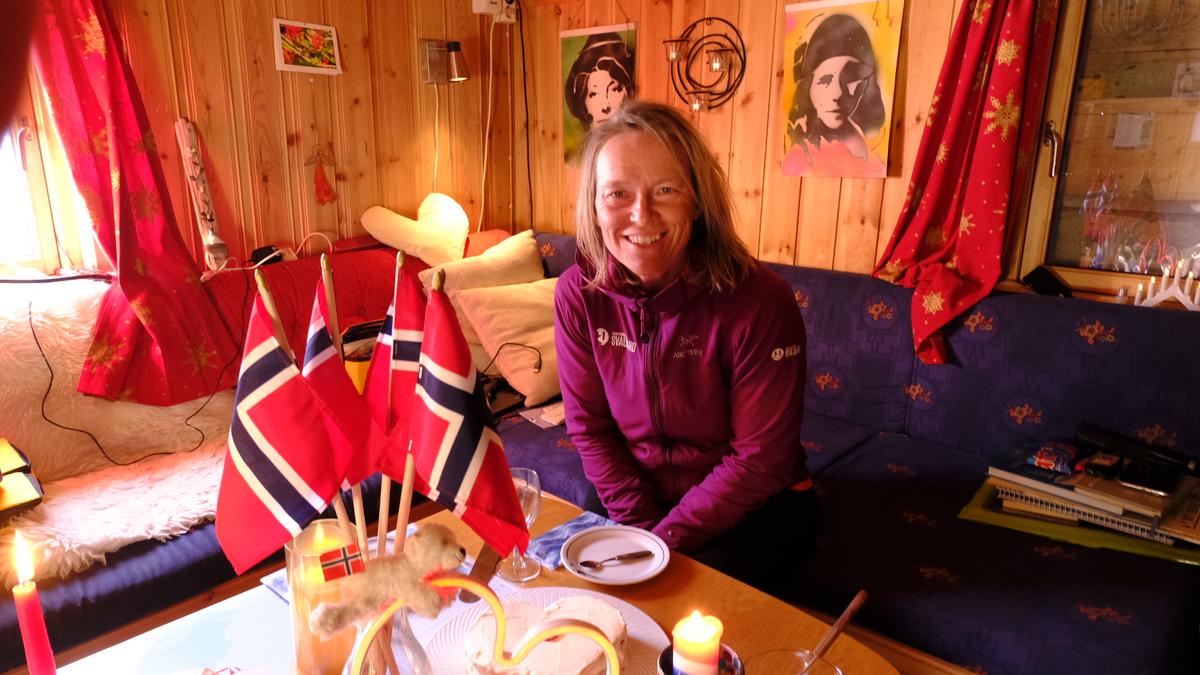
Meet the woman who’s on a climate mission to the North Pole
The Hindu
Inside the Arctic cabin of Hilde Fålun Strøm — 19 months, 104 polar bears, and a call to save the planet
It isn’t every day someone casually mentions they are heading back to a cabin near the North Pole. Yet, that is exactly what 57-year-old Hilde Fålun Strøm, a citizen scientist based in Longyearbyen, the world’s northernmost town, told me when we met last year in the frozen archipelago of Svalbard.
Norwegian by nationality, Strøm grew up outside Oslo in a family that spent long days outdoors. Her passion for the Arctic began in childhood and deepened after she moved to Svalbard in 1995, where she lives with her husband Steinar, who works for Statsbygg and oversees properties owned by the Longyearbyen government. The two have lovely grandchildren.
An explorer, polar ambassador and climate advocate, Strøm runs Svalbard Expeditions and is the co-founder, with Sunniva Sorby, of Hearts in the Ice, a pioneering citizen-science initiative. She advocates for Arctic protection through global platforms such as COP26 and contributes to projects like Arctic Call, an Inuit-led summit integrating traditional knowledge with modern climate monitoring. This year, it is slated for September 11-15.
When I visited the region, it was early spring, and Svalbard was buried under snow. The sun didn’t set at all, yet no trees grew. The starkness felt almost extraterrestrial, and yet inviting. No wonder it held Strøm so firmly.
Reindeers of Longyearbyen. | Photo Credit: Courtesy Hilde Fålun Strøm
“When I return from the cabin,” she told me, “it is never with stories of solitude or survival. It is always science, encounters with polar bears, and a kind of happiness I cannot quite describe.” Bamsebu, the cabin, is a 20 sq.m structure built in 1930 for summer beluga hunting. There is no insulation, electricity or plumbing. “No heating either, unless you count the wood stove,” she said. “I have been collecting driftwood for years.”


Witness the blood moon during the lunar eclipse day in India and other countries, through pictures here.

Discover the fascinating world of hydroxyl megamasers, powerful cosmic lasers revealing secrets of distant galaxies and the universe's evolution.

Discover how India's unique resources could lead to groundbreaking advancements in global cancer care and research.

Discover groundbreaking research on Mars lightning, innovative smart materials, and a universal ageing marker in just one minute.

A launch vehicle’s ascent battles gravity to gain orbital velocity, while re-entry is a controlled struggle against the atmosphere to systematically shed that immense kinetic energy through aerobraking, thermal protection and precise guidance within the re-entry corridor. Operating as a semi-ballistic body, the crew module performs a deorbit burn, manages communication blackout, and deploys a three-stage parachute system to ensure a safe splashdown.

The Nissan Gravite is a budget-friendly seven-seater MPV designed for practical family use in India. Sharing its platform with the Renault Triber, it offers flexible 2-to-7 seating, a removable third row, generous boot space, and a fuel-efficient 1.0-litre petrol engine delivering around 19 km/l. With features such as a floating touchscreen, wireless connectivity, digital instrument cluster, and six airbags as standard, the Gravite blends affordability, safety and everyday usability in a compact footprint tailored to urban and small-family needs.

Discover the dedication of Tamil Nadu's teenage cyclists competing at the Track Asia Cup, balancing sport and academics.

Explore how Salar de Pajonales in Chile serves as a vital Mars analogue for studying microbial life and ancient fossils.

NASA revamps its Artemis lunar program to address delays and ensure a Moon landing by 2028.