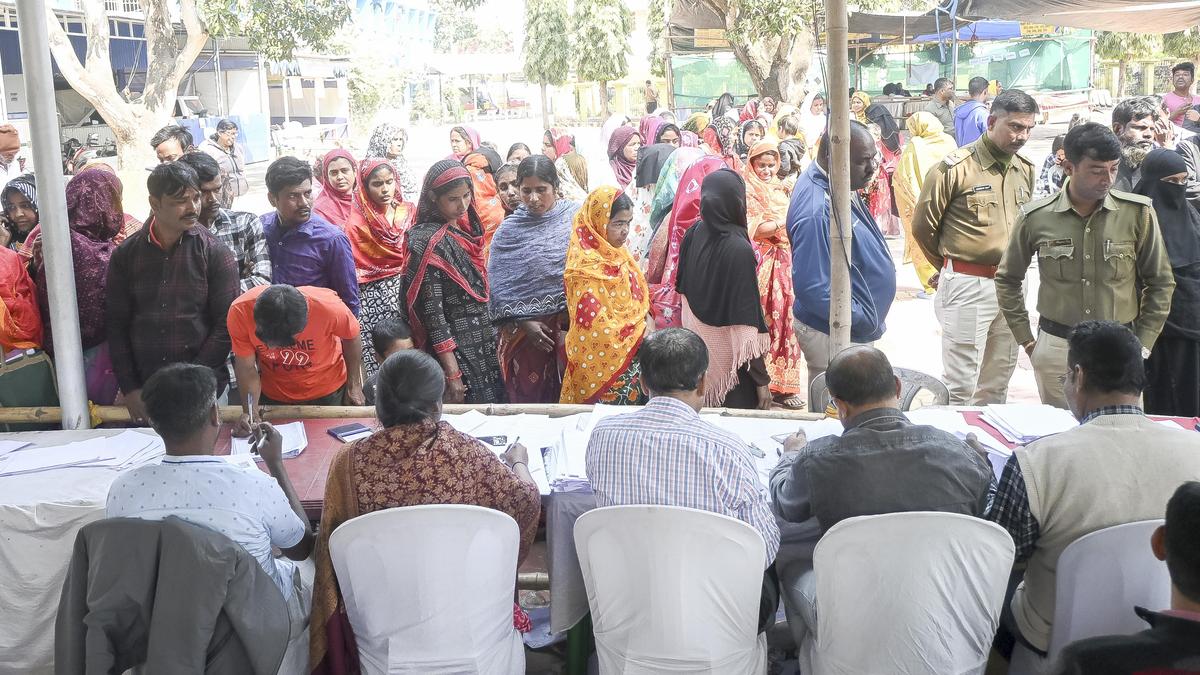
People raised in State-run orphanages and charity homes struggle with SIR rules on parent mapping
The Hindu
State-run orphanage residents face challenges with SIR rules on parent mapping, risking disenfranchisement without proper documentation.
Md. Palash Shekh is in a fix. Rescued from a railway station and brought up in the government-run Subhayan Home for Boys in West Bengal’s Dakshin Dinajpur district, he had to leave the shelter once he turned 18. He has a voter ID card and an Aadhaar card proving his own identity, but has no way to provide any evidence of his parents, as required for the Special Intensive Revision (SIR) of electoral rolls currently underway in West Bengal and 11 other States and Union Territories.
Unable to “map” either of his parents to the voters’ list of 2002, when the last SIR was carried out, Mr. Shekh falls into the “unmapped” category, and has now got a hearing notice from poll officials.
With no lineage to claim in the SIR, it is up to the State to provide him with the necessary documentation, he says, failing which he might be disenfranchised.
According to SIR rules, those born between 1987 to 2004 need to furnish their own documents as well as that of one of their parents, while those born after 2004 need to show their own documents as well as those of both their parents if they are unmapped. Even if someone wants to register as a fresh voter by filling Form 6, a separate declaration has to be signed regarding the mapping of parents to the 2002 list.
Many people like Mr. Shekh who were brought up in State-run orphanages and charity homes are now facing the same conundrum, with no way to map their parents as required by the rules. Most wards of the State had to leave their shelter homes once they turned 18, and either have no parents or relatives or are not in touch with them.
According to a 2016 study by the Ministry of Women and Child Development, there are approximately 9,500 child care institutions (CCIs) in India (including government-run homes and NGO-supported homes), housing nearly 3.7 lakh children at any given time. Every year, thousands of “Care-Leavers” turn 18 and transition out of these homes.


The DMK and Congress finalize a crucial seat-sharing deal thanks to key negotiations by Kharge, Chidambaram, Kanimozhi, and Karti.

Justice Swaminathan allows time for the Thirupparankundram temple trustees to respond to his suggestion regarding Karthigai Deepam prayers.

New Zealand secures a dominant T20 World Cup final spot, led by Finn Allen's explosive century against South Africa.

Central government allocates ₹64 crore for PM Ekta Mall project in Puducherry, promoting local artisans and crafts.

Farmers demand NAFED procurement of maize to secure Minimum Support Price amid declining market rates.

Four workers fainted from toxic gas exposure at a Ranipet effluent treatment plant; all are now stable after treatment.

Textiles Minister inaugurates ₹35 crore Bypass Road in Ranipet, enhancing traffic flow and connecting key highways for efficient travel.

P. Sibin takes charge as the new Superintendent of Police for Ranipet, succeeding Ayman Jamal.

Jagriti Theatre brings the sixth edition of their annual Morning Raag concert series back to the city this weekend

Karur inaugurates a new ₹2.4 crore swimming pool at Government Higher Secondary School, enhancing local sports infrastructure for aspiring swimmers.

Protests in West Bengal escalate over electoral roll issues, prompting Chief Minister Mamata Banerjee to plan a dharna against the SIR.

Palestinian envoy criticizes military dominance in Iran-U.S. conflict, calling it "jungle law" that undermines future for vulnerable nations.

AIADMK renominates veteran Thambi Durai for Rajya Sabha; PMK receives an additional Upper House seat allocation.