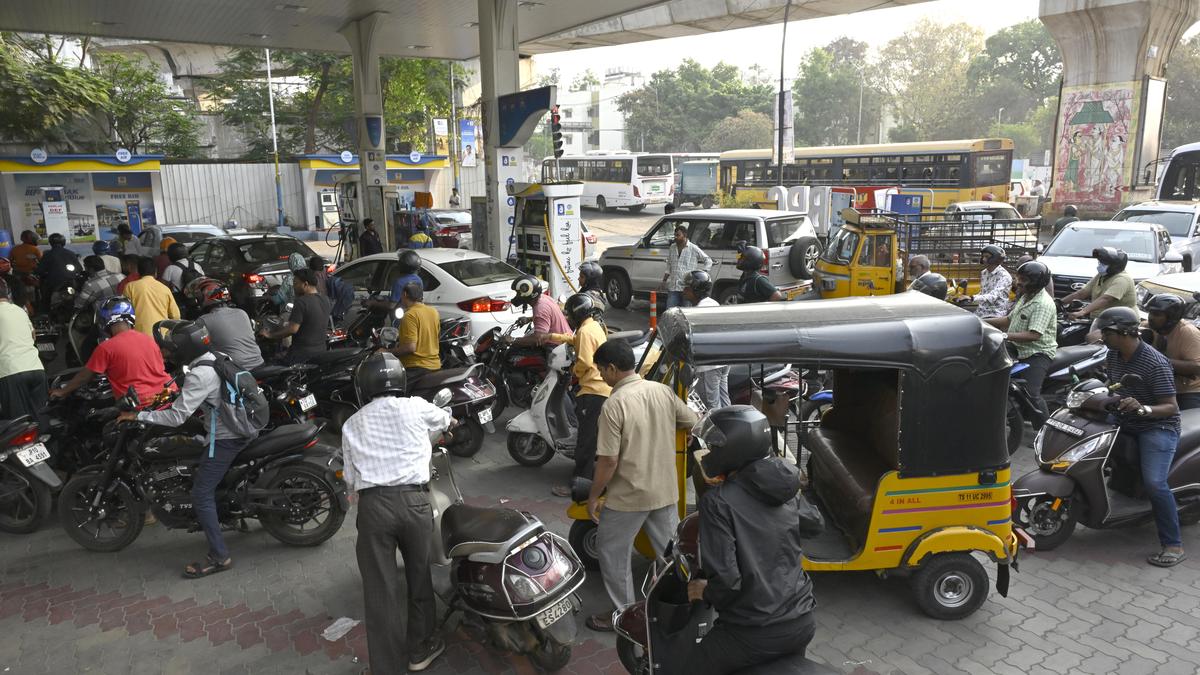
Panic over fuel supply chokes Hyderabad roads on March 25, traffic grinds to a crawl during morning rush hour
The Hindu
Fuel supply panic causes severe traffic congestion in Hyderabad on March 25, 2026, prompting police intervention to manage long queues and road chaos.
Long queues to refill vehicles with fuel spilled aggressively onto Hyderabad’s main roads by Wednesday (March 25, 2026) morning, turning key stretches into bottlenecks and forcing traffic police into continuous on-ground regulation to keep the city moving.
As vehicles crowded around petrol pumps and extended onto carriageways, peak-hour traffic slowed sharply across several junctions. The police personnel worked to compress the swelling lines into single-file or two-line queues, attempting to carve out space for traffic even as the volume continued to build.
The impact was most visible along the Old Mumbai Highway in Raidurgam, a crucial IT corridor that handles heavy office-hour traffic. The stretch from the Cyberabad Commissionerate office towards Care Hospitals near the Biodiversity Park junction resembled a parking lot rather than a moving roadway. Service lanes were completely saturated, while two to three lanes on the main carriageway were taken over by vehicles waiting to refuel, leaving only narrow gaps for moving traffic.
According to Raidurgam Traffic Inspector Pavan Mayasa, the situation began deteriorating late Tuesday night, particularly along the Lemon Tree stretch, where queues extended up to the IKEA underpass as well as near the Gachibowli U-turn towards Indira Nagar. Despite attempts by the traffic personnel to temporarily halt operations at some pumps to ease congestion, resistance from both customers and fuel station operators meant the queues continued to grow.
In Gachibowli, the traffic police maintained a near round-the-clock presence, regulating waiting motorists and enforcing queue discipline. Vehicles were allowed towards fuel dispensers in a controlled manner, with officers ensuring that the lines did not completely choke the junction.
The problem was not limited to arterial roads in the city. In several areas, especially those with narrow roads, queues that began at petrol pumps quickly stretched into adjoining streets. With customers arriving as early as 4 a.m., by daybreak the pressure had already built up, leaving little room for normal traffic to function.


Karnataka Minister announces efforts to resume separate Haj terminal at Mangaluru airport, pending Centre's approval.

Ahead of the Assembly election, DMK Youth Wing secretary and Deputy Chief Minister Udhayanidhi Stalin has tasked the party youth wing members with meeting young voters every day till the polling day to explain various achievements of the ‘Dravida model government’ to them.

Bird flu outbreak in Chhattisgarh's Bilaspur kills 4,400 chickens, prompting increased surveillance and culling measures.

Four queer activists discuss the repercussions of the Trans Amendment Bill 2026 on dignity and identity within the community.

Explosion in Ooty's Botanical Garden highlights Tamil Viduthalai Padai's protest against Hindi imposition and demand for Tamil Eelam.

Assembly polls 2026: Follow updates from The Hindu on the upcoming elections in five States on March 25, 2026

Royapuram faces urgent issues like livelihood security, affordable housing, and social welfare as residents prepare for the assembly election.

Long queues at Hyderabad fuel stations persist on March 25, 2026, as motorists face delays

ChatGPT maker OpenAI is offering private-equity firms a sweeter deal than rival Anthropic as both artificial intelligence companies court buyout firms to form joint ventures

Opposition parties criticize Delhi's budget as inflated and misleading, questioning transparency and funding for key initiatives.

Srirangam residents seek improved infrastructure and amenities to support rapid urbanization and growing tourism demands in the constituency.

Alandur faces unresolved civic infrastructure issues, including lack of water and drainage, despite recent development efforts ahead of TN Election 2026.

Delhi's fiscal deficit surged by 62% in 2025-26, reflecting revenue declines and raising concerns about the city's economic health.