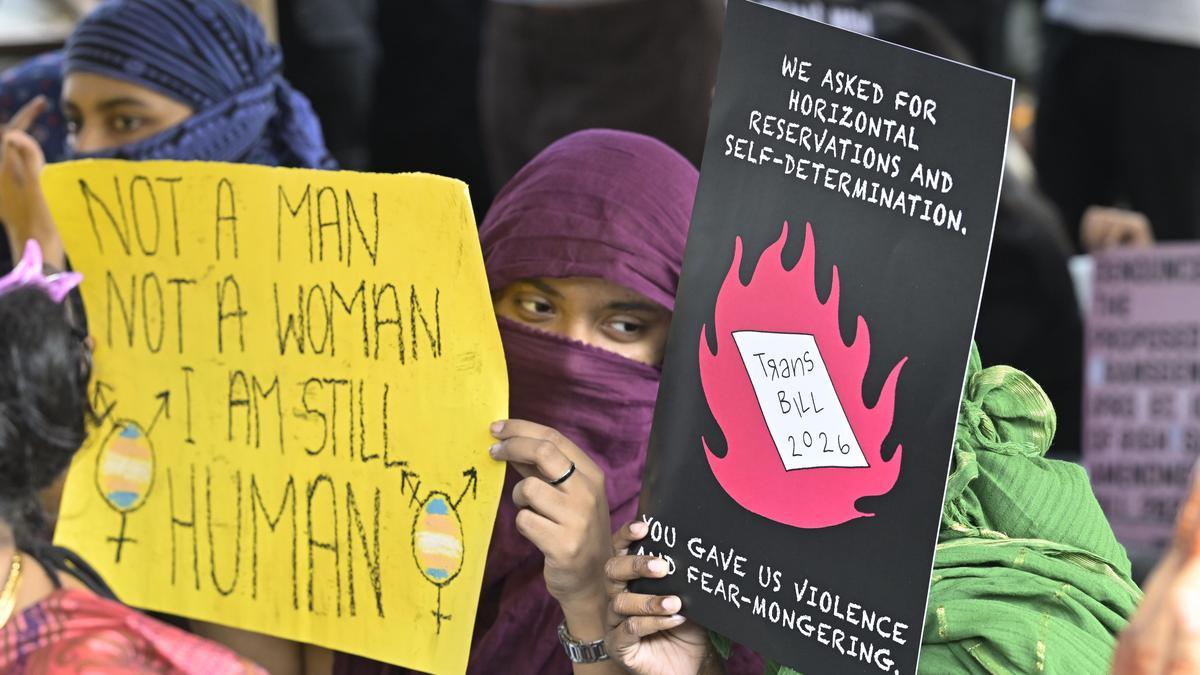
Opposition MPs, activists oppose amendments to Transgender Persons Act
The Hindu
Opposition MPs and activists voice strong concerns against proposed amendments to the Transgender Persons Act at a Delhi hearing.
Members of Parliament and officials of political parties from across the country on Sunday (March 22, 2026) spoke out against the Union government’s Bill to amend the Transgender Persons (Protection of Rights) Act, 2019, which proposes to remove the right to a self-perceived gender identity and introduces the requirement for a medical board to determine whether a person is transgender based on a new definition of “transgender person”.
At a public hearing held at the Press Club of India, Rajya Sabha MPs from the Rashtriya Janata Dal, Indian National Congress, and the Communist Party of India (Marxist) spoke against the Bill and said that there was an attempt to coordinate a strategy to oppose it within Parliament. However, Manoj Kumar Jha, MP from the RJD, said, “This government is only afraid of the streets,” even as Renuka Chowdhury said that it would be an “uphill battle”. John Brittas said that while no formal meeting of political parties had taken place over the strategy to oppose the Bill, it is expected to be taken up in the next meeting of Opposition Parliamentarians.
At the public hearing, Congress leader Sandeep Dikshit was also present along with Anish Gawande, national spokesperson of the Nationalist Congress Party. Both opposed the Bill.
The Bill was introduced in the Lok Sabha on March 13 by Union Social Justice Minister Virendra Kumar. It proposes to redefine a “transgender person” and remove a section that currently recognises transgender people’s right to a self-perceived gender identity.
In the Bill, the government said the “existing vague definition” of transgender persons had made it “impossible to identify the genuine oppressed persons to whom the benefits of the Act are intended to reach”. It added that the purpose of the law was never to protect “persons with various gender identities, self-perceived sex/gender identities or gender fluidities”. It said the policy “was and is” to protect “only those who face severe social exclusion due to biological reasons for no fault of their own and no choice of their own.”
The Bill also introduces the terminology of an “authority”, which would be a medical board constituted by the government. This “authority” would make a recommendation to the District Magistrate for the issuance of a transgender certificate. The Bill also proposes to give District Magistrates the discretion to decide if the transgender certificate is “necessary or desirable”. It also mandates that medical institutions conducting gender-affirming procedures share their details with district administrations.


The Vice-Chancellor of Rajiv Gandhi University of Health Sciences (RGUHS) B. C. Bhagavan said on Sunday that the university will soon open a research centre on Yoga and Naturopathy on 60-acre land in Bengaluru.

UT Matters: Construction of Uppar drain road overbridge in Puducherry to be completed in four months, amid traffic regulations.

Union Minister Dharmendra Pradhan highlights Bharat Innovates' aim to elevate Indian deep-tech startups to the global stage.

In an exclusive interview, DMK MLA Ezhilan discusses Tamil Nadu's 2026 elections, party structure, and local governance challenges.

Minister Satish Jarkiholi asserts confidence in retaining Davangere and Bagalkot seats in upcoming bypolls amid addressing internal discontent.

Sunil Ambekar of RSS emphasizes national unity, defending road prayer restrictions and promoting awareness of shared ancestry in India.

Opposition MPs and activists voice strong concerns against proposed amendments to the Transgender Persons Act at a Delhi hearing.

Four Assam police commandos injured in an extremist attack during a gunfight in Tinsukia district, officials report.

Campaigning intensifies in Ernakulam district as candidates engage voters ahead of the crucial Assembly polls.

Lord Rama rides Hanumantha Vahanam on sixth day of Brahmotsavams in Tirupati

Nagapattinam faces underdevelopment and resource challenges, impacting its rich heritage and the livelihoods of its fishing community.

Governor Arlekar emphasizes that justice must embody human values, fairness, and accessibility for all citizens at VIT conference.

Motorists on Valparai Road are warned of increased wild animal activity this summer, particularly elephants seeking water.