On AI, India’s enthusiasm contends with fundamental constraints
The Hindu
India is addicted to the potential of AI across personal and professional spheres alike. That will have massive consequences for how the Internet is used, how LLMs diffuse into companies, and what lies ahead for knowledge work beyond the IT industry. As the implementation of Aadhaar, UPI and other such frameworks show, Indians either welcome or eventually embrace the use of digital technologies when it is possible to do so, and scale is more of an amplifier than a restraint, especially when an enthusiastic State is making a push.
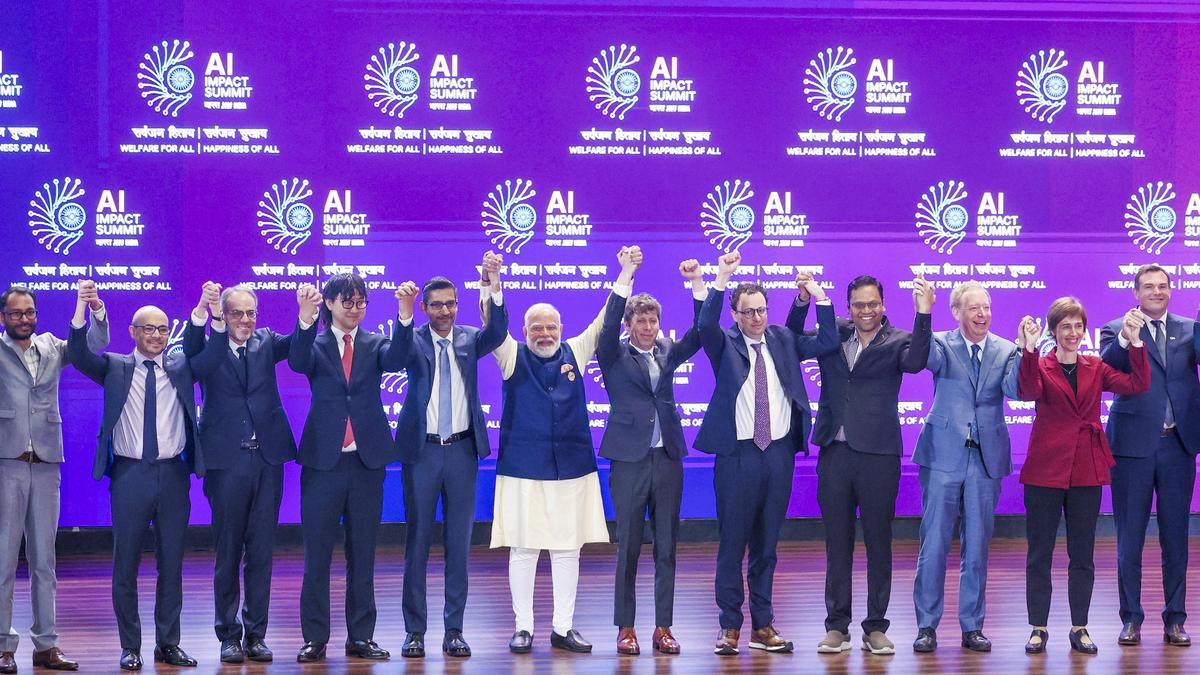
As the AI Impact Summit drew to a close on Friday, it was clear that the government sought, if at least for a week, to make India the centre for all things AI in the world. The crowds showed up, with half-a-million attendees thronging the expo and crowding out all the session rooms. World leaders and Ministers from dozens of countries waded through the heavily-regulated traffic to attend. AI heavyweights such as Sam Altman and Dario Amodei deliver keynotes.
By all means, the users are there: in a report on Friday, OpenAI published a telling insight into how Indians use AI: ChatGPT prompts from here take advantage of the firm’s most advanced data analysis, writing and technical tools available on the platform. This, the firm says, means that Indians have largely closed the “capability overhang,” the gap between what the latest large language models can do, and what they’re actually used for.
It is clear: India is addicted to the potential of AI across personal and professional spheres alike. That will have massive consequences for how the Internet is used, how LLMs diffuse into companies, and what lies ahead for knowledge work beyond the IT industry. As the implementation of Aadhaar, UPI and other such frameworks show, Indians either welcome or eventually embrace the use of digital technologies when it is possible to do so, and scale is more of an amplifier than a restraint, especially when an enthusiastic State is making a push.
A central problem is the infrastructure layer. For previous waves of technology, costs became so manageable that, at least for government projects, achieving sovereign computing resources was entirely an achievable goal. The physical servers of Aadhaar and UPI are within India, and the cost of running these systems is manageable.
Not so for AI, which has drastically disrupted the surprising power efficiency of the Internet. The graphics processing units (GPUs) powering AI — both in training LLMs and running “inference” on them — are in and of themselves expensive. The costs,however, are buried in the opex: AI training runs require millions of dollars’ worth of electricity, and inference in data centres also add up enormously.
India is the world’s most populous country, but only the third largest electricity producer; rural electrification was only substantially completed in the last decade. As with any scarce resource, electricity costs are bound to be challenging, especially when factoring in renewable energy goals, and India’s target to be carbon neutral by 2070. That bodes well for power generation and transmission companies, with guaranteed near-captive clients. It could, however, drive energy prices, at least for AI, up.


Sattankulam father-son custodial deaths case: Trial court convicts all nine accused police personnel
Nine police personnel convicted in Sattankulam custodial deaths; sentencing to be announced on March 30.

Erode district conducts first EVM randomisation for April 23 Assembly elections, ensuring transparency and fairness in allocation.

TNCC conducts public consultation in Erode to gather community input for its upcoming election manifesto.

CID to investigate sexual assault allegations against suspended Moodbidri Police Inspector P.G. Sandesh, reveals Home Minister Parameshwara.

A 50-year-old woman was found dead in southwest Bengaluru’s Kengeri in the early hours of Monday, the police said.

Papanasam dam's water level reaches 66.15 feet, with inflow at 76 cusecs and discharge at 300 cusecs.

Development without impact: Coastal residents of Kanniyakumari and Nagercoil constituencies voice discontent

Rampant encroachments in Tiruchi threaten pedestrian safety and traffic flow, undermining smart pavement initiatives and exacerbating congestion.

Discover Kerala's electoral history in 'Vottarivu,' a 201-page booklet released ahead of the 2026 Assembly elections.

Experts at a floriculture conference in Shivamogga stress the need to reduce greenhouse gas emissions and enhance soil carbon levels.

First randomisation of EVMs and VVPATs for Tiruchi and Perambalur districts completed with political party representatives present.

Puducherry elections see ongoing DMK-Congress rift over seat-sharing, leading to candidate conflicts on nomination day.

Einstein College and Sri Sarada College in Tirunelveli celebrated significant events, honoring academic excellence and cultural heritage.