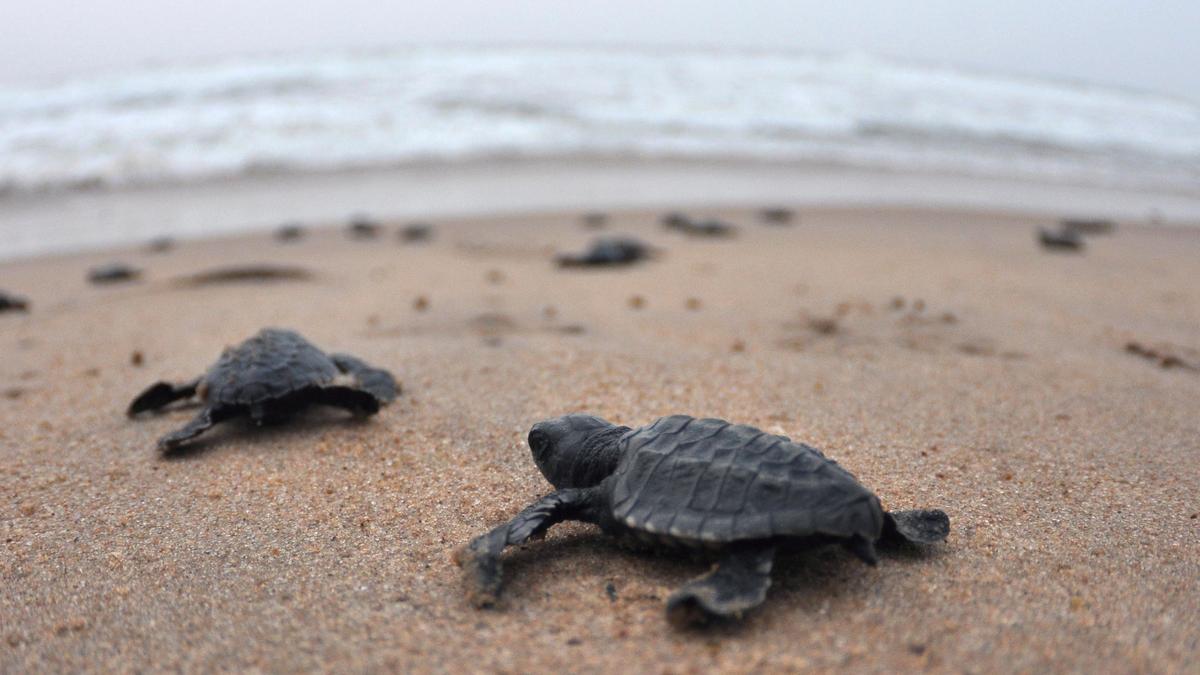
On a metropolitan coast begins a turtle odyssey
The Hindu
The Olive Ridley turtles in Tamil Nadu face threats from fishing gear, plastic pollution, and light and noise pollution.
After swimming thousands and thousands of miles in the magical oceans, the Olive Ridley turtles, not all but some, arrive on the city shores every year to nest. These sea turtles invoke no less fascination in Tamil Nadu than in Odisha, where they mass-nest, famously referred to as arribada, a spectacle that enthrals wildlife enthusiasts.
In the ever-expanding metropolis of Chennai, solitary female Olive Ridleys arrive in the stormy or starlit nights by the end of winter monsoons on the same stretch of the coast, where they were born, to nest in peace. Each turtle lays around 50 to 150 eggs, which take nearly two months to hatch. By the beginning of summer, the tiny Ridleys waddle through the warm sands into the blue bay to begin a life unpredictable in the oceans. Over the years, the Tamil Nadu government’s efforts at conserving sea turtles have strengthened, along with the active support of non-governmental organisations. However, while the effect of ocean warming, brought on by climate change, is threatening the turtle population by skewing the gender ratio, anthropogenic factors and poor enforcement of regulations continue to have a negative impact on Olive Ridleys, which are listed in Schedule I of the Wildlife (Protection) Act, 1972, and as ‘vulnerable’ by the International Union for Conservation of Nature.
One of the primary threats to Olive Ridleys is fishing gear, especially ‘ghost’ nets. Owing to the high cost of nets, fishermen use them for many years. Ideally, the nets should be replaced every three to five years. Because of the wear and tear, the nets get disconnected in sea and end up becoming ghost nets. As sea mammals need to swim up for breathing regularly — 45 minutes in the case of Olive Ridleys — they get entangled in the ghost nets, leading to drowning. “When we did the dugong recovery programmes in two States and a Union Territory [Gujarat and Tamil Nadu, and Andaman and Nicobar Islands], we realised that ghost nets were one of the most important problems for dugongs, especially in Gujarat and Tamil Nadu,” says K. Sivakumar, Department of Ecology and Environmental Sciences, School of Life Sciences, Pondicherry University.
A former scientist at the Wildlife Institute of India, Mr. Sivakumar worked on the National Marine Turtle Action Plan, which was launched by the Ministry of Environment, Forest and Climate Change in 2021. “In fact, it is a big problem for the fishers too. Nets get entangled in ghost nets. Or they lose their catch sometimes. It is a problem not only for the wildlife but also for fishermen,” he says, suggesting that the States subsidise the timely replacement of fishing nets.
Supraja Dharini, founder and chairperson, TREE Foundation, a non-governmental organisation working in marine conservation, says her team has observed around 165 turtles wash ashore dead so far this nesting season. The Foundation works with the Forest Department and fishermen of Neelankarai in Chennai district and Alamparai in Chengalpattu. At a workshop conducted by Ms. Dharini’s team at the Thazhuthali Kuppam estuary in Chengalpattu last week to demonstrate the right methods to remove sea turtles, whales, and sharks from fishing nets, it was said fishermen of Chinnakuppam, a hamlet in the Kadalur panchayat, came across nine Olive Ridley turtles entangled in a ghost net on February 6 and freed them in the sea.
The ghost nets apart, the nets set for ray fish and squid, called thirukka valai and kadamba valai respectively in the northern Tamil Nadu coast, pose a major threat to the sea turtles. “From the information we have got from fishermen along the coast from Neelankarai to Alamparai, a few of the villagers have set nets for ray fish, and a lot of turtles have been dying here. We have also heard that a net for squid is trapping a lot of turtles because it is set parallel to the beach from the evening to the next morning, when the turtles come ashore for nesting,” she explains. In a letter to officials of the Department of Fisheries, Ms. Dharini has requested that the ban on ray fish and squid nets during the turtle nesting season be enforced strictly. “They can ask fishermen to hand the nets over to the department till the month of April,” she suggests.
In areas where trawlers are used for commercial fishing, it is recommended that the nets be fitted with the Turtle Excluder Device (TED) to help turtles escape. TEDs have helped to reduce mortality in Odisha where they are mandatory, says Mr. Sivakumar. “Fishermen say that when they use the TEDs, they lose catch. Of course, there is a 5%-8% of catch loss and that is a substantial loss for the fishermen. It needs to be compensated by the government by [giving] a discount on diesel or something else, he adds. For fishermen like Selvam of Cuddalore, who fishes on trawlers, turtles are akin to God. “Most of our fishing nets have TEDs and if we get a turtle on board by chance, we let it go back to the sea with a prayer and after lighting a piece of camphor or an agarbatti. We never harm turtles,” he says.


Two RSS workers arrested for hurling a bomb at a policeman’s house in Kannur, Kerala; major tragedy averted.

Three youths radicalised by ISIS and AQIS arrested in Vijayawada for planning terror activities across India.

T.N. CM Stalin challenges PM Modi on government preparedness for West Asia crisis, emphasising leadership responsibility over public outsourcing.

Telangana DCA warns against unsupervised semaglutide use, stressing the importance of medical supervision and safe purchasing practices.

From origami classes at Rosary matriculation school to the two-day Makers Market in Mylapore, Chennai resident Priya Subramaniam has come a long way.

Election Commission bans exit poll results in Tamil Nadu from April 9 to April 29 ahead of Assembly elections.

Residents of Tambaram express concern over inadequate infrastructure amid rapid urban growth, highlighting traffic, drainage, and waste management issues.

Explore the defining moments and developments of Tamil Nadu's 16th Assembly, marked by political confrontations and administrative innovations.

Kerala CM Pinarayi Vijayan defends his remarks on G. Sudhakaran, labeling him a 'class traitor' amid election tensions.

Social media rumors spark panic buying of petrol in Belagavi, causing long queues and temporary fuel shortages at stations.

Delhi Budget 2026 LIVE: Follow live updates from The Hindu on the Delhi state budget for 2026-27, on March 24, 2026

Shorts News:WatchNetanyahu says Trump sees chance of striking deal with Iran

The facility in New Colony will benefit over 17,000 consumers, say officials