Old management truisms may be revised or busted in a rapidly changing world: Ashok Soota Premium
The Hindu
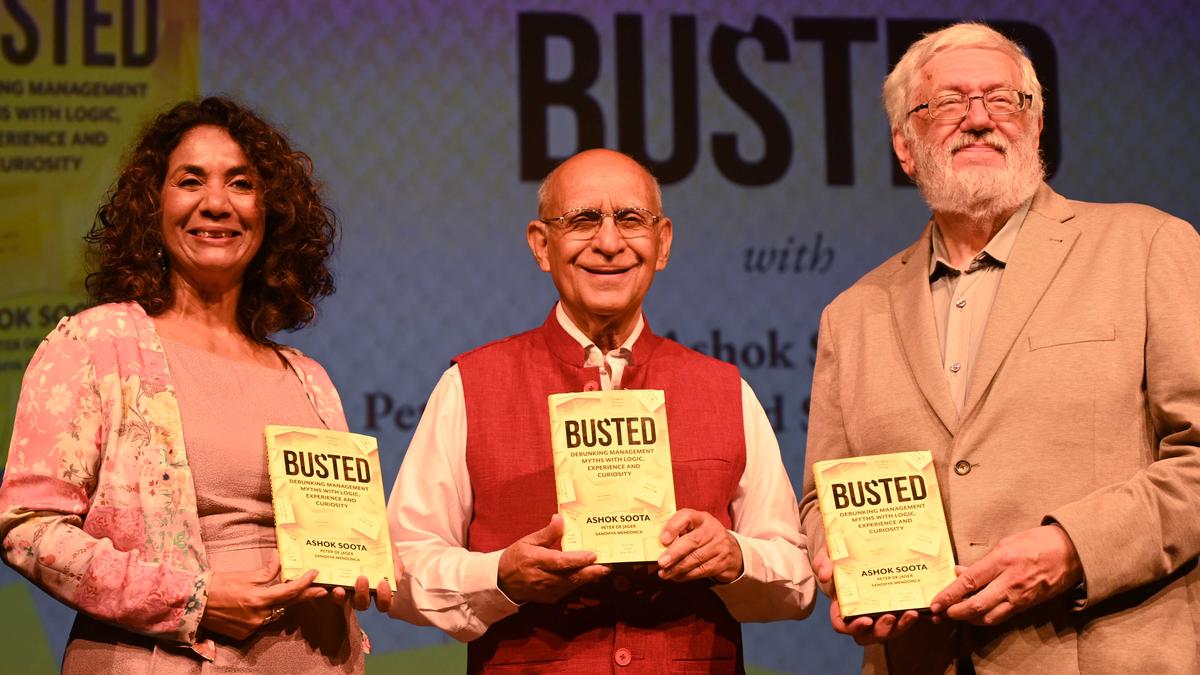
There are aphorisms galore in management circles -- It’s lonely at the top; if it ain’t broke, don’t fix it; people leave people, not organisations... and so on -- that are often accepted as undisputed truths. But these are explored, analysed, and busted in the recent book by serial entrepreneur and tech industry veteran Ashok Soota and Peter De Jager, speaker, writer, and consultant on change management, and co-authored by Sandhya Mendonca, a journalist-turned-author.
There are aphorisms galore in management circles -- It’s lonely at the top; if it ain’t broke, don’t fix it; people leave people, not organisations... and so on -- that are often accepted as undisputed truths. But these are explored, analysed, and busted in the recent book by serial entrepreneur and tech industry veteran Ashok Soota and Peter De Jager, speaker, writer, and consultant on change management, and co-authored by Sandhya Mendonca, a journalist-turned-author.
Busted: Debunking Management Myths With Logic, Experience, and Curiosity questions the relevance of several management truisms and debates if they are just myths that need to be examined or principles that still hold good in today’s rapidly-changing world.
The book also carries a disclaimer of sorts that there is a core of truth in these management truisms and questioning the wisdom of management gurus is not the aim of this book. Yet, it insists it is worth exploring other and newer point of views.
In the opening chapter titled Culture eats strategy for breakfast, Mr. Soota, who co-founded Mindtree (which was later acquired by L&T), Happiest Minds, and other ventures in the health space, says, “In recent years, we have witnessed the adverse impact of negative cultures in high profile companies such as poor governance in Enron and Satyam Computers.’‘ The macho culture or “brotopia” which predominated Uber till the advent of Dara Khosrowshahi, is also prevalent in many Silicon Valley companies, he says. Thus it was not surprising that interest in the belief “culture eats strategy for breakfast” has revived.
On Micheal Porter’s principle “The Essence of Strategy is choosing what not to do”, Soota writes, “There is no doubt that strategy requires constant and prolonged focus, and demands that we learn to say `no’ to new ideas, to protect us from a world of possible distractions.
Jack Welch did not prevent him from saying ‘yes’ to other business opportunities which eventually led General Electric (GE) to a diverse conglomerate that spanned from aircraft engines, medical equipment, and many other realms. However, Bill Gates in a way said `no’ to developing Android, despite being a world leader in operating systems (OS). He later admitted that was his biggest mistake, that he didn’t expand his strategic vision and compete effectively and thus completely missed the exploding OS market for mobile phones, where Google became a dominant force. Soota explains, “So the errors of omission are far costlier than errors of commission, in terms of opportunity cost.”
Even changing focus is accepted, when the whole world, times and concept of ‘focus’ itself changes, he says, “Organisations are entering territories that have been dominated by others. For instance, Google’s entry into operating systems with Android and Microsoft’s entry into search engine with Bing.’‘


Lok Sabha Speaker Om Birla emphasizes the importance of Question Hour over meetings and urges decorum during obituary references.

Karnataka approves 300-bed Puttur Government Medical College Hospital project, enhancing healthcare in the coastal region.

Explore the court challenge to MGR's Andipatti election, focusing on the legality of his oath-taking process.

Forest, Ecology and Environment Minister Eshwar Khandre on Wednesday instructed forest department officials to ensure maintenance of elephant trenches and hanging solar fences, which have been installed in Kodagu district to control human-elephant conflict.

Humayun Kabir's Aam Janata Unnayan Party will contest 182 seats, challenging Mamata Banerjee in Bhabanipur with a Muslim candidate.

Justice Swaminathan adjourns contempt hearing until April 9, expressing frustration over manipulation in the Thirupparankundram case.

Hyderabad's LGBTQIA+ community protests against the Transgender Persons Amendment Bill, advocating for trans rights and human dignity.

Sharmila criticizes Avinash Reddy's remarks on Viveka’s murder, calling Jagan a disgrace and questioning his leadership and support.

All the three major political fronts appear to be drowned in indecision when it comes to officially declaring their candidates for the prestigious Thiruvananthapuram Assembly constituency.

BJP protests for MCC council elections, claiming mismanagement and corruption, threatens to escalate protests if demands are unmet.

Hyderabad Collector assures no LPG shortage, urges residents to avoid panic booking and trust available supplies.

Telangana to soon set up nodal agency for flood plain zoning: Irrigation Minister

Patronage on Chennai's MRTS doubles post-extension to St. Thomas Mount, despite complaints about missing amenities at Puzhithivakkam station.