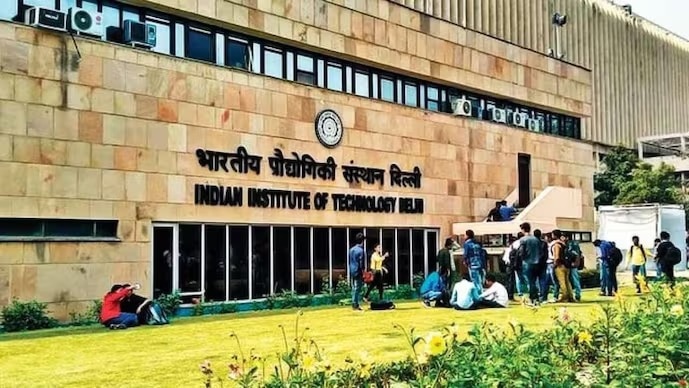
No IIT, IIMs this year in FM Nirmala Sitaraman's Budget 2026
India Today
Finance Minister Nirmala Sitharaman's Union Budget 2026 prioritised youth empowerment, women in STEM and skilling reforms, while skipping major announcements for IITs and IIMs, marking a shift from last year's higher-education focus.
Finance Minister Nirmala Sitharaman presented her ninth consecutive Union Budget on Sunday, the first time in independent India that the Budget was delivered on a Sunday.
While the government reiterated its reform-driven growth agenda with a sharp focus on youth power (Yuva Shakti), the Budget stood out for what it left out: no major, broad-based announcements for premier institutions such as IITs and IIMs this year.
Presenting the Budget, Sitharaman said that over 350 reforms have been rolled out to boost job creation and strengthen India's growth engine.
The Finance Minister announced several initiatives aimed at transforming the education ecosystem, including a strong push to increase women's participation in STEM disciplines, new programmes to encourage youth engagement with emerging technologies, the establishment of new Ayurveda institutes, and the setting up of content creator labs in schools to nurture digital and creative skills from an early age.
Together, these measures signal the government's intent to modernise education while expanding learning opportunities beyond conventional academic pathways.
Unlike previous years, the 2026 Budget did not include any major allocation or expansion plan specifically for the Indian Institutes of Technology (IITs) or Indian Institutes of Management (IIMs) at a broader level.


US authorities have arrested Super Micro Computer Co-founder Wally Liaw for allegedly smuggling $2.5 billion worth of Nvidia-powered AI servers to China. The case comes at a time when the US is tightening export rules to stop advanced AI hardware from reaching China amid the growing AI rivalry between the two countries.

WhatsApp is reportedly set to launch usernames on its platform, like Instagram and Telegram. This will let users communicate without sharing phone numbers, providing them with an extra layer of privacy.

Nvidia CEO Jensen Huang has urged tech leaders to stop scaring people over AI's capabilities amid Anthropic's fallout with the Pentagon. Huang also addressed fears regarding job losses, saying that AI may allow companies to hire more.

CBSE schools are set to begin the new academic session from April 1, but the new NCERT Class 9 books are not ready yet. NCERT said the Class 9 books are still under development. CBSE schools now face uncertainty, while teachers are being asked to bridge the gap for students.

In less than two days, Meta has changed its mind on the Metaverse. The company has confirmed that it will not be shutting down its metaverse platform, Horizon Worlds for VR headsets. The announcement comes after Meta received feedback from users.

OpenAI is set to build a super app that combines ChatGPT, its coding agent Codex, and its web browser Atlas into a single platform. This announcement comes after the Sam Altman-led firm went into "code red" as rival Anthropic's Claude Code gained a lead in the developer space.

A humanoid robot was "arrested" by police in Macau after it unintentionally shocked an elderly woman during her evening walk. The elderly woman reportedly lashed out at the robot and was so startled that she had to go to a hospital due to shock.

The US and China are in the middle of an AI race. Elon Musk believes that China will win this race, although he says that when it comes to space his own company SpaceX will be the ultimate AI winner.

A video has gone viral on social media that shows a humanoid robot in a restaurant that decides to give up work to dance. The robot creates such chaos that even the restaurant's staff is unable to stop it.

Screen addiction is no longer just a Gen Z problem. According to recent studies and reports, elderly are now spending just as much, if not more, time on smartphones, TVs and social media. Researchers say this rising screen time among boomers and retirees may also have serious effects on their health.


Meta has announced a new programme where it will pay you to post on Facebook. The Mark Zuckerberg-led firm will shell out up to $3,000 (roughly Rs 2,78,000) per month if you have a big following on YouTube, Instagram or TikTok.

Nothing CEO Carl Pei believes that the way we use smartphones is about to change. Users may no longer need apps as AI agents will be able to do everything we need on our phones in the future.