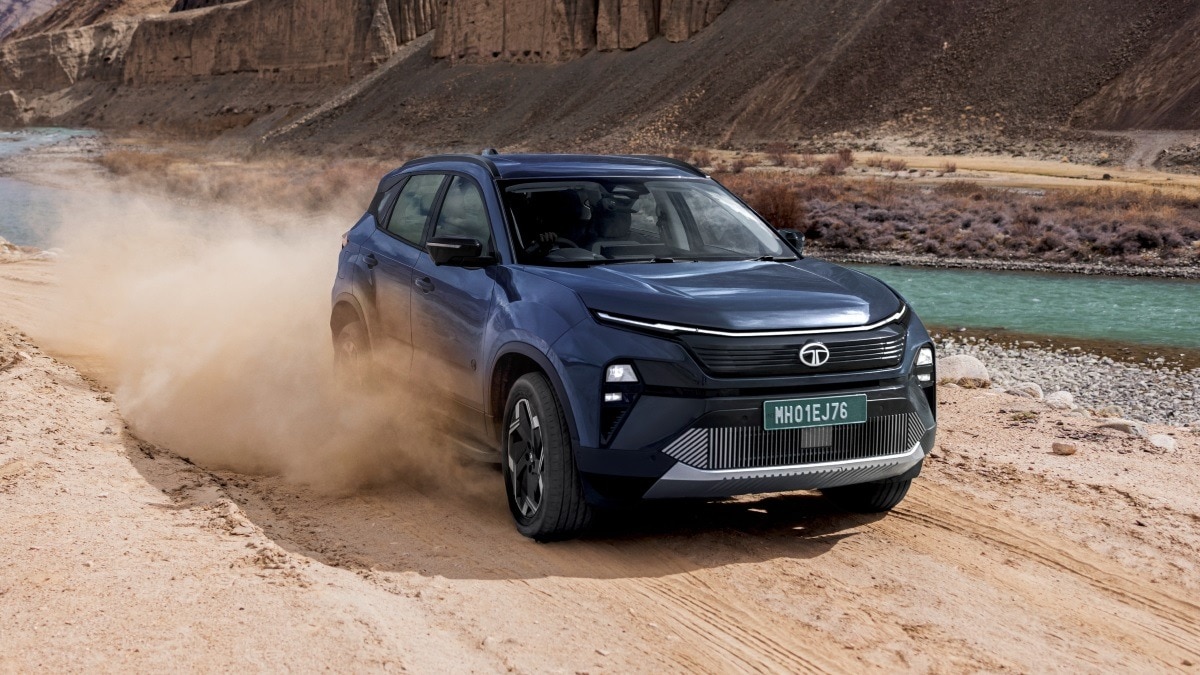
Looking for a more affordable AWD Harrier.ev? More accessible variant launched at Rs 26.49 lakh
India Today
Tata Motors has introduced a more affordable dual-motor QWD variant of the Tata Harrier.ev, bringing all-wheel drive capability and strong performance to a wider audience at a lower entry price.
Tata Motors has expanded the appeal of its flagship electric SUV, the Tata Harrier.ev, with the introduction of a more accessible dual-motor Quad Wheel Drive (QWD) variant. The new Fearless+ QWD 75 trim is priced at Rs 26.49 lakh (ex-showroom), effectively lowering the entry point into the all-wheel drive lineup.
This move brings the all-wheel drive technology, previously limited to the top-spec variant, to a wider set of buyers, reinforcing Tata’s push to make high-performance electric mobility more attainable.
Built on the brand’s acti.ev+ dedicated EV architecture, the Fearless+ QWD 75 employs a dual-motor setup. one on each axle, delivering a combined 504Nm of torque and a total power output of 313bhp. The SUV can sprint from 0–100kmph in just 6.3 seconds, positioning it among the quickest in its segment.
The all-wheel drive system is complemented by six terrain modes, along with Off-Road Assist and a Boost Mode, enhancing its versatility across challenging surfaces while maintaining composure in everyday driving scenarios.
The QWD configuration continues to be paired exclusively with the larger 75kWh battery pack. Tata claims a driving range of up to 622km on a single charge for this configuration, making it suitable for both long-distance touring and urban commutes.
With this addition, the Harrier.ev’s all-wheel drive setup is now available in two trims, widening its reach without altering the overall pricing band of the lineup.


US authorities have arrested Super Micro Computer Co-founder Wally Liaw for allegedly smuggling $2.5 billion worth of Nvidia-powered AI servers to China. The case comes at a time when the US is tightening export rules to stop advanced AI hardware from reaching China amid the growing AI rivalry between the two countries.

WhatsApp is reportedly set to launch usernames on its platform, like Instagram and Telegram. This will let users communicate without sharing phone numbers, providing them with an extra layer of privacy.

Nvidia CEO Jensen Huang has urged tech leaders to stop scaring people over AI's capabilities amid Anthropic's fallout with the Pentagon. Huang also addressed fears regarding job losses, saying that AI may allow companies to hire more.

CBSE schools are set to begin the new academic session from April 1, but the new NCERT Class 9 books are not ready yet. NCERT said the Class 9 books are still under development. CBSE schools now face uncertainty, while teachers are being asked to bridge the gap for students.

In less than two days, Meta has changed its mind on the Metaverse. The company has confirmed that it will not be shutting down its metaverse platform, Horizon Worlds for VR headsets. The announcement comes after Meta received feedback from users.

OpenAI is set to build a super app that combines ChatGPT, its coding agent Codex, and its web browser Atlas into a single platform. This announcement comes after the Sam Altman-led firm went into "code red" as rival Anthropic's Claude Code gained a lead in the developer space.

A humanoid robot was "arrested" by police in Macau after it unintentionally shocked an elderly woman during her evening walk. The elderly woman reportedly lashed out at the robot and was so startled that she had to go to a hospital due to shock.

The US and China are in the middle of an AI race. Elon Musk believes that China will win this race, although he says that when it comes to space his own company SpaceX will be the ultimate AI winner.

A video has gone viral on social media that shows a humanoid robot in a restaurant that decides to give up work to dance. The robot creates such chaos that even the restaurant's staff is unable to stop it.

Screen addiction is no longer just a Gen Z problem. According to recent studies and reports, elderly are now spending just as much, if not more, time on smartphones, TVs and social media. Researchers say this rising screen time among boomers and retirees may also have serious effects on their health.


Meta has announced a new programme where it will pay you to post on Facebook. The Mark Zuckerberg-led firm will shell out up to $3,000 (roughly Rs 2,78,000) per month if you have a big following on YouTube, Instagram or TikTok.

Nothing CEO Carl Pei believes that the way we use smartphones is about to change. Users may no longer need apps as AI agents will be able to do everything we need on our phones in the future.