Markets open lower amid mixed global cues; turn volatile later
The Hindu
Indian markets open lower amid mixed global cues, with Sensex and Nifty experiencing early declines and later volatility.
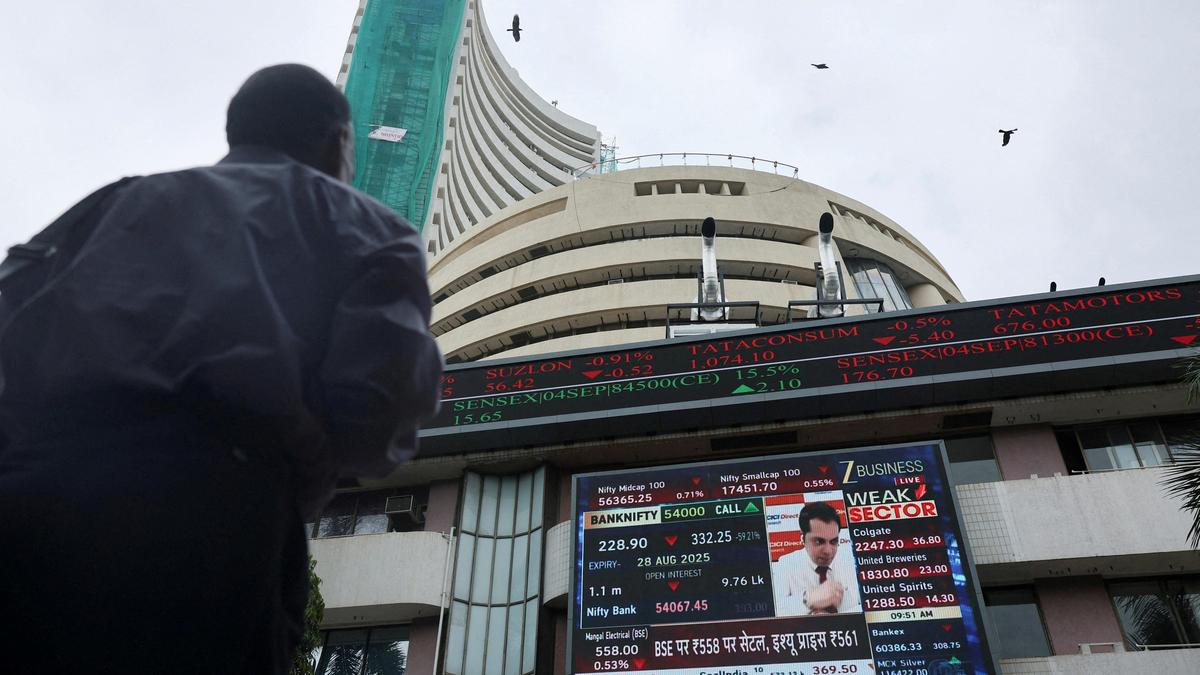
Benchmark equity indices Sensex and Nifty began the trade on a weak note on Monday (February 16, 2026), tracking a mixed trend in global markets, but later turned volatile as investors engaged in selective buying after early losses.
The 30-share BSE Sensex declined 349.81 points, or 0.42%, to 82,276.95 in early trade. The broader NSE Nifty dropped 98.4 points to 25,372.70.
Later, both the benchmark indices turned volatile, swinging between gains and losses. The Sensex quoted 136.04 points higher at 82,762.80, while the 50-share NSE Nifty rose 51.15 points to 25,522.25 after initial decline.
Among the Sensex constituents, PowerGrid, HDFC Bank, NTPC, Bajaj Finserv, Sun Pharmaceuticals, Eternal, HCL Technologies, ITC, Trent, Asian Paints, and Tata Steel were the gainers.
On the other hand, Infosys, Adani Ports, State Bank of India, Hindustan Unilever, Tech Mahindra, Reliance Industries, Titan, UltraTech Cement, ICICI Bank, and Tata Consultancy Services (TCS) were among the major laggards.
"The IT sell-off last week will continue to weigh on markets in the near-term. The mild recovery in IT ADRs on Friday is unlikely to support IT stocks. Institutions are likely to continue selling IT stocks and switch to sectors like financials, automobiles, capital goods, telecom and pharma where there is good earnings growth visibility," V.K. Vijayakumar, Chief Investment Strategist, Geojit Investments Ltd, said.


The booming market for artificial intelligence servers brought Taiwan's Foxconn a 24 percent jump in annual net profit, the company said

In a statement on its website, Adobe said it has in recent years streamlined its sign-up and cancellation processes and made them more transparent.

Stock markets recover as Sensex and Nifty bounce back following a three-day slump, driven by value-buying in blue-chip stocks.

U.S. President Donald Trump’s administration is set to receive a roughly $10 billion fee from investors in the recently completed deal to take control of TikTok’s U.S. business, the Wall Street Journal reported

Meta is planning sweeping layoffs that could affect 20% or more of the company, three sources familiar with the matter told Reuters

Learn how to choose the best personal loan lender by evaluating eligibility, interest rates, and borrowing experience.

Discover why pension planning is essential in modern India to ensure financial security and peace during retirement.

The U.S. has launched two investigations under Section 301 of the Trade Act of 1974 against India and other economies to examine practices that may be ‘unreasonable or discriminatory and burden or restrict U.S. commerce’. One probe examines whether countries, including India, are using excess manufacturing capacity to export to the U.S. in a manner that hurts American businesses, while another looks at whether countries have taken ‘sufficient steps’ to prohibit imports of goods produced with forced labour.

NHAI raises annual pass fee to ₹3,075 from April 1, 2026, streamlining toll payments for FASTag users.

The U.S. probes forced labour in global supply chains, scrutinizing China and India's exports, warns the Global Trade Research Initiative.

The Hindu collection of images of the LPG crisis: War lights a kitchen fire

The company, which launched its IPO in 2020, is now listed on the National Stock Exchange as well as the Bombay Stock Exchange.

Explore the Essential Commodities Act's role in addressing India's gas crisis and its impact on various sectors.