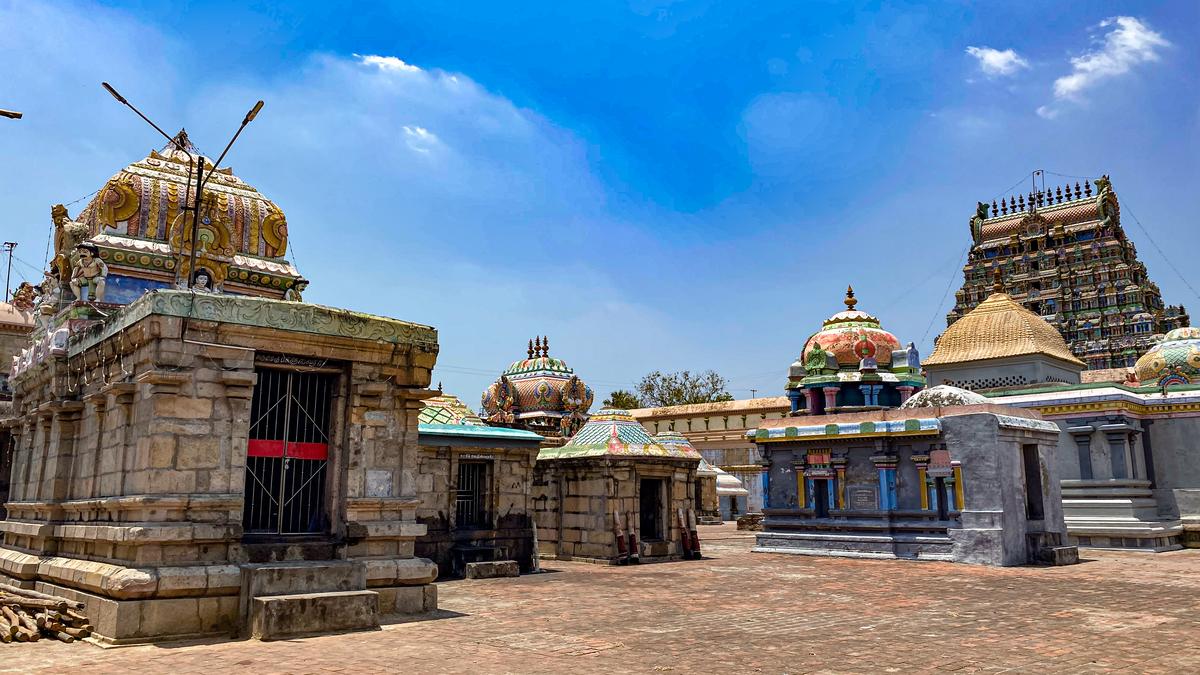
Madras High Court refuses to interfere with inquiry into alleged mismanagement of Tiruvarur Thyagarajaswamy temple properties
The Hindu
Madras HC refuses to interfere with inquiry into alleged mismanagement of Tiruvarur Thyagarajaswamy temple properties
The Madras High Court has refused to interfere with a show-cause notice issued by Tamil Nadu’s Hindu Religious and Charitable Endowments (HR&CE) department, seeking an explanation from Sri-la-Sri Sathya Gnana Mahadeva Desika Paramachariya Swamigal of Velakurichi Mutt, regarding alleged mismanagement of properties belonging to two Kattalais of the ancient Thyagarajaswamy temple in Tiruvarur.
Justice D. Bharatha Chakravarthy dismissed a writ petition pending in the High Court since 2002 and directed the Mutt head to submit an explanation to the HR&CE Commissioner within four weeks regarding the alleged mismanagment, occupation of Kattalai (endowment) properties by third parties, and non-cooperation of the Kattalaidars in proper administration of the properties.
“If the petitioner submits a fresh explanation, along with any previous explanations, those will be considered by the respondents (HR&CE department) in accordance with the law ... the petitioner will also be given due opportunity, including the chance for a personal hearing, and the matter will be decided in accordance with the law,” the judge ordered while deciding the 23-year-old case.
The judge pointed out that the Tiruvarur Thyagaraja Swamy temple had a rich history, and its Aazhi Ther (temple chariot) was the largest in South India and widely known. A peculiar feature of the temple was that it did not have any immovable properties directly registered in its name. The administration of the temple was overseen by 13 Kattalais established for different purposes.
Each of those Kattalais had been endowed with several hectares of properties used for fulfilling the temple’s needs. Of the 13 Kattalais, Abisheka Kattalai and Annadhana Kattalai were the most significant. The Aadheena Karthars of Velakurichi Mutt serve as the hereditary trustees of these two Kattalais related to abishekam (ablution of the deity) and annadhanam (serving food to devotees).
The British government had taken over the management of the Kattalai properties in 1817 but returned them in 1842. Thereafter, the HR&CE Act of 1927 empowered the then HR&CE Board to notifiy temples and specific endowments in cases of mismanagement. Accordingly, an Executive Officer was appointed for the administration of the temple in 1937, the judge said.
Justice Chakravarthy further pointed out the Paramacharya Swamigal himself had admitted that though the two Kattalais had 3,900 acres of land as of 1937, nearly 2,600 acres had been lost over the decades, leaving the Kattalais with just 1,300 acres at present. Though the Mutt head pointed fingers at the Executive Officer in management since 1937, the HR&CE department, in turn, accused the petitioner of non-cooperation.


Perundurai's industrial growth faces challenges of pollution, water scarcity, and healthcare, impacting residents ahead of the 2026 elections.

The Travancore Devaswom Board asserts that courts should respect community beliefs in its Supreme Court submission on Sabarimala's entry issue.

Karnataka cancels Deendayal Upadhyay event at KSOU due to protocol violations, citing inconsistency with university objectives.

Illegal pickle unit busted in Hyderabad, one arrested; unhygienic stock worth ₹3 lakh seized

Karnataka has entered a state of demographic transition where a large working-age population will no longer be enough to drive economic growth, and future gains will depend on how productively people are employed, the ‘State of Working India 2026’ report said.

Key demands in Sulur Assembly constituency include reviving the powerloom sector, addressing farmers' needs, and protecting River Noyyal.

Kodihalli urges Karnataka CM to allocate ₹10,000 crore revolving fund for seamless procurement of farm products under MSP scheme.

Kerala's political parties continue to marginalize women candidates, highlighting a troubling disconnect between gender demographics and representation.

The High Court of Karnataka on Tuesday ordered the issue of a notice to the State government on a PIL petition, which had complained about disturbances caused to people residing in the localities around the National Public School situated in Rajajinagar 5th block due to use of loudspeakers with high volume in the school and parking of school buses in residential areas.

China is extensively mapping ocean floors to enhance submarine warfare capabilities against the U.S. and allies across key oceans.

AIADMK's 2026 manifesto promises free rations, women's benefits, education reforms, and economic growth initiatives for Tamil Nadu.

The vehicle towing drive will soon resume in the city to ease traffic congestion. The Bengaluru Traffic Police (BTP), in coordination with the Greater Bengaluru Authority (GBA), is set to relaunch the vehicle towing drive across the city shortly to tackle traffic congestion and illegal parking.

Panic buying, not shortage, is leading to long queues at Hyderabad petrol pumps.