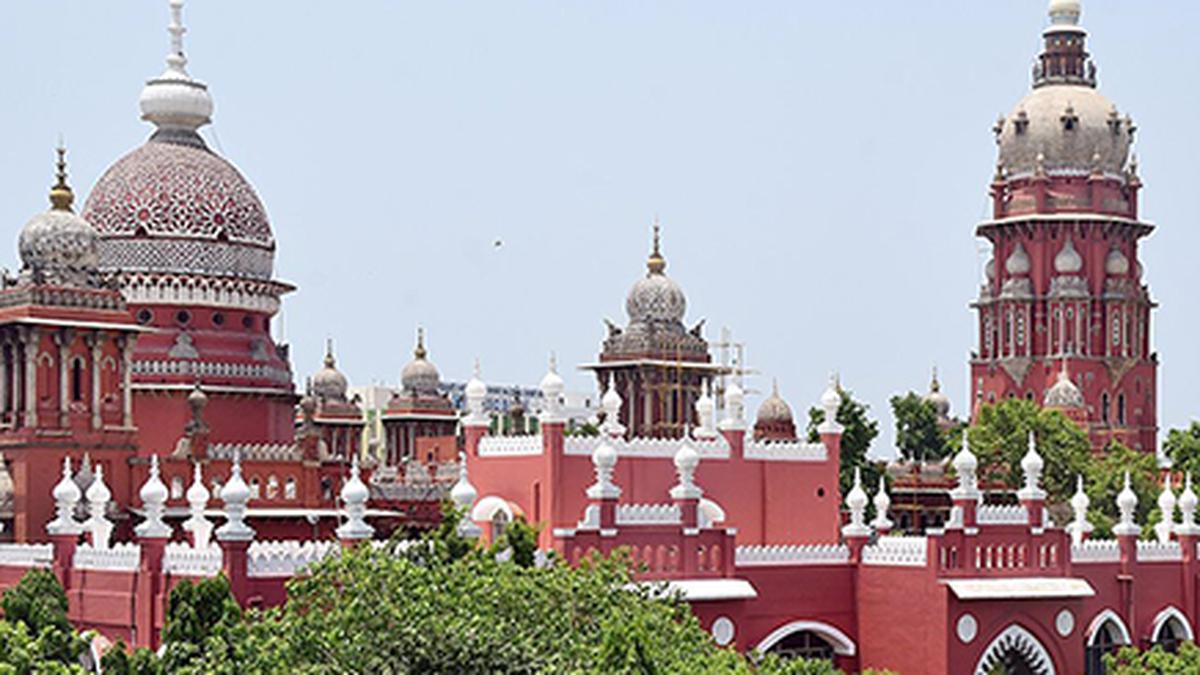
Madras High Court recommends constitution of expert committee to address behavioural issues among college students
The Hindu
Madras High Court recommends expert committee to prevent college student violence, highlighting the importance of addressing behavioral issues.
Observing that criminals are made and not born, the Madras High Court on Thursday recommended the constitution of a committee comprising academicians, psychoanalysts, education department officials and the police to devise means and ways to prevent college students from indulging in violence.
Justice A.D. Jagadish Chandira made the recommendation while disposing of a bail plea made by four students of Pachaiyappa’s College in Chennai in a murder case booked against them pursuant to the death of a Presidency College student whom they had assaulted at central suburban railway station in 2024.
The judge said, the data submitted by the State Crime Records Bureau (SCRB) revealed that 231 student related criminal cases were registered in the past decade and of them, 198 were registered by Greater Chennai City Police and 33 were registered by the Government Railway Police.
Notably, 58 of the criminal cases had the involvement of Pachaiyappa’s College students and 28 involved students from the Presidency College though both the educational institutions boast of a rich legacy of having produced distinguished alumni in the past, the judge lamented.
“Pachaiyappa’s College, South India’s first and the country’s fourth oldest educational institution has a proud legacy. Notable alumni include mathematician Srinivasa Ramanujan and former Chief Minister ‘Arignar’ C.N. Annadurai who was also a faculty member. The college hosted Mahatma Gandhi’s first speech in Madras. Similarly, the Presidency College has produced distinguished alumni like Nobel laureate Sir C.V. Raman and several prominent judges,” he said.
Expressing concern over the students of such institutions now indulging in violent activities, the judge said, their acts do not just tarnish the reputations of those institutions but also jeopardize the future of the students concerned. He also took note that most of the students in these institutions come from economically poor families or from modest background.
Some of them had only single parent and in many cases, it was the mothers who educate the children with great difficulty. However, “without realizing the sacrifices and noble intentions of their parents, the students indulge in criminal activities and lose their future,” the judge rued.


CPI-M accepts DMK's five-seat offer for Tamil Nadu Assembly elections, prioritizing INDIA bloc unity over seat demands.

Ricky Rai, son of former underworld operative Muthappa Rai, on Monday appeared before the Bengaluru Traffic Police for questioning in connection with a case involving a Lamborghini performing dangerous stunts at Anil Kumble Circle on March 21.

The Dispur election heats up as 'CongBJP' defections shape a high-stakes contest between veteran candidates from BJP and Congress.

Bengaluru's M. Chinnaswamy Stadium conducts readiness drill ahead of IPL 2026, ensuring upgrades and technical preparations are complete.

First-level randomisation of EVMs completed in Nagapattinam for upcoming elections, ensuring transparency and security.

A district-level committee in Krishnagiri has been formed to assess and verify seizure claims of goods and cash.

Minister Anam Ramanarayana Reddy pledges government support for local fishermen and farmers facing challenges in Andhra Pradesh.

MP M. Sribharat urges collective efforts to revive Visakhapatnam Steel Plant, highlighting key reforms for crucial recovery and growth.

141 candidates have filed nominations for Kozhikode's Assembly elections, with scrutiny on March 24 and campaigning intensifying.

BJP's Vijayendra accuses Congress of using money to influence Bagalkot bypolls, urging voters to reject their tactics.

First randomization of electronic voting machines completed in Tirunelveli and Tenkasi districts for upcoming Assembly elections.

RPF seizes 10.12 kg of unclaimed cannabis worth ₹5.06 lakh from a train in Mangaluru.

Kolar's groundwater levels rise to 50-100 ft due to the K.C. Valley project, ensuring clean water and improved health outcomes.