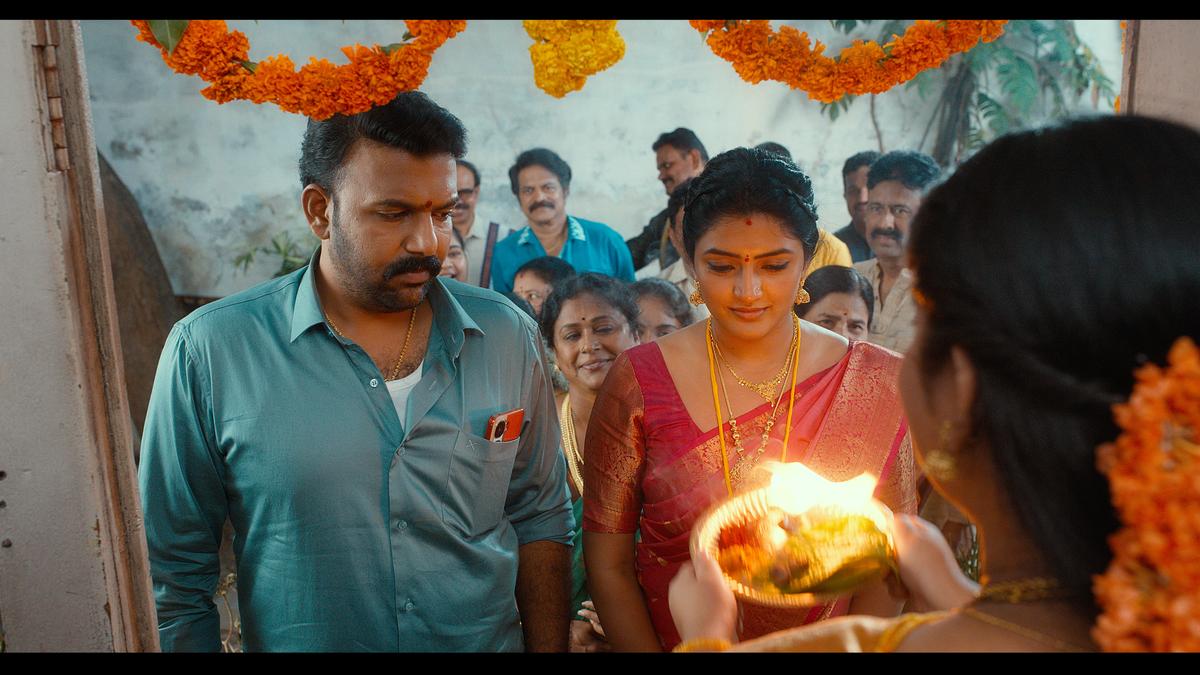
‘Om Shanti Shanti Shantihi’ movie review: Eesha Rebba, Tharun Bhascker shine in this sharp critique of patriarchy
The Hindu
Om Shanti Shanti Shantihi review: Eesha Rebba and Tharun Bhascker shine in this thought-provoking critique of patriarchy.
The 2022 Malayalam film Jaya Jaya Jaya Hey was not subtle in its take on patriarchy, opting instead for an intentionally over-the-top reversal of power. In adapting the film into Telugu and relocating it to the Godavari region, director A.R. Sajeev stays largely faithful to the original. Om Shanti Shanti Shantihi is a partly fun, partly simmering emotional drama, shouldered by compelling performances from Eesha Rebba and Tharun Bhascker. While it does not always strike the right note, the film effectively captures the many ways patriarchy continues to stifle women, and how both men and women often enable it.
The childhood portions establish how the female protagonist is short-changed at every turn — in toys, books, clothes, and even something as simple as being denied the fruit of her choice — under the guise of others knowing what is best for her. Some character writing is especially sharp, notably the nosy, supposedly well-meaning uncle, a familiar figure who believes he has the right to dictate everything from a child’s education to her leisure.
Early on, when the girl’s father expresses a desire to raise her like the fearless Rani Lakshmibai, he is swiftly corrected by this uncle on what society would find acceptable. The father’s lack of resolve and the mother’s internalised patriarchy shape how Prashanti (Eesha Rebba) grows up. Nanda Kishore Emani’s dialogues not only root the film firmly in its regional dialect but also mirror everyday conversations with unsettling accuracy.
Om Shanti Shanti Shantihi begins lightly before steadily exposing layers of social hypocrisy. Writer Nanda Kishore Emani appears briefly as a professor whose lofty talk of women’s empowerment amounts to little more than lip service.
At the matchmaking meeting, Prashanti’s conversation with Omkar Naidu (Tharun Bhascker) barely moves beyond his fish business. The humour lies not just in his limited interests, but in how these seemingly throwaway remarks are cleverly used in the narrative later.
The sections set in Naidu’s home, as Shanti adjusts to life as a new bride, go beyond depicting his rage. They raise pointed contradictions. Is a man who insists on the same breakfast every day — idlis made only from stone-ground batter — an emblem of simple living, or merely intolerant of change? What role does his family, especially his mother, play in excusing his behaviour? The film resists easy binaries, urging viewers to read the subtext. Refusing dowry alone, it reminds us, is no green flag; an unchecked ego can make everyday life unbearable.


Priyanka Gandhi criticises PM Modi's West Asia remarks, urging for a comprehensive Parliament discussion on the matter.

Learn who can vote by postal ballot in the upcoming Tamil Nadu Assembly election, including seniors and persons with disabilities.

Decomposed body of a missing 25-year-old man discovered in Dindigul stone quarry, prompting calls for investigation and quarry closure.

SVEEP activities launched in The Nilgiris aim to boost voter turnout at 13 polling booths with low participation rates.

Learn who can vote by postal ballot in the upcoming Tamil Nadu Assembly election, including seniors and persons with disabilities.

Shorts News:Watch: UDF linked to communal forces in Kerala: CPI(M) leader A Vijayaraghavan

Karnataka government postpones Deendayal Upadhyaya event at KSOU Mysuru due to protocol violations and lack of government involvement.

Sameer Wankhede denies bribery allegations involving Shah Rukh Khan’s son in drugs case during Bombay High Court proceedings.

What does it take to design gloves, masks and uniform that factor in the various challenges faced by workers on the waste beat? Indore, Bengaluru and Pune have an answer

Gaurav Gogoi files nomination for Jorhat Assembly seat, marking his electoral debut in the upcoming Assam elections.

A round-up of events and programmes held at colleges in Tiruchi and other Cauvery delta districts

CPI(M) and Congress clash over accusations of aiding BJP, threatening the LDF-UDF duopoly ahead of Kerala Assembly polls 2026.

Shivamogga veterinarians demand accountability for the death of trainee vet Dr. Sameeksha Reddy, citing systemic failures in zoo administration.