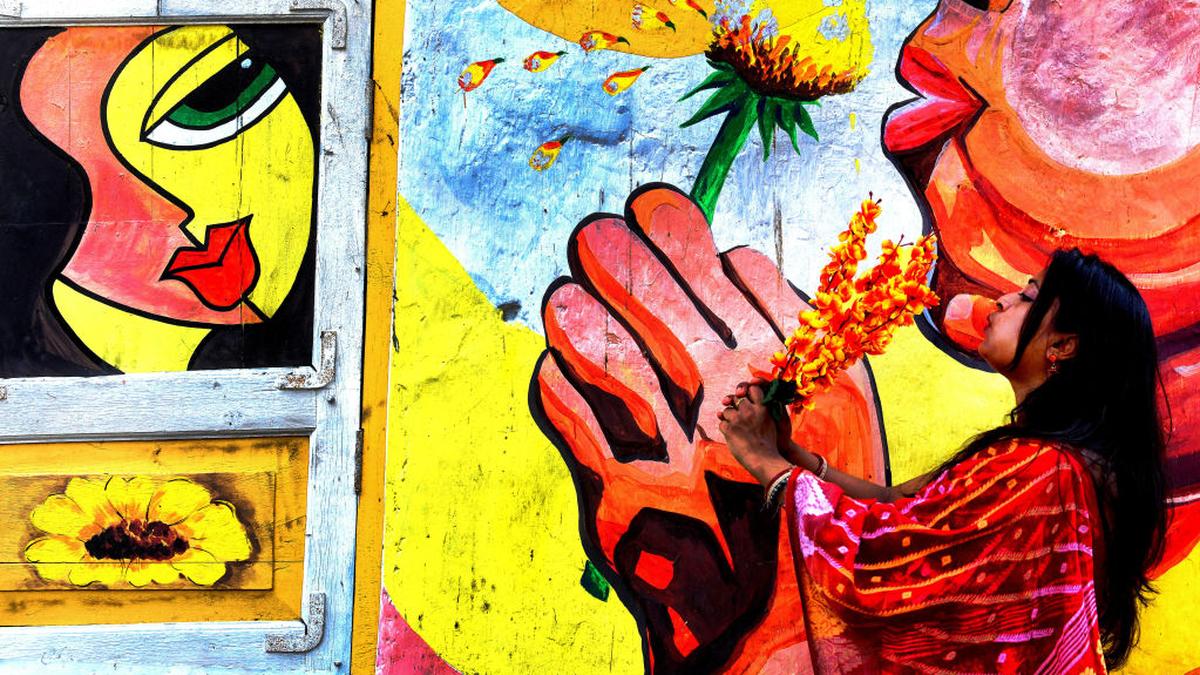
Made of ambition | Review of ‘Great Eastern Hotel’ by Ruchir Joshi
The Hindu
Ruchir Joshi's ambitious novel, Great Eastern Hotel, explores art, characters, and Calcutta in a loquacious, people-dense narrative.
It is clear Ruchir Joshi set out to write a great big novel about a great big subject. Great Eastern Hotel with its 900-plus pages, about 4,50,000 words by my reckoning, belongs to the loquacious, people-dense, naturalist tradition of Zola, Balzac, F. Scott Fitzgerald, and in more recent times, Franzen, Vikram Chandra, and Lauren Groff. These are authors who seek to eat the world; they are pursuing, as Tom Wolfe memorably said, “the beast with a million feet”.
The novel has several primary characters, each with their own timeline. The central figure is Kedar Nath Lahiri, painter, playboy, zamindar, music expert, and one of those “Macaulay’s Minutemen”, as Rushdie put it. Other significant characters include the Marxist revolutionary Nirupama; the Englishwoman Imogene; the British Intelligence in the form of Jerome Lambert, about to be spice-trapped by the humble jhaalmuri; and Gopal aka Gogai, the thieving subaltern orphan who sins his way to a decent, prosperous life. The world-setting is pre- and post-independence India, specially Calcutta.
There are many novels about painting and about painters. Zola’s L’Œuvre (1886), which launched this genre, also ended his long friendship with Cezanne. I can think of some two dozen novels since. Maugham’s Of Human Bondage (1915) stands out for me, as does, perhaps quite inevitably, Virginia Woolf’s To The Lighthouse (1927).
The artistic development of Kedar is a familiar one. But what matters in literary fiction is how the familiar is narrated. This is where ekphrastic (a verbal or written description of a visual work of art) writing runs into trouble: the how. As Raymond Bellour described in his now classic essay ‘The Unattainable Text’, a film or musical experience, unlike a written fictional experience, cannot be packaged into a quote. So too, for the actual act of seeing a specific painting. Now, author Joshi is also a filmmaker; he knows there is no real solution to this problem. But the act of painting, the effect it has on others, the consequences of a painting: these things are within the reach of sentences.
Joshi tells us at the end of the book, via a convenient curator character, how he wants the novel to be seen: not as an upanya or a saga, but rather, as a kind of exhibition. Even though Great Eastern Hotel may be inspired by painterly ideas, it isn’t really an ekphrastic novel. Joshi’s discussions of Kedar’s paintings or his technique or the materiality of the act of painting are quite conventional, even superficial. There is none of Woolf’s subtle indications of her character Lily Briscoe’s volition in beginning a painting — “she took her hand and raised her brush” rather than “she raised her brush”. Kedar could’ve been a novelist in the novel; not much would be required to change. Indeed, the novel might even have been improved.
Kedar is voiced by an overt narrator who is a creative force in their own right. Kedar feels like a creation, not a creator. For example, the novel’s opening segment describes with great skill and imagination the massive outpouring of grief after Tagore’s death. When we learn, many pages later, that Kedar has painted a piece based on his participation in the event, his achievement has already been usurped by his author. Kedar’s paintings feel derivative, not first-rate artworks of an original mind. No wonder Kedar burns his paintings.
This problem extends to other characters, or more precisely, characterisation. Joshi is brilliant at describing events, situations, atmosphere. His characters, however, lack substance. Joshi relies on dialogue a great deal, and though he has an ear for the right register, there is the strange sense that actors are needed to bring the words to life. His characters have interiority, but it is the shallow kind consisting of what they keep hidden from others. They are not hidden to themselves. Had this world a Freud, he would have no unconscious to discover.


MLC Kishore Kumar Puttur criticizes the State for poor implementation of the Centre's health scheme for senior citizens.

Karnataka's Health Minister announces redeployment of specialists to taluk hospitals to reduce neonatal mortality rates effectively.

Celebrate IPL's start and Polly Umrigar's legacy, reflecting on cricket's evolution and the enduring impact of its pioneers.

BJP accuses Congress and Rahul Gandhi of endorsing an ‘anti-India’ USCIRF report undermining India's global image.

Education Ministry proposes UGC-like funding under Shiksha Adhishthan, raising concerns about centralization and public university financing.

Shivraj Singh Chouhan defends the new rural jobs Act, dismissing opposition protests as ineffective and highlighting increased funding and worker protections.

Supreme Court questions why heirs can't access unclaimed funds of deceased depositors, urging government to develop a disclosure policy.

Karnataka High Court demands LPG supply details amid state restrictions, threatening Bengaluru's restaurants and livelihoods.

Shorts News:UN body investigating deadly strike on Iranian girls school

Moodbidri police inspector suspended pending inquiry over allegations of misbehaviour and inappropriate conduct towards women.

The State currently hosts more than 880 GCCs, up from around 500 GCCs in 2021.

Transgender and intersex activists march to Lok Bhavan, protesting the regressive Transgender Persons Bill and demanding its withdrawal.

Hyderabad's LGBTQIA+ community opposes the Transgender Amendment Bill, stressing dignity over identity verification and highlighting economic and medical concerns.