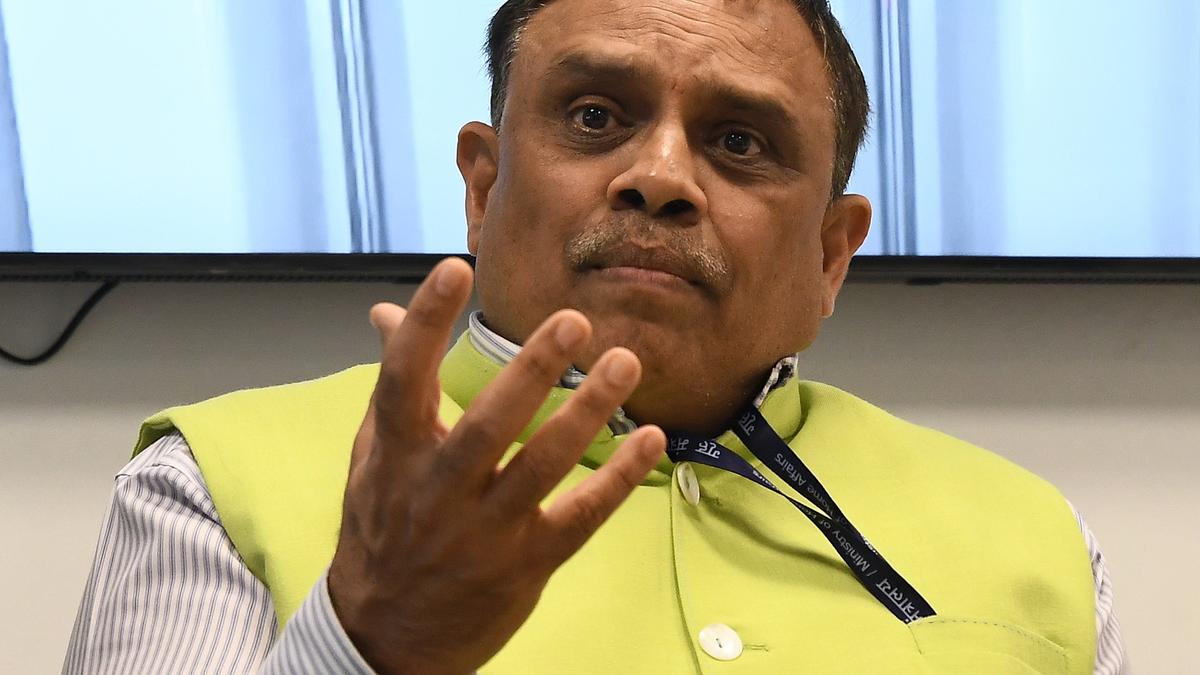
Lower number of credits, focus on practical learning key to progress: AICTE chief
The Hindu
A lower number of credits with greater emphasis on practical and industry-specific learning is essential for the country’s progress, said T.G. Sitharam, chairman, AICTE
A lower number of college course credits with greater emphasis on practical and industry-specific learning is essential for the country’s progress, said T.G. Sitharam, chairman, All India Council for Technical Education (AICTE).
In an interaction with senior faculty members of the National Institute of Technology – Tiruchi (NIT-T) on the sidelines of a symposium on February 14, Mr. Sitharam said India’s best chances to succeed on a global level in the higher education stakes was to concentrate on promoting STEM (science, technology, engineering, mathematics) courses.
“We are producing over 1.3 million engineers, not just for India, but for the whole world. The National Education Policy [NEP] in its third year has shown us that traditional classroom teaching is irrelevant today. Instead, we have to incorporate flexible undergraduate and postgraduate courses, and provide talented students an opportunity to thrive. I am planning to reduce the number of credits from 160 to 140-145 next year, as educational institutions abroad offer only around 120 credits,” said Mr. Sitharam. [Every course is allotted credit points based on the number of hours of tutorials and practicals. Credit points secured by students reflect in their overall assessment.]
The AICTE chief said greater emphasis would be placed on practical and vocational learning. “Make internship mandatory, from three months to a full year, and get it accredited. You could also incorporate micro-credits for skill courses in self-learning mode,” he said. “Already, University Grants Commission and AICTE allow for 40% of the course to be taken up through self-learning.”
Speaking on pedagogy and learning modules, he encouraged teachers to let children use ChatGPT ethically in their course work. He also highlighted the gap between school and college education in the country. “In the past three years of the NEP, we have seen that there are nearly 4.3 crore students in higher education, while we have over 15 crore students in school education. We need to fix this in the coming years,” he said.
Replying to a query on how to deal with M.Tech students who drop out midway in favour of public sector jobs, Mr. Sitharam admitted that the problem was prevalent across many institutions. “Students could be allowed to leave after they complete two semesters, but perhaps there should be an arrangement for them to return briefly to finish their course later,” he said.
He also said the AICTE was mulling how to break the norm of students using diploma courses as a lateral entry to get admission into core engineering. “We want to shift the focus away from the joint engineering entrance [JEE] test, and bring schools earlier into higher education,” Mr. Sitharam said.


Diya Chitale and Manav Thakkar reach semifinals, while Yashaswini Ghorpade upsets top seed Sreeja Akula at National TT Championships.

DYFI criticizes A.P.'s job calendar for failing unemployed youth, demanding a revision to include 1 lakh posts and higher age limits.

‘Lethargic’ officials who left Chambal sanctuary to the mercy of sand miners will be held liable: SC
Supreme Court holds negligent officials accountable for enabling illegal sand mining in Chambal Sanctuary, emphasizing habitat protection laws.

Work on the Srisailam Left Bank Canal tunnel resumes after 13 months, with completion targeted by 2027-end, says Minister Reddy.

Ancient ‘Vanni’ tree at Sri Meenakshi Sundareswarar Temple tilts; steps on to restore it

Bengaluru Metro penalises 14 passengers for disrupting services with loud singing, following a viral clip of their antics.

ASR district plans a 122 km world-class trekking network, enhancing tourism and local employment across Araku, Paderu, and Lambasingi.

Development without impact: Coastal residents of Kanniyakumari and Nagercoil constituencies voice discontent

Environmentalists in Kakinada celebrate World Sparrow Day, urging conservation efforts for sparrows and migratory birds.

T.K. Govindan secures full support from K. Sudhakaran for Kerala Assembly polls 2026 as a UDF-backed Independent candidate.

Karnataka implements weekly reviews and control rooms to combat rural drinking water shortages during the summer months.

BJP leads candidate selection for upcoming bypolls, while Congress faces internal challenges and community pressure in Bagalkot and Davangere.

A man died in a Kolkata hospital lift, prompting accusations of negligence against the West Bengal government and hospital authorities.