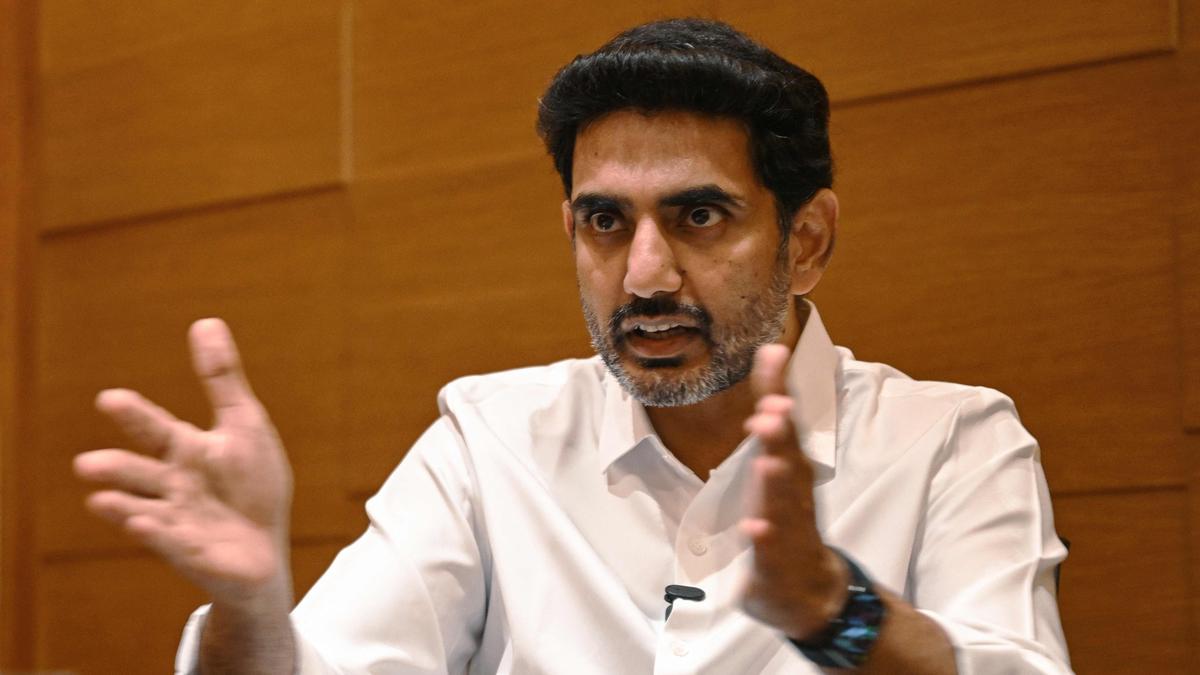
Lokesh tells officials to focus on job creation for youths in A.P.
The Hindu
Minister Nara Lokesh emphasizes job creation for youth in A.P., directing officials to enhance skill development and faculty recruitment.
Minister for HRD, IT and Electronics Nara Lokesh on Thursday directed the officials of the Skill Development Department to focus on employment generation, especially at a time when large-scale industrial investments are flowing into Andhra Pradesh.
Addressing a review meeting with officials of A.P. State skill Development Corporation (APSSDC) at his Undavalli residence, Mr. Lokesh said the government had set a target of generating 2 lakh jobs this year in industries that had been grounded. He directed the officials to prepare a concrete roadmap accordingly and focus on maximising employment opportunities for youth in these operational industries.
Mr. Lokesh wanted the officials to identify skill requirements of the industries such as Reliance Industries (CBG projects), Jupiter Wagons, Lauras Labs, Hetero Drugs and the upcoming renewable energy projects and undertake skilling initiatives accordingly.
He said curriculum design should be developed in consultation with the reputed industries in respective sectors. Citing the examples of some organisations which had established dedicated skill development training centres, Mr. Lokesh asked the officials to study such models and set up similar training centers attached to ITIs.
Mr. Lokesh claimed large-scale employment was being facilitated through job melas conducted every three months in the constituency headquarters and directed the officials to work in alignment with Key Performance Indicator (KPI) targets.
Referring to the proposed skill portal, the Minister directed the officials to expedite its launch. Officials informed him that modules had already been prepared and data integration for 25 sectors had been completed.


A CSR collaboration has helped in providing critical medical care to 20 infants from poor families as AI-native automotive platform company Tekion partnered with the NGO Neonates Foundation of India to support the treatment of such critically ill newborns from poor families in five States.

Union Civil Aviation Minister to inaugurate Coimbatore airport's expansion and new passenger amenities on February 20, 2026.

Lamenting that politics had become an investment, MDMK MP and party’s principal secretary Durai Vaiko said people from councillors to MPs were being identified by their caste and the amount of money they could invest in the elections.

AICC reviews Telangana ULB polls, praises Revanth's efforts against BJP, while cautioning on proximity to MIM ahead of elections.

Uttar Pradesh Congress demands mass FIRs against Assam CM for alleged communal statements, urging judicial intervention for accountability.

Two suspects arrested in inter-state bike theft ring; 14 stolen motorcycles worth ₹12.60 lakh recovered by Kalaburagi police.

Minister Nara Lokesh emphasizes job creation for youth in A.P., directing officials to enhance skill development and faculty recruitment.

Mamata Banerjee criticizes PM Modi for cultural insensitivity in referring to Ramakrishna Paramhamsa as 'Swami' on social media.

DGCA's report highlights improper landing technique by a trainee pilot at Kalaburagi Airport, leading to a serious incident.

Kavitha to launch party in May, eyes KCR’s earlier turf Siddipet

The Italy-based MIR Group is planning to invest about € 20 million in Mangaluru to set up its manufacturing unit for the production of energy-efficient building materials such as Building Integrated Photovoltaic (BIPV) panels, thermal insulation materials and sodium-ion batteries, according to Sai Chandu, Sustainability Head, MIR Group.

Paytm leads in monetisation as merchant payments boost industry profits, significantly outperforming competitors in revenue generation.

Sangeet Bharati Foundation, Mangaluru, will present a novel and an exquisite classical music programme on the theme “Stree“ on Sunday from 5 p.m. at Ambedkar Bhavan, Urva Store.