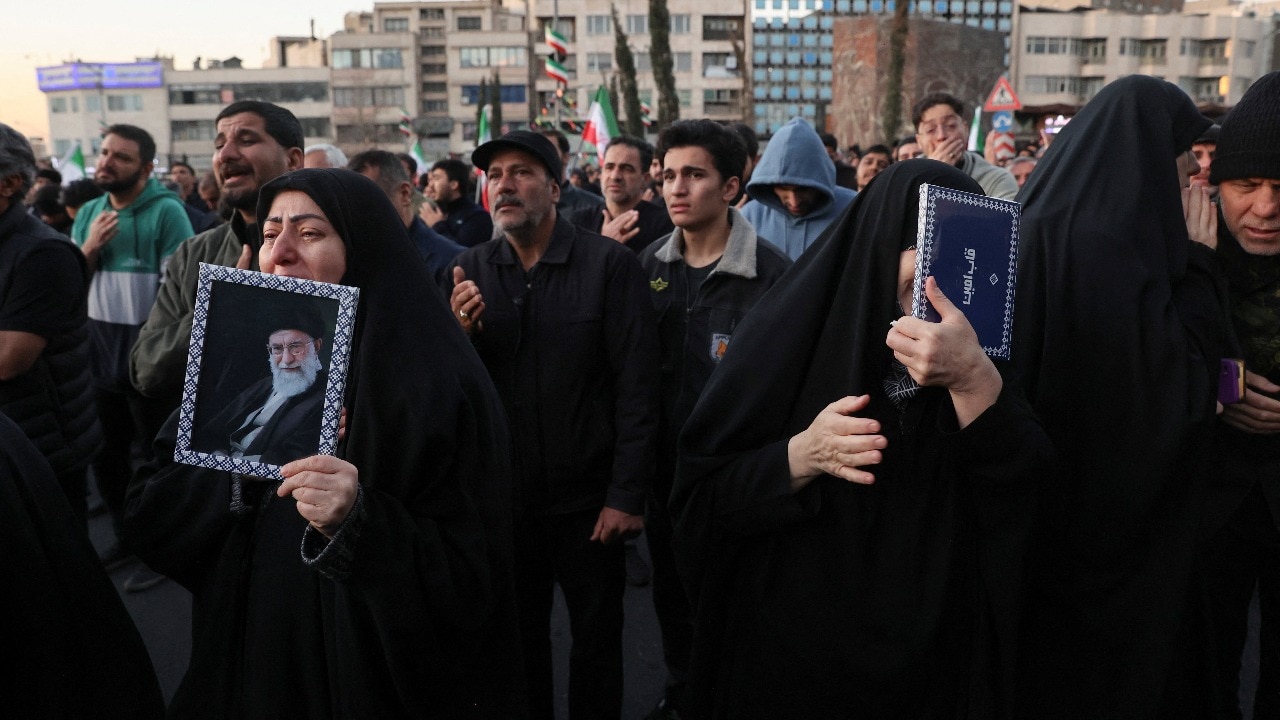
Khamenei's death: Have US, Israel achieved their goals, or is Iran unbreakable?
India Today
Ayatollah Ali Khamenei's killing by the US and Israel was meant to break the system in Iran. Instead, it has tested it, and, for now, it has seemingly strengthened it. The conflict is widening across the Middle East, and it appears that Iran is not going to step back.
As the crisis in Iran escalated, the speculation that the Shia regime's Supreme Leader, Ayatollah Ali Khamenei, might be killed by the US and/or Israel, was always there. And then Khamenei's killing happened on Saturday. The US and Israeli forces launched coordinated strikes on the morning of February 28, targeting Iranian leadership and military sites in what Washington dubbed "Operation Epic Fury" and Tel Aviv called "Roaring Lion". However, even after the death of Ayatollah Ali Khamenei, Iran has shown no signs of capitulation. It has been relentless in its counterstrikes, which has spread the fire across the Middle East.
A regime change has not happened, and a senior cleric, Ayatollah Arafi, has been named the interim Supreme Leader. Meanwhile, Iranian President Masoud Pezeshkian has already said the regime sees revenge for the attacks by Israel and the US as its "legitimate right and duty".
"US President Donald Trump has crossed 'a very dangerous red line' by killing Iran's Supreme Leader Ali Khamenei," the Iranian deputy foreign minister Saeed Khatibzadeh told CNN on Sunday.
The joint strikes by the US and Israel killed top Islamic Revolutionary Guard Corps (IRGC) commanders, the Army's Chief of Staff, Abdul Rahim Mousavi, and Defence Minister Aziz Nasirzadeh, other than hitting suspected nuclear sites.
Tehran has launched intense retaliation, with missile barrages on Israeli cities and 14 US bases in the Gulf region, even as it vowed "severe punishment" to both Israel and America.
This raises a very important question: Have the US and Israel fulfilled their goals of weakening the regime? Or curbing its regional influence? Did the strike force a behavioural change in the nature of the Iranian leadership? Or has it become more determined to take on Israel and the US?


A video from Kolkata showed a chaotic interaction between a man and a cop after he hurled stones at his vehicle, which left social media users jaw-dropped.

On March 18, Israel struck a gas field in Iran. Tehran responded in a matter of hours, striking refineries in several Gulf countries. What explains this sharp, quick counter-attack capability of a country whose military infrastructure has supposedly been severely degraded? The answer lies in a cheap drone and a dispersed military.

The truck, loaded with straw beyond its capacity, began swerving dangerously while moving towards the temple stretch. Eyewitness visuals show the vehicle tilting and rolling sideways on the road as bystanders shouted for it to stop.

How Benjamin Netanyahu handed Donald Trump a war and a bill he may never stop paying

A video showed a man calmly eating popcorn while a heated argument broke out outside a screening of Dhurandhar The Revenge, with his reaction stealing the spotlight online.

From Eli Cohen to AI-driven espionage, Israel has turned infiltration into its sharpest weapon. For Iran, the real threat isn't missiles at its borders, but invisible enemies within, quietly mapping targets and striking with precision.

A Gurgaon housing society decided to publicly name maintenance defaulters on a board at the main gate. They also plan to block services like domestic help and deliveries, sparking debate over strict recovery measures.

Canada had previously accused India of interference and transnational repression, including threats and alleged killings. RCMP Commissioner Mike Duheme now says current probes no longer support that conclusion.

A man from Florida has clarified that he is not Jeffrey Epstein after a video went viral last week in which viewers claimed he resembled the late sex offender.


Australian PM Anthony Albanese and Home Affairs Minister Tony Burke were attending an event marking the end of Ramadan at Sydney's Lakemba mosque when some worshippers loudly protested against their presence.

At a crucial Senate hearing, US intelligence contradictions and careful wordplay expose deep divisions, raising serious doubts over the White House's justification for the Iran war

A French sailor accidentally compromised the location of the aircraft carrier Charles de Gaulle by logging his workout on the fitness app Strava. The app's geolocation feature allowed real-time tracking of the carrier and its fleet.