Kerala’s people’s plan campaign: key lessons and the road ahead Premium
The Hindu
The foremost goal of the People’s Plan Campaign (PPC) in Kerala is to deepen democracy by empowering the Local Governments (LGs) and expanding the space for citizen’s participation in governance.
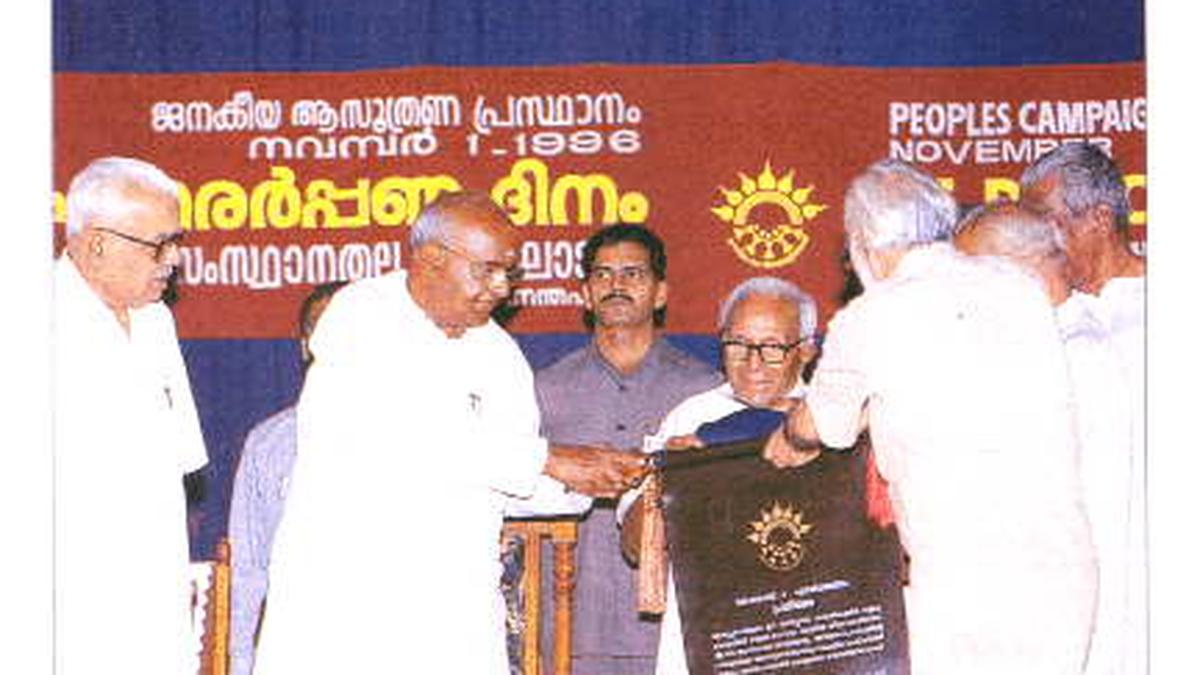
The People’s Campaign for Participatory Planning in Kerala is now widely recognised as one of the most enduring and successful experiments of its kind in the world. Highly touted participatory governance initiatives in different parts of the globe, including the famous Participatory Budgeting (PB) process in Porto Alegre, Brazil, have either been weakened or discontinued. Scholars identify multiple reasons for the success of the Kerala experiment, including the legacy of the broader democratic movement in the State, which the People’s Campaign sought to advance. In our view, too, the single most important reason for the success of people’s planning in the State has been the commitment to pursue democracy as an end in itself, notwithstanding its obvious instrumental value.
The foremost goal of the People’s Plan Campaign (PPC) in Kerala is to deepen democracy by empowering the Local Governments (LGs) and expanding the space for citizen’s participation in governance. Democracy is embraced as a goal in itself for its intrinsic value. This is not to say that democracy’s instrumental benefits are unimportant – there have been high expectations regarding the tangible gains that empowered LGs would deliver. But none of them have been valued more than the gains of making democracy more genuine and deeper. In hindsight, this ‘democracy first’ approach has paid rich dividends, functioning as an inbuilt and highly efficient mechanism for internal correction and rejuvenation of the State’s local governance system.
The prerogative of the people to choose between the competing elites to run the government cannot be ‘the be-all and end-all’ aim of democracy. The citizens in a democracy should have enough room for continuous engagement with the State and governance. The legacy of public action in Kerala is best seen in this light. The people of Kerala are not willing to leave their destiny to be made by the government or the market. They have evolved a mechanism of collective action to intervene in the market as well as in governance to assert their right to influence the process by which their collective destiny is made. They do not hesitate to act together decisively for the public good. Admittedly, democracy in Kerala has been a bit too noisy, thanks to the high density of public action.
Undoubtedly, the neo-liberal policies have affected the scope of public action significantly. The response of the people of Kerala, however, has not been one of despair, indecision and inaction. On the contrary, if anything, the commitment to collective action for the public good has only strengthened. It is as if the people wanted to compensate for the loss of democratic space caused by the neo-liberal turn. There are many new instances of public action, such as the renowned palliative network, wherein groups of individuals or communities come forward and launch highly influential collective experiments to augment the common good.
There is criticism that the people’s campaign has failed in sustaining the tempo of participation recorded during its initial phase. The observed ‘participation fatigue’ is attributed to several factors such as the excessive focus of the campaign on the problems of the below-poverty-line (BPL) population, the inability to include the middle and the upper-middle classes, cumbersome and bureaucratic procedures of local-level planning that alienate people, the ritualistic conduct of gramasabha meetings, the failure to address the real problems of the people, and the rescaling of social life from its local-centric nature to a national or even global orientation.
Nevertheless, there are a number of reasons to argue that participation should be seen in a much broader and dynamic sense than what can be gauged by the attendance at gramasabha meetings. The gramasabhas, as the statutory forums of all the voters in a ward, are entrusted with critical general tasks related to the formulation of local development plans and meet just for a few hours. They are not the right platforms to discuss specific problems confronting different sections of the people. Therefore, people tend to use specialised forums such as special gramasabhas for the farming households, families with persons with disabilities, senior citizens, palliative patients, etc. Such participatory avenues/activities report very high and continuous participation of people. Some of the special programmes such as Kudumbashree, Pallium Kerala, and Haritha Karmasena are already nationally and even globally renowned initiatives. They help add to the depth of democracy by including the hitherto marginalised, and at the same time, help the community by providing services which cannot be rendered efficiently through alternative means. Therefore, a study of participation, since it has become multidimensional in nature, requires a much more nuanced approach than counting the number of participants in the gramasabha meetings.


Students have the power to change the nation, says Ex Diplomat Deepak Vohra

The foremost goal of the People’s Plan Campaign (PPC) in Kerala is to deepen democracy by empowering the Local Governments (LGs) and expanding the space for citizen’s participation in governance.

BRS MLA Kaushik Reddy accuses Karimnagar CP of misusing government vehicles for personal use and demands an inquiry.

Lionel Messi's two goals lead Inter Miami to a thrilling 4-2 comeback victory over Orlando City at Inter&Co Stadium.

To barge in on; Overpriced and expensive

Students protest against increasing restrictions on dissent at Delhi universities amid rustications and campus tensions over caste discrimination issues.

IIT Madras plans to raise ₹70 crore from Indo-MIM IPO to invest in innovation through equity share sales.

Maharashtra Chief Minister Fadnavis highlights investment opportunities in AI, infrastructure, and climate finance during a reception for Canadian leaders.

Madhya Pradesh CM Mohan Yadav releases gharials and turtles at Kuno National Park, enhancing conservation efforts for endangered species.

Arsenal secures a tense 2-1 victory over Chelsea, while Manchester United rises to third in the Premier League standings.

Explore how AI learning parallels physics laws, revealing insights into neural networks and their performance mechanisms.

Explore how sustainability, rather than productivity, is crucial for the future of coconut cultivation amidst climate challenges.

Iran-Israel conflict: Follow live updates from The Hindu on the West Asia conflict on March 2, 2026