Why key to coconut cultivation today is sustainability, not productivity Premium
The Hindu
Explore how sustainability, rather than productivity, is crucial for the future of coconut cultivation amidst climate challenges.
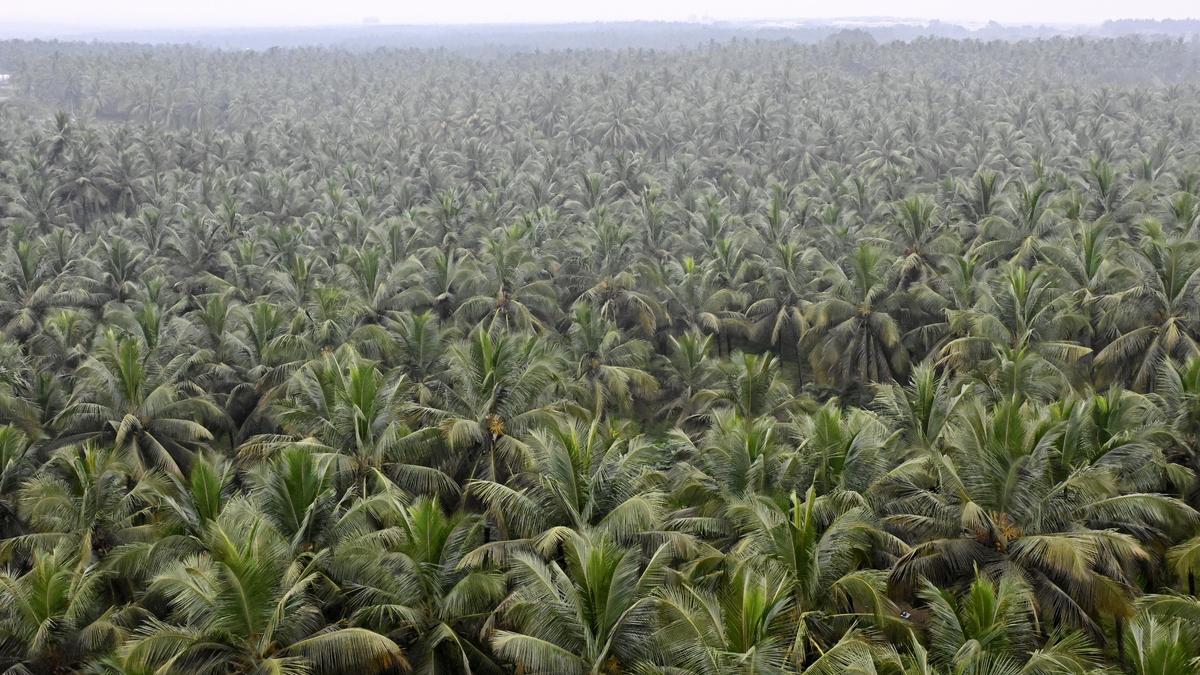
The 2026-27 Union budget announced a ‘Coconut Promotion Scheme’ with the primary aim of improving productivity by rejuvenating old, non-productive gardens with high yielding coconut varieties and establishing new plantations along the coast. The farming community has welcomed the announcement.
The Coconut Development Board (CDB) is already implementing a similar scheme, which has helped rejuvenate old gardens and expanded cultivation into non-traditional areas, including in parts of Gujarat, Assam, and other non-peninsular regions — sufficient to partially offset the widespread destruction of coconut palms in Kerala and Tamil Nadu by disease.
India is the world’s largest producer and consumer of coconuts. The domestic prices of coconut and tender coconut remain far higher than prevailing international prices even though the productivity per palm in India is already higher than in Sri Lanka, the Philippines, and Indonesia. In places like Anaimalai in Tamil Nadu, dwarf x tall hybrid palms regularly produce 250-300 tender coconuts per tree.
Today, climate change and disease are greater concerns than productivity. Research by the Central Plantation Crops Research Institute (CPCRI) has projected that temperatures in regions with plantations may rise by 1.6-2.1°C by 2050 and up to 3.2 °C by 2070. Higher temperature without a significant change in the rainfall levels will increase the vapour pressure deficit and intensify drought stress.
Studies have also found that large parts of interior peninsular India, including parts of Karnataka and Andhra Pradesh, along with the south interior region of Tamil Nadu and the east coasts could become less suitable for coconut cultivation in the coming decades as a result.
The CPCRI has found that coconut can still be cultivated along the Western Ghats belt in Kerala, coastal Karnataka, and western Tamil Nadu even during the high temperature regimes. However, these regions are beset by root wilt disease; in Alappuzha and Pollachi districts, the coconut landscape has been completely devastated.


Chennai Port's upgraded cruise terminal, featuring enhanced facilities, will be ready by April after a ₹29.8 crore renovation.

Anakapalli police conduct thorough inspections of firecracker units after an explosion, enforcing safety regulations and legal compliance.

SEBI plans to enhance market surveillance using AI, aiming to protect investors and deter fraud while ensuring market stability.

PM Modi discusses regional tensions and civilian safety with Netanyahu, emphasizing the need for an end to hostilities in West Asia.

Chief Minister M.K. Stalin to inaugurate a new ₹20 crore Critical Care Block in Jawadhu Hills, enhancing local healthcare services.

Jipmer's new Regional Cancer Centre enhances treatment capacity and services, solidifying its role as a premier cancer care facility.

Middle East airspace closures lead to 48 flight cancellations at Hyderabad Airport on March 1 amid escalating tensions.

Explore how arbitrage funds leverage price gaps in volatile markets for stable returns without directional market bets.

Praveen Kumar accuses Telangana government of undermining education, criticizing the State Education Commission's controversial report and proposed reforms.

BJP launches Parivartan Yatras across West Bengal, promising change ahead of Assembly elections, culminating in a rally with PM Modi.

Chennai's female auto drivers establish their own stands, enhancing safety and security amid ongoing resistance from male counterparts.

Anakapalli police conduct thorough inspections of firecracker units after an explosion, enforcing safety regulations and legal compliance.

FICCI FLO Chennai honors outstanding women achievers, celebrating their contributions to society and promoting empowerment and influence.