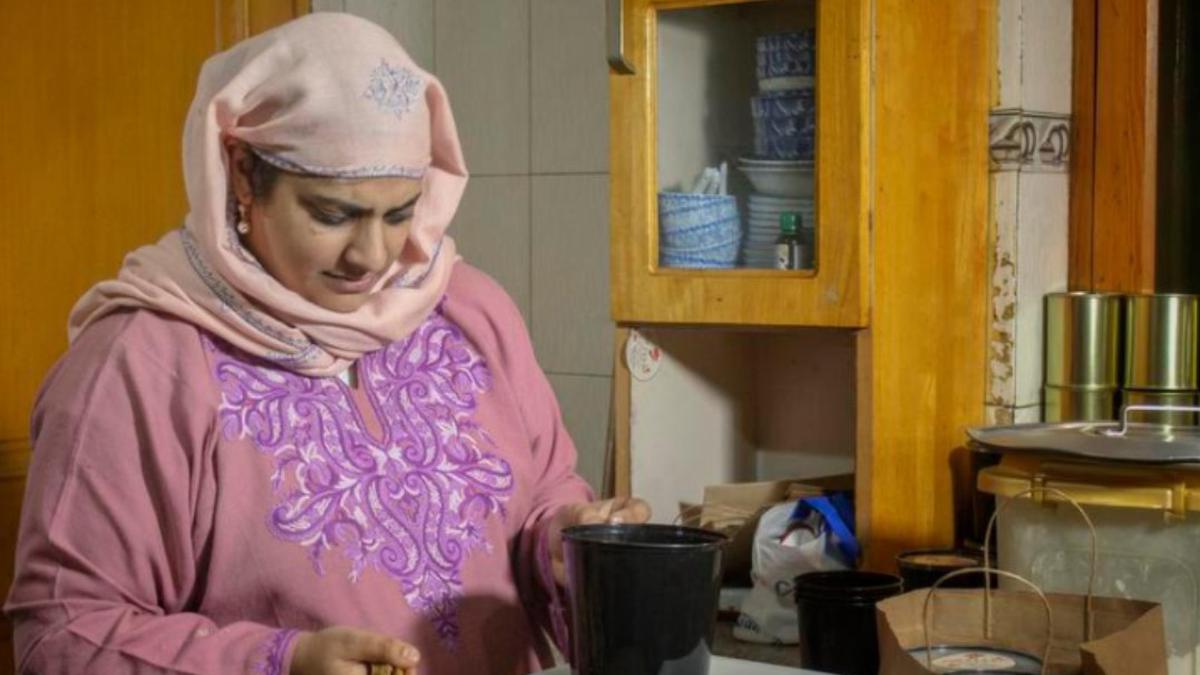
Kashmiri women break the harissa glass ceiling
The Hindu
Kashmiri women are breaking the male monopoly on making the labour-intensive mutton breakfast dish, Harissa, this winter, powered by online sales both within and beyond the Valley
For centuries, it was men who monopolised the culinary skills required to make harissa, a mutton dish which is a sought-after winter breakfast delicacy in Kashmir, copied from a popular Armenian dish. Prepared overnight using the slow heat of firewood in a utensil buried in a tandoor or clay oven, the dish required muscle power, night-long patience and knowledge of spices.
However, women in Kashmir are giving a tough competition to the harissa-goaer or special harissa cooks this winter, with online platforms emerging as a game changer.
Sheikh Hirra is an engineering graduate and a mother from Srinagar’s Hyderpora area. She started the trend of capturing the otherwise male-dominated market for harissa. “Earlier, people would stand outside harissa shops in queues very early in the morning in the old city. My idea was to make harissa available just a click away. The idea did pick up and the sales are going up,” said Ms. Hirra, who now sells in all major districts of Jammu and Kashmir.
Using the internet power of online platforms such as Gatoes and FastBettle, Ms. Hirra has even been able to ship harissa beyond J&K. “It’s getting popular outside. I receive orders from all corners of the country. In Kashmir, harissa is also an emotion. Many Non-Resident Indians place orders for their old parents in Srinagar, so that they don’t have to come out early in the cold mornings to buy. Customer reviews have helped a lot,” said Ms. Hirra, who owns the Fall Winter Harissa brand.
Harissa is a breakfast dish only available in the peak winter months of November to February in Kashmir. People queue up at the crack of dawn to buy harissa in the city, as it finishes fast due to growing demand. This high-protein diet keeps people warm and helps them brave the sub-zero temperatures of Valley winters. Until a few years ago, only men dominated the cooking of harissa at a small number of outlets in the city as it required overnight cooking and constant grinding with a huge wooden pestle.
Armed with technology, women are equal competitors now. Shahida Fazili, 58, a former school principal from the Pampore area, said that her annual shipments of home-made harissa to her two sons in Dubai became a runaway hit among their friends and colleagues.
“Earlier only relatives and friends would approach me. This year, I received an order for 15 kg of harissa from Delhi. People are liking it outside. I am energetic and ensure that my harissa has all the qualities of a professional harissa-maker,” Ms. Fazili said.


Want to up your breakfast game, but do not have the time to cook and prefer not to reach out for sugary supermarket cereals? Here are three home-grown, women-run brands trying to make it a little easier to get a nutritious, fibre-rich morning meal

Day 1 of BioAsia 2026 sees a panel discussion on advanced therapies highlighting India’s evolving role as a global manufacturing backbone for next-generation biologics.

The BMW X3 30 xDrive M Sport Pro blends sporty performance with everyday luxury, powered by a 258 hp 2.0-litre TwinPower Turbo engine and BMW’s xDrive all-wheel-drive system. With bold M Sport styling, a high-tech Curved Display running Operating System 9, advanced driver assistance features, and genuine off-road capability, the latest X3 delivers a versatile premium SUV experience that excels on city roads, highways, and beyond.

Explore the concept of 'snowball earth' and recent findings on climate variability during this ancient icy period.

A riot of capes, corsets, and carefully crafted armour took centrestage as Chennai Comic Con wrapped up at the Chennai Trade Centre, with cosplay emerging as the undisputed showstopper. From anime icons and gaming legends to beloved Indian comic characters, over 500 fans transformed the venue into a living, breathing multiverse, showcasing how Chennai’s fandom culture has evolved, placing the city on India’s pop culture map.

Warmer oceans and depleting food have affected the ubiquitous loggerhead turtle’s reproductive and migratory patterns — and even its size.

Toyota Urban Cruiser Ebella review: Explore design, range, features, ride comfort and safety of Toyota’s new electric SUV for India. Expected price ₹14–18 lakh, with up to 500 km claimed range and practical urban usability.

Explore India's potential in bio-based chemicals and enzymes, highlighting industry leaders and challenges in sustainable manufacturing.

Astronomers discover an unusual planetary system with a rocky planet formed outside its gaseous neighbors, challenging existing formation theories.

Four new astronauts arrive at the ISS to replace a crew evacuated due to a serious health issue.

Neurobehavioural therapy can transform brain connectivity in functional neurological disorders, highlighting the link between cognition, emotion, and behavior.

The centuries-long quest for synthetic diamonds, also known as lab-grown diamonds or human-made diamonds, came to an end in 1954-55. On February 15, 1955, the creation of the first synthetic diamonds were announced, and it was quickly picked-up by newspapers around the world. A.S.Ganesh tells you more about these diamonds and the man who first made it happen…

Kadhambari S. Viswanathan highlights online education's evolution and its coexistence with traditional methods at The Hindu Tech Summit 2026.