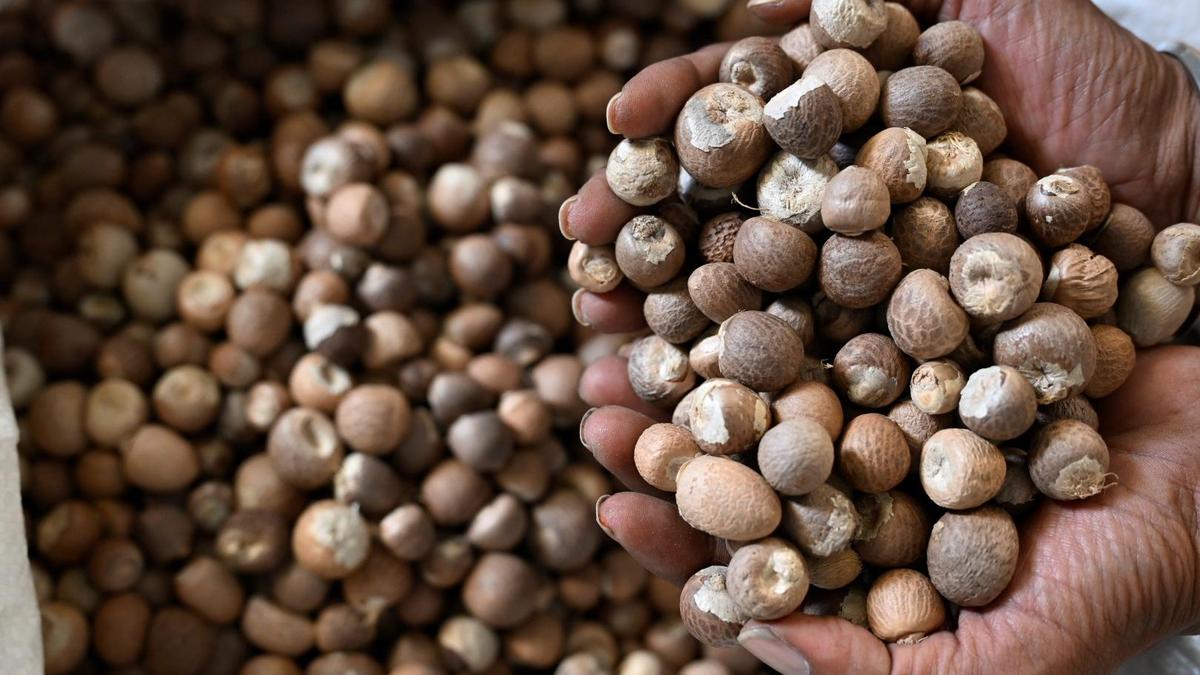
Karnataka farmers urge Union Government to recommend to WHO to re-classify arecanut from ‘carcinogenic’ to ‘possibly carcinogenic to humans’
The Hindu
Karnataka farmers urge the Union Government to advocate for reclassification of arecanut from carcinogenic to possibly carcinogenic status by WHO.
Fearing that the World Health Organisation (WHO) might recommend banning arecanut on the ground that it causes cancer, a leading cooperative body of arecanut farmers of Karnataka and Kerala has written to Union Health Minister J. P. Nadda to recommend to WHO to re-classify arecanut from Group I to Group II-B.
Currently, the International Agency for Research on Cancer (IARC), under WHO, has placed arecanut under Group I (carcinogenic to humans) while arecoline, one of its principal constituents, is classified under Group II B (possibly carcinogenic to humans), stated S. R. Satishchandra, president, Central Arecanut and Cocoa Marketing and Processing Cooperative Limited (CAMPCO), Mangaluru, in his January 24 letter to the Minister.
“Such contradictions underscore the need for further rigorous, India-specific scientific scrutiny before arriving at any policy-level conclusion,” the letter states.
Mr. Satishchandra said that the re-classification (from Group I to Group II-B) be done ‘at least as an interim measure’ till the Indian government’s on-going ‘evidence-based research on arecanut and human health’ is completed. The multi-institutional research is led by the Central Arecanut Plantation and Crops Research Institute (CPCRI), under the Indian Council of Agricultural Research (ICAR). The All-India Institute of Medical Sciences; the National Botanical Research Institute; the Centre for Cellular and Molecular Biology; the Indian Institute of Science; Jawaharlal Institute of Postgraduate Medical Education and Research; the Central Food Technological Research Institute (CFTRI); Kasturba Medical College; K.S. Hegde Medical Academy, and SDM College of Medical Sciences and Hospital are part of the research team.
The CAMPCO, over a 50-year-old multi-State cooperative body of Karnataka and Kerala farmers, wrote the letter in view of WHO’s South-East Asia Regional Office (SEARO) organising a webinar on January 30 on the topic ‘Areca Nut Challenge: Turning Policy into Impact in South-East Asia’.
The letter stated that the webinar follows deliberations arising from a declaration made in Sri Lanka in October 2025, and appears to focus on policy transition and implementation related to arecanut.


LPG refill backlogs now range from 4 to 12 days as panic bookings decline amid ongoing restrictions, say distributors.

Acid attack on a minor girl sparks protests and Assembly outrage, with demands for swift justice and government accountability.

Three luxury cars were destroyed in a fire at a Vellore workshop, damaging nearby houses but causing no injuries.

Kerala's Pala constituency braces for a high-stakes three-way battle in the 2026 Assembly elections amid evolving political dynamics.

Delhi CM announces ₹10 lakh compensation for families of fire victims in Palam, pledging a magisterial probe for safety improvements.

As Tamil Nadu's assembly elections approach, Chepauk-Thiruvallikeni voters demand better civic solutions and security amid a competitive political landscape.

Justice Kurian Joseph urges graduates to value dignity over status and promote equality and respect in society.

Supriya Sahu highlights the ongoing gender disparities in skill training opportunities for women at FICCI FLO's ceremony.

Height restrictions near airports are stifling Bengaluru's growth, prompting calls for a review to boost development potential.

Meta challenges Delhi HC ruling on CCPA fine for walkie-talkie sales, arguing Facebook is not an e-commerce platform.

U. Nirmala Rani, AIDWA leader and advocate, passes away at 60, leaving a legacy in women's rights and justice.

‘Serve society with honesty and sincerity’

Jagan attends Iftar in Vijayawada, promoting unity, harmony, and communal respect during the sacred month of Ramzan.