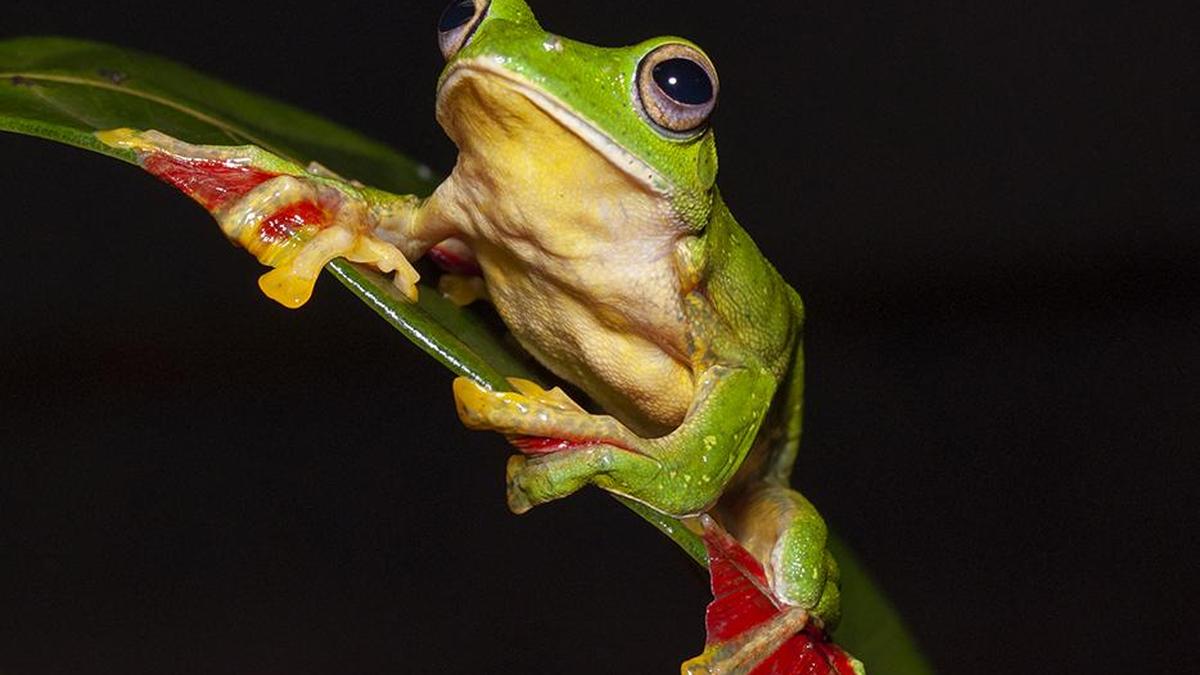
India’s frogs are finding allies from citizen science to sanctuaries Premium
The Hindu
Explore India's frog conservation efforts through citizen science and sanctuaries, highlighting their critical ecological role on World Frog Day.
World Frog Day on March 20 celebrates the role of frogs, the world’s most numerous amphibians. They live at the interface between freshwater and terrestrial ecosystems, eat insects and in turn get eaten by other vertebrates, and are thus crucial in converting insect biomass into vertebrate biomass.
Losing them can mean a boom in insects that prey on plants as well as a depleted food base for many terrestrial vertebrates, which in turn can irreparably damage both freshwater and terrestrial ecosystems. Unfortunately for the earth, since the 1980s, frog and other amphibian populations have been on the decline worldwide. In 2023, the International Union for Conservation of Nature (IUCN)’s Global Amphibian Assessment Report said 37 species have become extinct and continue to decline, making them the most threatened vertebrate group.
The most prominent historical driver of amphibian decline has been chytridiomycosis, a fungal disease caused by Batrachochytrium dendrobatidis and Bactrachochytrium salamandrivorans in frogs and salamanders, respectively. This disease affects their skin — an organ that protects them as well as allows respiration and exchange of ions to maintain electrolyte balance. In the last two decades, more than 60% of amphibians globally have been affected by it — although intensive monitoring and conservation efforts have reduced the extinction risk of 63 species, halving the impact.
Today, however, the most important drivers of extinction are climate change for 39% of species and habitat loss for 37%.
India is home to more than 450 amphibian species, and roughly a quarter of them are categorised as ‘threatened’ and one-fifth as ‘data deficient’. The burden of B. dendrobatidis and B. salamandrivorans fungi in India is substantial but it has not caused mass mortality the way it has for frogs in the Americas and Australia.
B.dendrobatidis and B. salamandrivorans both had their roots in Asia and spread worldwide through the trade on frog legs and salamanders as pets. In 1987, after Humayun Abdul Ali from Bombay Natural History Society published a scientific report highlighting their role in controlling agricultural pests, this trade was banned. However, by then, frog and salamander populations had been significantly affected as B. dendrobatidis had spread from Asia to Europe, the Americas, and Australia.


Dolores Huerta accuses César Chavez of sexual abuse, prompting reevaluation of his legacy in the labor rights movement.

LPG refill backlogs now range from 4 to 12 days as panic bookings decline amid ongoing restrictions, say distributors.

Acid attack on a minor girl sparks protests and Assembly outrage, with demands for swift justice and government accountability.

Three luxury cars were destroyed in a fire at a Vellore workshop, damaging nearby houses but causing no injuries.

Kerala's Pala constituency braces for a high-stakes three-way battle in the 2026 Assembly elections amid evolving political dynamics.

Delhi CM announces ₹10 lakh compensation for families of fire victims in Palam, pledging a magisterial probe for safety improvements.

As Tamil Nadu's assembly elections approach, Chepauk-Thiruvallikeni voters demand better civic solutions and security amid a competitive political landscape.

Justice Kurian Joseph urges graduates to value dignity over status and promote equality and respect in society.

Supriya Sahu highlights the ongoing gender disparities in skill training opportunities for women at FICCI FLO's ceremony.

Height restrictions near airports are stifling Bengaluru's growth, prompting calls for a review to boost development potential.

Meta challenges Delhi HC ruling on CCPA fine for walkie-talkie sales, arguing Facebook is not an e-commerce platform.

U. Nirmala Rani, AIDWA leader and advocate, passes away at 60, leaving a legacy in women's rights and justice.

‘Serve society with honesty and sincerity’