India set to become world’s third largest aviation market, Airbus outlines its industrial footprint
The Hindu
India is poised to become the world's third-largest aviation market, with significant growth projected in fleet and passenger demand.
India is projected to emerge as the world’s third largest aviation market within the next decade, driven by rapid fleet expansion, rising passenger demand, infrastructure growth and deepening industrial capabilities, Airbus said on Thursday (January 29, 2026).
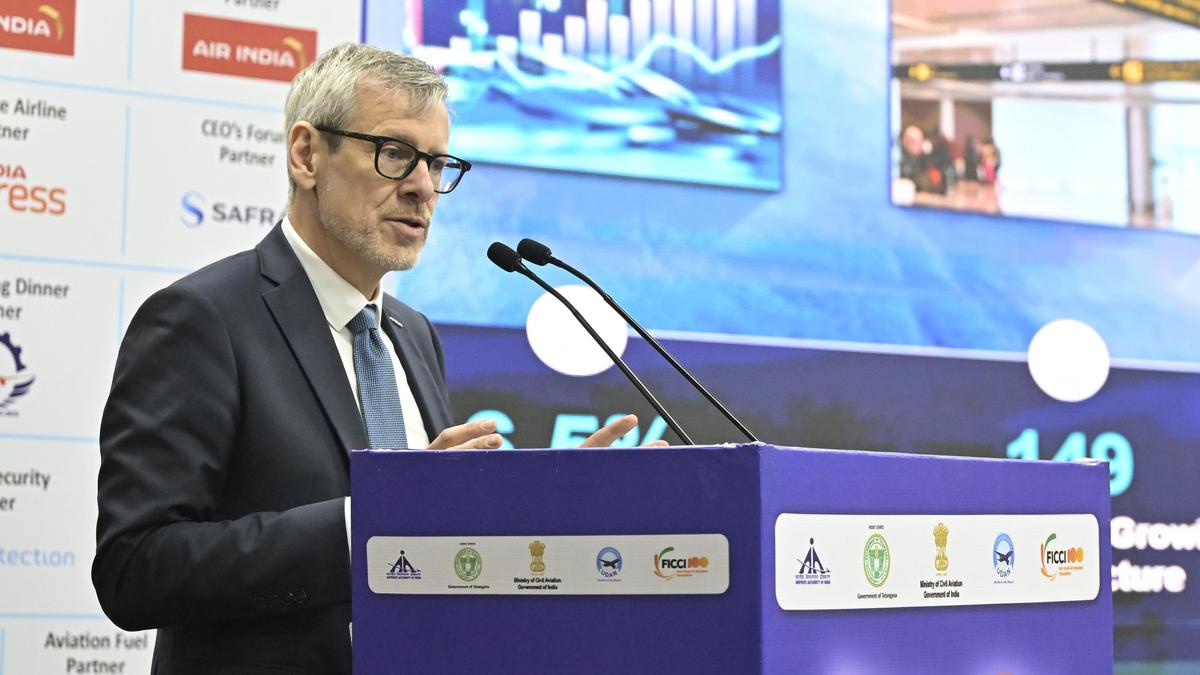
Addressing a press briefing at Wings India 2026, Jürgen Westermeier, president and managing director of Airbus India and South Asia, described India as one of Airbus’ most critical global markets. More than 10% of the company’s annual aircraft production is already delivered to India. “This is expected to grow further as the country’s aviation ecosystem expands at scale,” he said.
Currently the fifth largest aviation market, India is projected to rise to third place globally over the next 10 years, with a compound annual growth rate of 8.9%. Airbus estimates that trips per capita will double from 0.13 to 0.27 during this period, translating into around 400 million trips originating from India.
Over the past decade, the number of operational airports in India has more than doubled to around 150, backed by sustained government investment in aviation infrastructure. The sector is supported by a workforce of about 23,000 professionals. Airbus, however, described India as still a ‘nascent market’, with only 850 aircraft currently in service and relatively low air travel penetration compared with other regions.
Over the last 10 years, India’s fleet has doubled to 850 aircraft, while the number of routes has tripled. “Looking ahead, more than 1,700 aircraft are on order by Indian carriers, with Airbus accounting for 72% of the backlog, or 1,248 aircraft. Indian airlines have also strengthened their position in international traffic, which now stands at 47%, nearly 10% higher than a decade ago,” Mr. Westermeier said.
To accommodate future demand, the number of airports in India is expected to increase to around 200 over the next 10 years. The country’s fleet is projected to triple to about 2,200 aircraft, pushing annual passenger capacity beyond 450 million seats, nearly four times current levels. Capacity growth will be driven not only by an increase in aircraft numbers but also by the induction of higher-capacity aircraft such as the A321 and additional widebody jets.


Discover why pension planning is essential in modern India to ensure financial security and peace during retirement.

The U.S. has launched two investigations under Section 301 of the Trade Act of 1974 against India and other economies to examine practices that may be ‘unreasonable or discriminatory and burden or restrict U.S. commerce’. One probe examines whether countries, including India, are using excess manufacturing capacity to export to the U.S. in a manner that hurts American businesses, while another looks at whether countries have taken ‘sufficient steps’ to prohibit imports of goods produced with forced labour.

NHAI raises annual pass fee to ₹3,075 from April 1, 2026, streamlining toll payments for FASTag users.

The U.S. probes forced labour in global supply chains, scrutinizing China and India's exports, warns the Global Trade Research Initiative.

The Hindu collection of images of the LPG crisis: War lights a kitchen fire

The company, which launched its IPO in 2020, is now listed on the National Stock Exchange as well as the Bombay Stock Exchange.

Explore the Essential Commodities Act's role in addressing India's gas crisis and its impact on various sectors.

Star Health Insurance plans to boost AI-driven claim settlements from 20% to 50% within two years, investing heavily in technology.

The iron ore production has increased by nearly two-thirds since 2015

Benchmark indices fell 2% as high crude oil prices and FII selling pressures impacted market sentiment on March 14, 2026.

Follow The Hindu LIVE for updates on LPG crisis and crude oil prices due to the escalating Iran-Israel war in West Asia.

ICRA projects integrated sugar mills will see 5-8% revenue growth in FY26 due to improved cane supply and stable prices.

Benchmark indices fell 2% as high crude oil prices and FII selling pressures impacted market sentiment on March 14, 2026.