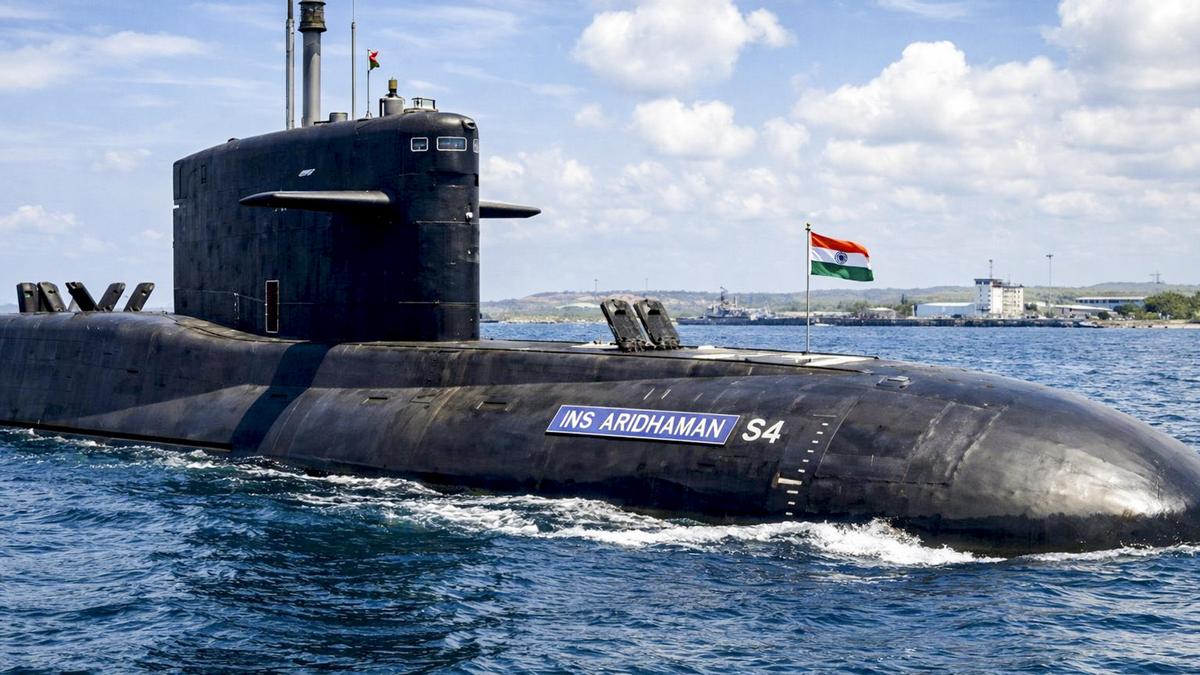
India’s new nuclear powered submarine INS Aridhaman commissioned
The Hindu
India quietly commissions the INS Aridhaman, its third nuclear-powered submarine, enhancing its strategic defense capabilities.
Defence Minister Rajnath Singh presided over a brief ceremony to formally commission the country’s third nuclear submarine, INS Aridhaman (S4), which is the third in the Arihant-class of SSBNs (Submersible Ship Ballistic Nuclear), on Friday (April 3) at Visakhapatnam.
The boat, being part of the strategic weapons programme, falls under the domain of the Strategic Forces and is part of the country’s nuclear triad. As per sources in the Navy, the commissioning was not made public and was carried out quietly, but Mr. Singh dropped enough hints to acknowledge the commissioning of the vessel.
While the event was kept under wraps, Defence Minister Rajnath Singh, taking to social media, posted a cryptic message on ‘X’, describing the submarine as: “It’s not words but power, ‘Aridhaman’!”
Sources in the Navy said that the commissioning of INS Aridhaman was on the cards, as the submarine had already undergone extensive sea trials, and it coincided with Mr. Singh’s visit to Visakhapatnam for the commissioning of the stealth guided-missile frigate INS Taragiri on April 3.
The closely guarded SSBN project, initially launched as the Advanced Technology Vessel (ATV) project, is being executed by the Ship Building Centre (SBC) in Visakhapatnam. The first boat was launched in July 2009 and was quietly commissioned in 2016. The second indigenously built SSBN, INS Arighaat, was commissioned in August 2024.
While Arihant and Arighaat are smaller vessels of about 6,000 tonnes, Aridhaman (S4) and S4* are bigger boats of about 7,000 tonnes. The S4* (which may be named Arisudan) is currently undergoing sea trials.


Coimbatore Corporation has collected ₹472 crore in property tax for 2025–26, achieving 89% of its target so far.

A NIMHANS review highlights the lasting impact of child suicides on parents and mental health professionals, urging better support systems.

People who distribute food to poor and needy in Hyderabad are concerned of potential LPG cylinder shortages, risking meal preparations for the poor and needy they serve daily.

Vishu Mahajan assumes office as Thoothukudi Collector

Rangayana's 'Chinnara Mela' summer camp for children runs from April 14 to May 10, 2026, in Mysuru.

West Bengal is gearing up for assembly elections. Mamata Banerjee will face her toughest challenge, given the anti-incumbency factor of three terms. The BJP, in 2021, had cemented its position as the primary opposition, winning 77 seats to the Trinamool’s 215 seats. This time, unusually, but no longer surprisingly, the Election Commission has become a key character in the political narrative. The Special Intensive Revision (SIR) ended up deleting more than 60 lakh voters. And in many constituencies, the number of voter deletions is greater than the margins of victory in previous elections. Another issue is the mass transfers in the state bureaucracy, which are unprecedented, and were challenged in court by the TMC. Mamata has used these developments to frame the polls as a fight between a besieged Bengal and Bengali ‘asmita’ on one side, and a BJP-led Centre on the other. The BJP has been playing the anti-migrant card to polarise voters, and has also sought to target the TMC on corruption and misgovernance. Whose narrative will gain the upper-hand? What is happening with the lakhs of voter deletions? How will the SIR impact the outcome?

India quietly commissions the INS Aridhaman, its third nuclear-powered submarine, enhancing its strategic defense capabilities.

Karnataka governor asks State to “re-examine” switch from marks to grades for third language in SSLC
Karnataka Governor urges re-evaluation of the state's move from marks to grades for SSLC third language, citing educational concerns.

Mumbai will soon host electric boats for a luxury commute to Alibaug, revolutionising travel with silent, eco-friendly rides.

Trial one-way traffic around KBR Park in Hyderabad on Sunday; no U-turns, follow diversions for smoother movement.

Israel under fire as Trump warns of destroying Iranian infrastructure; BJP, Congress release candidate lists for T.N. Assembly polls, and more in The Hindu’s top news of April 3, 2026.

YouTuber Salman Khan attempts self-harm live, alleging harassment by Bidar police officials over his journalistic work.

Conservationists urge documentation of freshwater fish species in Tamil Nadu's waterbodies, highlighting the importance of native species preservation.