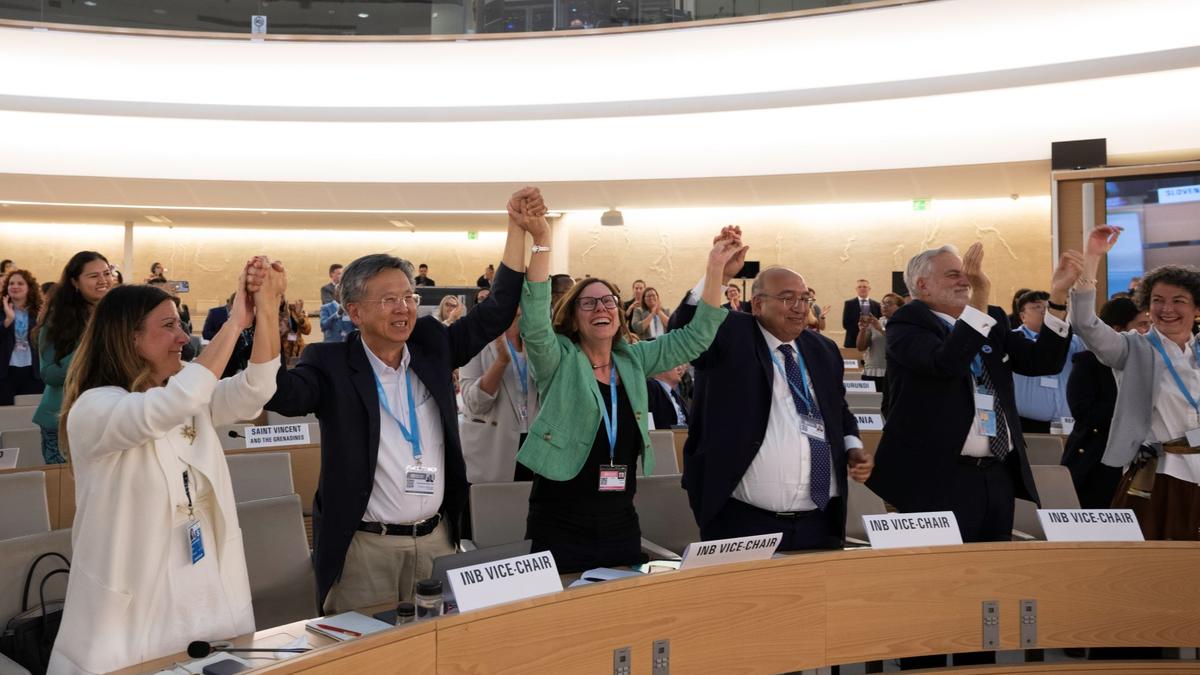
India roots for benefits system at pandemic agreement talks
The Hindu
India advocates for a fair benefit-sharing system for developing countries in upcoming pandemic agreement negotiations in Geneva.
Ahead of a crucial meeting of countries in Geneva this month where they must agree on a rule book, accompanying the so-called ‘Pandemic Agreement,’ India has found common cause with a coalition of developing countries — called the Group for Equity — that says developing countries that share pathogen materials and genetic sequence data must receive fair, concrete, and legally enforceable benefits in return.
The World Health Organisation (WHO) Pandemic Agreement was adopted by the World Health Assembly on May 20, 2025, and was developed in response to the COVID-19 pandemic, which revealed significant gaps and inequality in the world’s ability to prevent and respond to health emergencies, prompting nations to take action.
The aim of the body was to draft and negotiate a WHO convention, agreement or other international instrument on pandemic prevention, preparedness and response, that would culminate in a legally binding international instrument. Once adopted, the next step was for an Intergovernmental Working Group (IGWG) on the Pandemic Agreement to negotiate the details of the Pathogen Access and Benefit-Sharing (PABS) system, which will form an ‘annex’ to the Agreement. Once adopted by the World Health Assembly, expected to be May 2026, the full agreement will be open for countries to sign and ratify according to their own constitutional processes. The agreement will officially enter into force 30 days after 60 countries have ratified it.
A major point being discussed is how biological samples of viruses and bacteria, among other life forms, that may be linked to epidemics or public health emergencies ought to be shared with international networks of laboratories. These need not only be the physical samples but also the genetic sequence of these life forms. Developing countries say a system of standard legally binding contracts must govern every stage of pathogen and sequence data sharing. Every entity that touches PABS materials or sequence information — whether a laboratory within the WHO Coordinated Laboratory Network or a private pharmaceutical company outside it — must sign enforceable agreements that include benefit-sharing obligations. However, what defines networks and whether there is an exhaustive list governing them is a moot point, said Nithin Ramakrishnan of the Third World Network. a group that has been following negotiations.
Landmark agreement: On the draft WHO Pandemic Agreement
These benefits can mean that those who commercialise products derived from PABS materials, pay a percentage of annual revenue back into the system. Non-monetary benefits include requirements that manufacturers reserve a percentage of real-time production of pandemic products for WHO (with at least 10% donated), grant non-exclusive licences to developing country manufacturers during emergencies, and make products available at affordable or not-for-profit prices. The ‘equity group’ insists — their submissions show — that physical materials and digital sequence information ought to be traceable back to the originating country, and access to PABS materials require prior informed consent from the providing party.


Former Indian skippers recognised for their role in shaping women’s cricket

M.K. Stalin increases pensions for journalists and announces medical insurance and housing support in Tamil Nadu.

Kerala Cabinet approves a comprehensive Film Policy focused on job security, gender justice, and elevating the Malayalam film industry.

The High Court of Karnataka on Friday ordered issue of notice on a PIL petition questioning the State government’s January 8, 2026, order for transferring four acres of pristine land of the Karnataka Veterinary, Animal and Fisheries Sciences University to construct additional 20 quarters as an annexe for the Nyaya Grama, the existing residential quarters for judges of High Court, and another three acres to build a super-speciality hospital.

McGrath recalls his duels with Tendulkar

I want to play the next level; I’m at the top of my game and definitely ready: Shreyas Gopal Premium
Shreyas Gopal discusses his impressive season, ambitions for IPL, and readiness to elevate his cricket career.

CM A. Revanth Reddy defends the Musi Riverfront project against criticism, highlighting benefits for displaced families and urban development.

Artist Lalit Verma's photo exhibition captures the diverse experiences and unity at the 'Maha Kumbh Mela' in Prayagraj.

CRPF and Tiruchi City Police conduct a flag march in preparation for the upcoming Assembly election.

Finance Minister advises hoteliers to reduce menu items and consider alternate day operations amid cooking gas scarcity in the State.

British Council celebrated outstanding U.K. alumni at the Study U.K. Alumni Awards 2026 in Bengaluru, recognizing their remarkable achievements.

Twenty-seven Indian-flagged ships remain stranded in the Persian Gulf amid conflict, while one tanker has resumed its journey.

Regupathy claims CBI's summons to Senthilbalaji is an intimidation tactic against the DMK amid ongoing investigations.