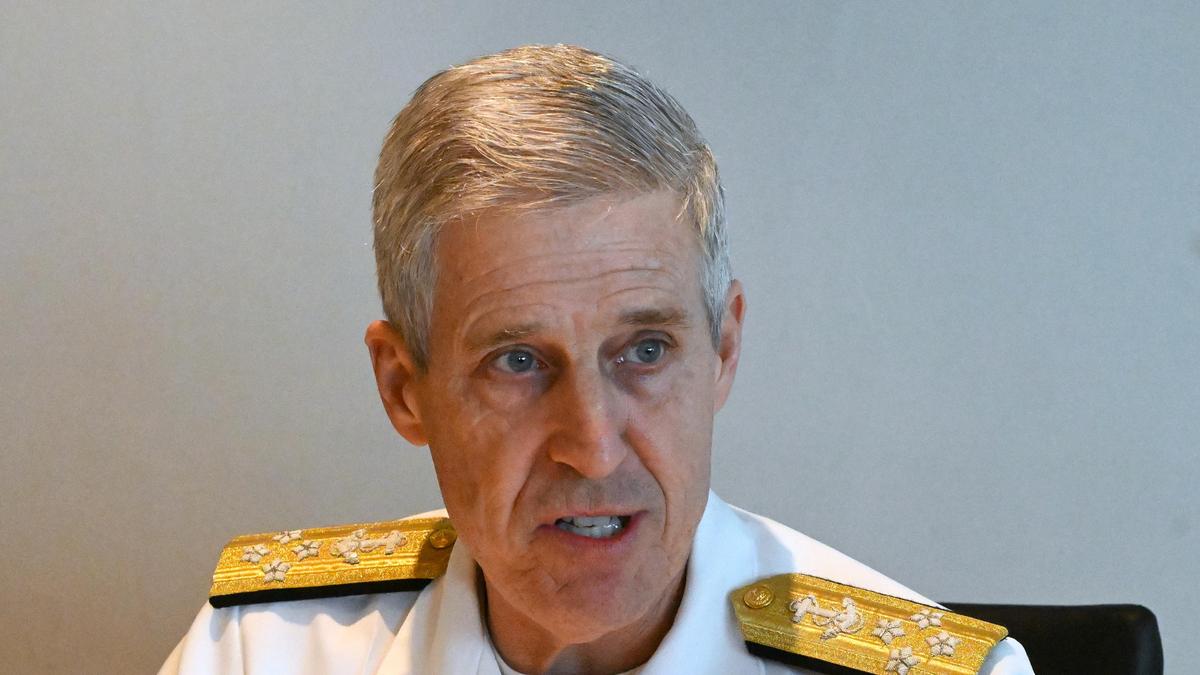
India and U.S. navies have major role in IOR and Indo-Pacific, says U.S. Pacific Fleet Commander Admiral Stephen Koehler
The Hindu
U.S. Pacific Fleet Commander emphasizes India and U.S. navies' vital roles in ensuring stability in the Indian Ocean and Indo-Pacific.
Both India and the United States have a critical role to play in the Indian Ocean Region (IOR) and the Indo-Pacific, given their strong naval capabilities, says Admiral Stephen T. Koehler, Commander of the U.S. Pacific Fleet.
Speaking to The Hindu on the sidelines of the recently held International Fleet Review (IFR) and MILAN-2026 in Visakhapatnam, Admiral Koehler said the IOR and the Indo-Pacific were vast oceanic regions where it was important to safeguard sovereignty and ensure stability.
“It is a major trade route that underpins the economies of many nations. It is vital for like-minded countries such as India and the U.S. to maintain freedom of navigation in this region. Both nations share common values and possess strong naval forces. When they work together with other like-minded partners, their combined strength can help protect the region from various challenges, safeguard sovereignty, maintain peace, respond swiftly to disasters, and, if necessary, act as a deterrent,” he said.
Highlighting the growing operational cooperation between the two countries, Admiral Koehler said India was a strong partner and that both nations regularly undertake joint operations and complex exercises such as Malabar, MILAN, and RIMPAC to enhance interoperability.
“Both navies operate P-8I aircraft and MH-60R helicopters, which are capable of anti-submarine warfare. We are working to strengthen our capabilities in areas such as quicker response to Humanitarian Assistance and Disaster Relief (HADR) operations and anti-submarine warfare by deploying our assets, as we value a free and open Indo-Pacific,” he said.
Responding to allegations from China that the Quadrilateral Security Dialogue (Quad) was formed to contain Chinese naval expansion, Admiral Koehler said the grouping — comprising the United States, Japan, India, and Australia — consisted of like-minded nations committed to a free and open IOR and Indo-Pacific, and was not created to contain any particular country.


Vishwanath, MLC, urges Karnataka government to form expert panel to assess effectiveness of its guarantee schemes for development.

Cyberabad's She Teams arrested 54 for indecent behavior, reunited 28 families, and enhanced safety awareness for women.

Tensions persist at Andhra University as student clashes continue for the fifth day amid protests and calls for arrests.

Dharwad High Court Bar Association building to be modeled after Delhi's, ensuring advanced infrastructure for advocates and public.

Manipal Hospitals, Vijayawada, successfully performs its first heart transplantation, offering hope to a young woman battling severe heart failure.

BJP youth wing protests in Shivamogga against Congress, condemning their demonstration at the AI summit in Delhi.

U.S. Pacific Fleet Commander emphasizes India and U.S. navies' vital roles in ensuring stability in the Indian Ocean and Indo-Pacific.

Youth Congress in Shivamogga protests, demanding PM Modi's removal over allegations of tarnishing India's international image.

Tiruchi Corporation invites tenders for a ₹50.47 crore Cauvery riverfront project, enhancing recreation and pilgrimage spaces.

Clash between Congress and BJP youth workers in Indore leaves 10 injured, including police and journalists, during protest.

On Mother Language Day, Kolkata emphasizes that language, not religion, should define human identity and cultural unity.

Mullaperiyar dam's water level is at 118 feet, with significant inflow and discharge rates reported.

Historic Kalingarayan Canal, once vital for irrigation, now suffers severe pollution from sewage and waste, alarming farmers and residents.