Hollowing out the hills Premium
The Hindu
The Nilgiris faces ecological peril as real estate expansion threatens its fragile landscape, driven by climate change and declining tea prices.
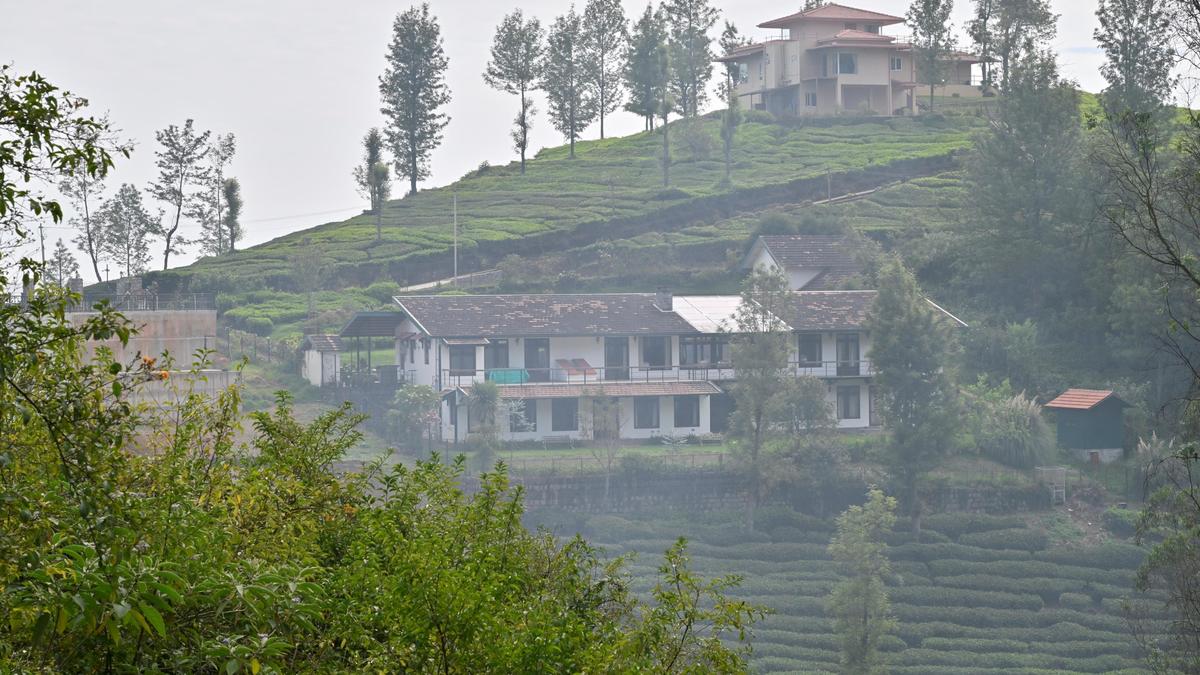
Large, palatial houses now peek over the high canopy of silver oak trees in Yedapalli in Coonoor. Over the years, the once-sprawling tea estate on which these houses stand was sold in small parcels in multiple phases to buyers and subsequently developed into real estate projects, readily purchased by those drawn to the allure of the Blue Mountains.
Local residents say they have witnessed many such estates around Coonoor – once the defining feature of the landscape – gradually give way over the last two decades to buildings and residential layouts. “These buildings remain unoccupied for most of the year, serving only as holiday homes, retreats, and homestays for the wealthy,” said N. Muthu, a resident of Bandishola in Coonoor, another area where estates are being converted at a frenetic pace.
The Nilgiris district administration is alarmed at the rising pace at which tea estates are being sold off to builders. “The issue is that tea cultivation is no longer viable for many small and medium-sized estates in the Nilgiris, prompting owners to sell them in small parcels to builders, who then construct buildings without obtaining plan approvals and later approach the district administration seeking regularisation,” said a district official.
“Builders believe that individuals who can afford to purchase these properties are influential, and these groups then attempt to pressure us into granting approvals after construction is completed,” he added.
H. Thiagaraj, president of the Young Badaga Association and a small tea grower, said climate change and the financial unviability of tea cultivation were forcing small and medium-sized estate owners to sell their properties. “The price of green tea leaves has remained almost unchanged since the late 1990s, while input costs have steadily increased. Combined with an almost 50% reduction in yield across most estates due to climate change, a small estate owner can now expect to earn only ₹35,000 to ₹40,000 per acre annually, after accounting for input and labour costs,” he explained.
He said this was leading estate owners and their heirs to sell land in the hills and move out of the Nilgiris. “The last 15 years have witnessed a distinct change. Persistently low prices for green tea leaves and climate change have certainly pushed estate owners to sell land that has been owned for generations. Unless immediate steps are taken in the form of a Minimum Support Price (MSP) and other measures, more estates will be sold and converted into bungalows and housing layouts,” he added.


Vishwanath, MLC, urges Karnataka government to form expert panel to assess effectiveness of its guarantee schemes for development.

Cyberabad's She Teams arrested 54 for indecent behavior, reunited 28 families, and enhanced safety awareness for women.

Tensions persist at Andhra University as student clashes continue for the fifth day amid protests and calls for arrests.

Dharwad High Court Bar Association building to be modeled after Delhi's, ensuring advanced infrastructure for advocates and public.

Manipal Hospitals, Vijayawada, successfully performs its first heart transplantation, offering hope to a young woman battling severe heart failure.

BJP youth wing protests in Shivamogga against Congress, condemning their demonstration at the AI summit in Delhi.

U.S. Pacific Fleet Commander emphasizes India and U.S. navies' vital roles in ensuring stability in the Indian Ocean and Indo-Pacific.

Youth Congress in Shivamogga protests, demanding PM Modi's removal over allegations of tarnishing India's international image.

Tiruchi Corporation invites tenders for a ₹50.47 crore Cauvery riverfront project, enhancing recreation and pilgrimage spaces.

Clash between Congress and BJP youth workers in Indore leaves 10 injured, including police and journalists, during protest.

On Mother Language Day, Kolkata emphasizes that language, not religion, should define human identity and cultural unity.

Mullaperiyar dam's water level is at 118 feet, with significant inflow and discharge rates reported.

Historic Kalingarayan Canal, once vital for irrigation, now suffers severe pollution from sewage and waste, alarming farmers and residents.